
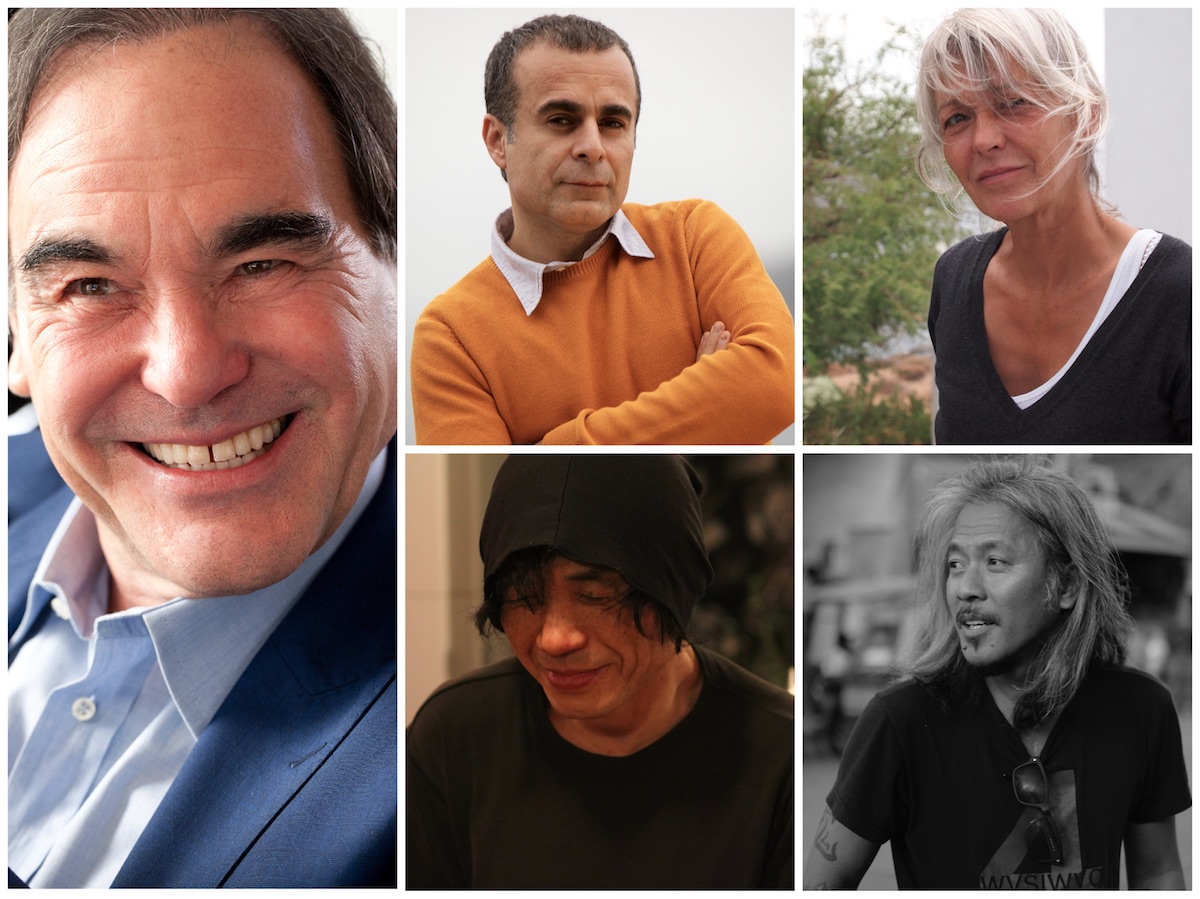
 Clockwise (l to r) Oliver STONE, Bahman GHOBADI, Agnès GODARD, Lav DIAZ, JANG Sun-woo[/caption]
The 22nd Busan International Film Festival has selected five jurors headed by director Oliver Stone to judge the New Currents, a competitive section, that introduces the works of up-and-coming Asian directors. The New Currents section has been a place to meet young Asian directors’ films with broad genres and themes wrapped up with uniqueness and passion.
Oliver Stone will serve as the head juror for BIFF’s New Currents this year. His film Platoon (1986), earned him Best Director at the Academy Awards, a Golden Globe and a Silver Bear from the Berlin International Film Festival. Another film Born on the Fourth of July (1989) also brought him the honor of winning Best Director at the Academy Awards and Golden Globes. Stone’s films have constantly examined modern history with critical insight and significant cultural impact. These films include Salvador (1986), deeply critical of the U.S. Government’s involvement in Central America; Wall Street (1987), an exposé of America’s new capitalism; W. (2008), a satirical view of former U.S. President, George W. Bush; Snowden (2016), a feature film that follows American whistleblower Edward Snowden. He recently produced documentaries on recent world historical events and political issues; Oliver Stone remains a preeminent and globally influential director. His attendance and role as chief juror will draw more attention to the winners of New Currents 2017.
In addition, Bahman Ghobadi – a world-famous director representing Iran, Agnès Godard – a preeminent cinematographer who has consistently built her career in France for 30 years, Lav Diaz – a multi-artist and an ideological father of the New Philippine Cinema, and Jang Sun-woo – a leader of New Wave in Korean films through A Short Love Affair (1990), A Petal (1996) and Lies (1999) showing his freewheeling style, are also commissioned as jurors for the New Currents at the 22nd Busan International Film Festival.
Clockwise (l to r) Oliver STONE, Bahman GHOBADI, Agnès GODARD, Lav DIAZ, JANG Sun-woo[/caption]
The 22nd Busan International Film Festival has selected five jurors headed by director Oliver Stone to judge the New Currents, a competitive section, that introduces the works of up-and-coming Asian directors. The New Currents section has been a place to meet young Asian directors’ films with broad genres and themes wrapped up with uniqueness and passion.
Oliver Stone will serve as the head juror for BIFF’s New Currents this year. His film Platoon (1986), earned him Best Director at the Academy Awards, a Golden Globe and a Silver Bear from the Berlin International Film Festival. Another film Born on the Fourth of July (1989) also brought him the honor of winning Best Director at the Academy Awards and Golden Globes. Stone’s films have constantly examined modern history with critical insight and significant cultural impact. These films include Salvador (1986), deeply critical of the U.S. Government’s involvement in Central America; Wall Street (1987), an exposé of America’s new capitalism; W. (2008), a satirical view of former U.S. President, George W. Bush; Snowden (2016), a feature film that follows American whistleblower Edward Snowden. He recently produced documentaries on recent world historical events and political issues; Oliver Stone remains a preeminent and globally influential director. His attendance and role as chief juror will draw more attention to the winners of New Currents 2017.
In addition, Bahman Ghobadi – a world-famous director representing Iran, Agnès Godard – a preeminent cinematographer who has consistently built her career in France for 30 years, Lav Diaz – a multi-artist and an ideological father of the New Philippine Cinema, and Jang Sun-woo – a leader of New Wave in Korean films through A Short Love Affair (1990), A Petal (1996) and Lies (1999) showing his freewheeling style, are also commissioned as jurors for the New Currents at the 22nd Busan International Film Festival.
Busan International Film Festival
Busan International Film Festival held annually in in South Korea is the largest film festival in Asia. The festival includes a competition among up-and-coming Asian filmmakers; a showcase of the latest films of contemporary iconic filmmakers from around the world; a carefully selected lineup of Korean independent feature films of the year; and a showcase of non-Asian narrative features including the latest works from well-known filmmakers
Busan International Film Festival started in 1996 and takes place in Haeundae-gu, Busan, South Korea
-
Busan International Film Festival Announces the New Currents Jury Headed by Director Oliver Stone
[caption id="attachment_23951" align="aligncenter" width="1200"] Clockwise (l to r) Oliver STONE, Bahman GHOBADI, Agnès GODARD, Lav DIAZ, JANG Sun-woo[/caption]
The 22nd Busan International Film Festival has selected five jurors headed by director Oliver Stone to judge the New Currents, a competitive section, that introduces the works of up-and-coming Asian directors. The New Currents section has been a place to meet young Asian directors’ films with broad genres and themes wrapped up with uniqueness and passion.
Oliver Stone will serve as the head juror for BIFF’s New Currents this year. His film Platoon (1986), earned him Best Director at the Academy Awards, a Golden Globe and a Silver Bear from the Berlin International Film Festival. Another film Born on the Fourth of July (1989) also brought him the honor of winning Best Director at the Academy Awards and Golden Globes. Stone’s films have constantly examined modern history with critical insight and significant cultural impact. These films include Salvador (1986), deeply critical of the U.S. Government’s involvement in Central America; Wall Street (1987), an exposé of America’s new capitalism; W. (2008), a satirical view of former U.S. President, George W. Bush; Snowden (2016), a feature film that follows American whistleblower Edward Snowden. He recently produced documentaries on recent world historical events and political issues; Oliver Stone remains a preeminent and globally influential director. His attendance and role as chief juror will draw more attention to the winners of New Currents 2017.
In addition, Bahman Ghobadi – a world-famous director representing Iran, Agnès Godard – a preeminent cinematographer who has consistently built her career in France for 30 years, Lav Diaz – a multi-artist and an ideological father of the New Philippine Cinema, and Jang Sun-woo – a leader of New Wave in Korean films through A Short Love Affair (1990), A Petal (1996) and Lies (1999) showing his freewheeling style, are also commissioned as jurors for the New Currents at the 22nd Busan International Film Festival.
-
RIP: Kim Ji-seok, Deputy Director of Busan International Film Festival, Dies of Heart Attack at Cannes
 Kim Ji-seok, the Deputy Director and the Executive Programmer of Busan International Film Festival, died at age 57 on Thursday evening, May 18th (French local time), following a heart attack while attending the 2017 Cannes Film Festival, France, the Busan International Film Festival confirmed in a statement.
Born in 1960, Kim was a founding member of Busan International Film Festival from 1996 and was currently the Deputy Director and the Executive Programmer of the Festival.
In its statement, the Busan International Film Festival said, “In undying efforts, contribution and devotion in discovery of Asian films, Kim led Busan International Film Festival to be the center of Asian cinema and one of world-class film festivals.”
Kim Ji-seok
1960 Born in Busan, Korea
1983 Graduated from Busan National University
1990 M.A. in Film and Theater at Joong Ang University
1996-2017 Working in Busan International Film Festival
Kim Ji-seok, the Deputy Director and the Executive Programmer of Busan International Film Festival, died at age 57 on Thursday evening, May 18th (French local time), following a heart attack while attending the 2017 Cannes Film Festival, France, the Busan International Film Festival confirmed in a statement.
Born in 1960, Kim was a founding member of Busan International Film Festival from 1996 and was currently the Deputy Director and the Executive Programmer of the Festival.
In its statement, the Busan International Film Festival said, “In undying efforts, contribution and devotion in discovery of Asian films, Kim led Busan International Film Festival to be the center of Asian cinema and one of world-class film festivals.”
Kim Ji-seok
1960 Born in Busan, Korea
1983 Graduated from Busan National University
1990 M.A. in Film and Theater at Joong Ang University
1996-2017 Working in Busan International Film Festival
-
Korean FilmMakers Threaten to Boycott Busan International Film Festival
 A group representing the Korean Film Community issued a statement on Monday threatening to boycott the upcoming 2016 Busan International Film Festival (BIFF) unless the Busan city guarantees the festival’s independence.
The 2016 Busan International Film Festival is scheduled to take place October 6 to 15, 2016.
The statement:
The Entire Korean Film Community will boycott BIFF unless the Busan city guarantees the festival’s independence!
Does the city government really want to go for the worst? The city government accelerated interfering Busan International Film Festival (BIFF) by submitting a legal application for injunction to suspend the efficiency of 68 new committee advisors consisted of Korean film professionals and refusing to have the special assembly meeting for amending the articles of association. In addition, the recent city gazette published by Busan city government is filled with criticism of the festival and insulting the film professionals who support BIFF as if they are the intruders with ulterior intension. The city government provoked the regional antagonism by spreading rumors that the film professionals from Seoul are trying to control the Busan’s festival. This is beyond defamation of the Korean film professionals. It is the worst way of ruining the festival which is a valuable cultural asset for all of us.
We have watched ever since Mr. SUH Byung-soo, was elected as the mayor and became the organizing director of the festival as ex officio in 2014. And he has never stopped political retaliation against BIFF since the screening of The Truth Shall Not Sink with Sewol (aka. Diving Bell). We have patiently tried our best for peaceful solution between the festival and the city government. But SUH deceives people as if those film professionals are outsiders with wicked intention attempting to alienate between Busan citizens and the film professionals.
BIFF is not a property of Busan city government. It is true that the government’s financial support to the festival is a part of the reason for the success of the festival, but the festival is entitled to make decisions on how to run it autonomically without any outside interference. BIFF does not only belong to the Busan citizens but also to every cineaste in Korea. It is a cultural asset to be shared with everyone who loves cinema from all over the world. That is why the festival’s independence and autonomy have to be protected. That is why amending the articles of association is so important to guarantee its independence and autonomy.
We were enormously shocked and grieved by a series of discouraging events including practical ‘censorship’ from outside and unfair dismissal of the festival director, but we still believed that we should be able to provide institutional gird to prevent the recurrence of this unfortunate condition with all our efforts. That’s why many of us willingly agreed to be committee advisors in hoping to acquire basis for the festival’s autonomy and independence via revision of the article at the special assembly meeting. As we witnessed SUH promised that he would step down from the organizing director voluntarily, we were truly stuck to our belief in peaceful end to the situation,
However, Busan city government abruptly started arguing legitimacy of the special assembly meeting. The city government defamed us as intruders with ulterior intension though every media they can muster up and eventually submitted application for an injunction to suspend the efficiency of 68 new committee advisors. We cannot help resenting and lamenting to see the city’s attempt to distort the situation to some sort of power game among film professionals. We patiently maintained our support for BIFF to make the festival back on track, but we are afraid that our patience was for nothing after all.
It’s unimaginable to see BIFF without film people. However, if Busan city government still believes that they ‘own’ the festival just because they are the biggest sponsor and if Busan city keeps insulting our efforts in finding solution as ulterior interference from outside, we cannot find any reason to be attending BIFF. We, Korean group of film associations, will try to pass a resolution for boycotting BIFF2016 after collecting consensus of all associations. The world will witness the empty red carpet for the first time in 20 years of BIFF’ history and the audience from all over the world will stop coming to Busan for the festival any more. It takes quite a long time to build a festival, but it does just a blink of an eye to be collapsed. Do SUH and Busan city government want to see BIFF disappear just like that? By all means, we truly hope our desperate outcry and ultimatum will be taken seriously.
We strongly demand the followings;
– The mayor, SUH should resign from the BIFF’s organizing director immediately and agree to revision of the articles for the festival’s autonomy and independence!
– The city government must stop unjust interference on BIFF and withdraw the legal application for injunction against suspension of efficiency of 68 new committee advisors!
– SUH should make public apology for his continuous wrongful actions damaging the festival and promise that it will never happen again!
If the city government does not take significant actions on our demands above, there will be none of the Korean film community attending this year’s Busan International Film Festival.
Korean Film Group’s Emergency Committee for Defending BIFF’s Independence
What’s happening to BIFF? You can find the answers at www.isupportbiff.com
https://www.youtube.com/watch?v=AF5h_2H0IYA
A group representing the Korean Film Community issued a statement on Monday threatening to boycott the upcoming 2016 Busan International Film Festival (BIFF) unless the Busan city guarantees the festival’s independence.
The 2016 Busan International Film Festival is scheduled to take place October 6 to 15, 2016.
The statement:
The Entire Korean Film Community will boycott BIFF unless the Busan city guarantees the festival’s independence!
Does the city government really want to go for the worst? The city government accelerated interfering Busan International Film Festival (BIFF) by submitting a legal application for injunction to suspend the efficiency of 68 new committee advisors consisted of Korean film professionals and refusing to have the special assembly meeting for amending the articles of association. In addition, the recent city gazette published by Busan city government is filled with criticism of the festival and insulting the film professionals who support BIFF as if they are the intruders with ulterior intension. The city government provoked the regional antagonism by spreading rumors that the film professionals from Seoul are trying to control the Busan’s festival. This is beyond defamation of the Korean film professionals. It is the worst way of ruining the festival which is a valuable cultural asset for all of us.
We have watched ever since Mr. SUH Byung-soo, was elected as the mayor and became the organizing director of the festival as ex officio in 2014. And he has never stopped political retaliation against BIFF since the screening of The Truth Shall Not Sink with Sewol (aka. Diving Bell). We have patiently tried our best for peaceful solution between the festival and the city government. But SUH deceives people as if those film professionals are outsiders with wicked intention attempting to alienate between Busan citizens and the film professionals.
BIFF is not a property of Busan city government. It is true that the government’s financial support to the festival is a part of the reason for the success of the festival, but the festival is entitled to make decisions on how to run it autonomically without any outside interference. BIFF does not only belong to the Busan citizens but also to every cineaste in Korea. It is a cultural asset to be shared with everyone who loves cinema from all over the world. That is why the festival’s independence and autonomy have to be protected. That is why amending the articles of association is so important to guarantee its independence and autonomy.
We were enormously shocked and grieved by a series of discouraging events including practical ‘censorship’ from outside and unfair dismissal of the festival director, but we still believed that we should be able to provide institutional gird to prevent the recurrence of this unfortunate condition with all our efforts. That’s why many of us willingly agreed to be committee advisors in hoping to acquire basis for the festival’s autonomy and independence via revision of the article at the special assembly meeting. As we witnessed SUH promised that he would step down from the organizing director voluntarily, we were truly stuck to our belief in peaceful end to the situation,
However, Busan city government abruptly started arguing legitimacy of the special assembly meeting. The city government defamed us as intruders with ulterior intension though every media they can muster up and eventually submitted application for an injunction to suspend the efficiency of 68 new committee advisors. We cannot help resenting and lamenting to see the city’s attempt to distort the situation to some sort of power game among film professionals. We patiently maintained our support for BIFF to make the festival back on track, but we are afraid that our patience was for nothing after all.
It’s unimaginable to see BIFF without film people. However, if Busan city government still believes that they ‘own’ the festival just because they are the biggest sponsor and if Busan city keeps insulting our efforts in finding solution as ulterior interference from outside, we cannot find any reason to be attending BIFF. We, Korean group of film associations, will try to pass a resolution for boycotting BIFF2016 after collecting consensus of all associations. The world will witness the empty red carpet for the first time in 20 years of BIFF’ history and the audience from all over the world will stop coming to Busan for the festival any more. It takes quite a long time to build a festival, but it does just a blink of an eye to be collapsed. Do SUH and Busan city government want to see BIFF disappear just like that? By all means, we truly hope our desperate outcry and ultimatum will be taken seriously.
We strongly demand the followings;
– The mayor, SUH should resign from the BIFF’s organizing director immediately and agree to revision of the articles for the festival’s autonomy and independence!
– The city government must stop unjust interference on BIFF and withdraw the legal application for injunction against suspension of efficiency of 68 new committee advisors!
– SUH should make public apology for his continuous wrongful actions damaging the festival and promise that it will never happen again!
If the city government does not take significant actions on our demands above, there will be none of the Korean film community attending this year’s Busan International Film Festival.
Korean Film Group’s Emergency Committee for Defending BIFF’s Independence
What’s happening to BIFF? You can find the answers at www.isupportbiff.com
https://www.youtube.com/watch?v=AF5h_2H0IYA
-
Studio Ghibli to Receive 2015 Asian Filmmaker of the Year Award
 The 20th Busan International Film Festival selected Studio Ghibli as the recipient of the 2015 Asian Filmmaker of the Year Award. The Asian Filmmaker of the Year Award is presented to an Asian filmmaker or a group that has significantly contributed to the development of the Asian film industry and Asian culture.
Studio Ghibli, celebrating its 30th anniversary, was founded in 1985 by animated film directors Takahata Isao and Miyazaki Hayao who are well known for significant achievements in animated film history. Miyazaki Hayao consolidated the status of Japanese animated films, especially with Spirited Away (2001) which won with the Golden Bear at the 2002 Berlin International Film Festival and the 2002 Academy Award for Best Animated Feature Film at the 2003 Oscars. He was awarded the Golden Lion for Career Achievement at the 2005 Venice International Film Festival. Takahata Isao also led in the golden age of Japanese animated films by directing Grave of the Fireflies (1988), Only Yesterday (1991), Pom Poko (1994), and the Oscar-nominated feature The Tale of The Princess Kaguya (2013).
Studio Ghibli has produced numerous masterpieces with an extended production period, providing a stable production system as well as training successors for the development of animations. The studio has also left a significant mark through activities concerning environmental protection, peace, and the future of children.
In celebration of Studio Ghibli as the Asian Filmmaker of the Year, the Busan International Film Festival will screen Miyazaki Hayao’s My Neighbor Totoro (1988) in the Open Cinema section and Takahata Isao’s Only Yesterday (1991) in the Wide Angle – Animation Showcase section. A chairman and a producer of Studio Ghibli Suzuki Toshio will attend the award ceremony for The Asian Filmmaker of the Year. The Busan Cinema Center will also screen another 18 masterpieces of Studio Ghibli under the ‘Spotlight on STUDIO GHIBLI’ from September 21 (Mon) to September 27 (Sun). For more information, please visit the Busan Cinema Center website.
Studio Ghibli Inc. / Animation Film Studio/ Japan
Studio Ghibli was founded in 1985 by animated film directors Takahata Isao and Miyazaki Hayao, and has produced twenty-one feature-length films. Most Studio Ghibli films ranked number one at the box office in Japan in the year in which they were released. Spirited Away, directed by Miyazaki Hayao and released in 2001, is the all-time highest grossing film in Japan, earning 30.4 billion yen at the box office. The Studio’s Spirited Away (2001) and Howl’s Moving Castle (2004) are among Japan’s top 5 grossing films. Studio Ghibli films have garnered numerous awards and critical acclaim from film critics and animation specialists around the world. Spirited Away was awarded the Golden Bear as the Best Feature Film at the 2002 Berlin International Film Festival and won the 2002 Academy Awards for Best Animated Feature Film at the 2003 Oscars. In October 2001, Studio Ghibli, in conjunction with The Tokuma Memorial Cultural Foundation for Animation, founded the Ghibli Museum, Mitaka, designed by Miyazaki Hayao. Studio Ghibli released two films in 2013, The Wind Rises, written and directed by Miyazaki Hayao, and The Tale of The Princess Kaguya, directed by Takahata Isao, that earned consecutive nominations for the 2013 and 2014 Academy Awards for Best Animated Feature Film. The latest film, When Marnie Was There, opened in Japan on July 19, 2014.
Studio Ghibli Filmography
Nausicaä of the Valley of the Wind (1984)
Castle in the Sky (1986)
My Neighbor Totoro (1988)
Grave of the Fireflies (1988)
Kiki’s Delivery Service (1989)
Only Yesterday (1991)
Porco Rosso (1992)
Pom Poko (1994)
Whisper of the Heart (1995)
Princess Mononoke (1997)
My Neighbors the Yamadas (1999)
Spirited Away (2001)
The Cat Returns (2002)
Howl’s Moving Castle (2004)
Tales from Earthsea (2006)
Ponyo on the Cliff by the Sea (2008)
Arrietty (2010)
From Up on Poppy Hill (2011)
The Wind Rises (2013)
The Tale of The Princess Kaguya (2013)
When Marnie Was There (2014)
* Past Recipients of the Asian Filmmaker of the Year Award
12th (2014): Ann Hui (Director, Hong Kong)
11th (2013): Rithy Panh (Director, Cambodia)
10th (2012): Wakamatsu Koji (Director, Producer / Japan)
9th (2011): Tsui Hark (Director, Producer / Hong Kong)
8th (2010): Tsai Ming-Liang (Director / Taiwan)
7th (2009): Yash Chopra (Director, Producer / India)
6th (2008): Gulnara Sarsenova (Festival Director of International Eurasia Film Festival / Kazakhstan)
5th (2007): The late Edward Yang (Director / Taiwan)
4th (2006): Andy Lau (Producer, Actor / Hong Kong)
3rd (2005): NHK (Broadcasting Station / Japan)
2nd (2004): Hou Hsiao Hsien (Director / Taiwan)
1st (2003): Mohsen Makhmalbaf (Director, Producer / Iran)
via release
The 20th Busan International Film Festival selected Studio Ghibli as the recipient of the 2015 Asian Filmmaker of the Year Award. The Asian Filmmaker of the Year Award is presented to an Asian filmmaker or a group that has significantly contributed to the development of the Asian film industry and Asian culture.
Studio Ghibli, celebrating its 30th anniversary, was founded in 1985 by animated film directors Takahata Isao and Miyazaki Hayao who are well known for significant achievements in animated film history. Miyazaki Hayao consolidated the status of Japanese animated films, especially with Spirited Away (2001) which won with the Golden Bear at the 2002 Berlin International Film Festival and the 2002 Academy Award for Best Animated Feature Film at the 2003 Oscars. He was awarded the Golden Lion for Career Achievement at the 2005 Venice International Film Festival. Takahata Isao also led in the golden age of Japanese animated films by directing Grave of the Fireflies (1988), Only Yesterday (1991), Pom Poko (1994), and the Oscar-nominated feature The Tale of The Princess Kaguya (2013).
Studio Ghibli has produced numerous masterpieces with an extended production period, providing a stable production system as well as training successors for the development of animations. The studio has also left a significant mark through activities concerning environmental protection, peace, and the future of children.
In celebration of Studio Ghibli as the Asian Filmmaker of the Year, the Busan International Film Festival will screen Miyazaki Hayao’s My Neighbor Totoro (1988) in the Open Cinema section and Takahata Isao’s Only Yesterday (1991) in the Wide Angle – Animation Showcase section. A chairman and a producer of Studio Ghibli Suzuki Toshio will attend the award ceremony for The Asian Filmmaker of the Year. The Busan Cinema Center will also screen another 18 masterpieces of Studio Ghibli under the ‘Spotlight on STUDIO GHIBLI’ from September 21 (Mon) to September 27 (Sun). For more information, please visit the Busan Cinema Center website.
Studio Ghibli Inc. / Animation Film Studio/ Japan
Studio Ghibli was founded in 1985 by animated film directors Takahata Isao and Miyazaki Hayao, and has produced twenty-one feature-length films. Most Studio Ghibli films ranked number one at the box office in Japan in the year in which they were released. Spirited Away, directed by Miyazaki Hayao and released in 2001, is the all-time highest grossing film in Japan, earning 30.4 billion yen at the box office. The Studio’s Spirited Away (2001) and Howl’s Moving Castle (2004) are among Japan’s top 5 grossing films. Studio Ghibli films have garnered numerous awards and critical acclaim from film critics and animation specialists around the world. Spirited Away was awarded the Golden Bear as the Best Feature Film at the 2002 Berlin International Film Festival and won the 2002 Academy Awards for Best Animated Feature Film at the 2003 Oscars. In October 2001, Studio Ghibli, in conjunction with The Tokuma Memorial Cultural Foundation for Animation, founded the Ghibli Museum, Mitaka, designed by Miyazaki Hayao. Studio Ghibli released two films in 2013, The Wind Rises, written and directed by Miyazaki Hayao, and The Tale of The Princess Kaguya, directed by Takahata Isao, that earned consecutive nominations for the 2013 and 2014 Academy Awards for Best Animated Feature Film. The latest film, When Marnie Was There, opened in Japan on July 19, 2014.
Studio Ghibli Filmography
Nausicaä of the Valley of the Wind (1984)
Castle in the Sky (1986)
My Neighbor Totoro (1988)
Grave of the Fireflies (1988)
Kiki’s Delivery Service (1989)
Only Yesterday (1991)
Porco Rosso (1992)
Pom Poko (1994)
Whisper of the Heart (1995)
Princess Mononoke (1997)
My Neighbors the Yamadas (1999)
Spirited Away (2001)
The Cat Returns (2002)
Howl’s Moving Castle (2004)
Tales from Earthsea (2006)
Ponyo on the Cliff by the Sea (2008)
Arrietty (2010)
From Up on Poppy Hill (2011)
The Wind Rises (2013)
The Tale of The Princess Kaguya (2013)
When Marnie Was There (2014)
* Past Recipients of the Asian Filmmaker of the Year Award
12th (2014): Ann Hui (Director, Hong Kong)
11th (2013): Rithy Panh (Director, Cambodia)
10th (2012): Wakamatsu Koji (Director, Producer / Japan)
9th (2011): Tsui Hark (Director, Producer / Hong Kong)
8th (2010): Tsai Ming-Liang (Director / Taiwan)
7th (2009): Yash Chopra (Director, Producer / India)
6th (2008): Gulnara Sarsenova (Festival Director of International Eurasia Film Festival / Kazakhstan)
5th (2007): The late Edward Yang (Director / Taiwan)
4th (2006): Andy Lau (Producer, Actor / Hong Kong)
3rd (2005): NHK (Broadcasting Station / Japan)
2nd (2004): Hou Hsiao Hsien (Director / Taiwan)
1st (2003): Mohsen Makhmalbaf (Director, Producer / Iran)
via release
-
Korean actor Song Kangho and Afghanistan actress Marina Golbahari to Host Opening Ceremonies for 20th Busan International Film Festival
 Korean actor Song Kangho and Afghanistan actress Marina Golbahari will host the Opening Ceremony of the 20th Busan International Film Festival at the Busan Cinema Center on October 1, 2015.
Song Kangho will be hosting the opening ceremony at Busan International Film Festival for the second time since 2001. Song has captivated audiences with performances in films of various genres including Joint Security Area(2000), The Host (2006), Secret Sunshine (2007) and The Good, the Bad, the Weird (2008). He firmly established himself as an actor that audiences can rely on for high quality and popular films like Snowpiercer (2013), The Face Reader (2013), and The Attorney (2013). His recent work with director Lee Joon-ik, The Throne (2015) will be released soon. It will be a memorable event for the Festival to have him as the 20th anniversary host.
Marina Golbahari will be the second foreign actress to host the opening ceremony of Busan International Film Festival after Chinese actress Tang Wei in 2012. Though Afghan films are still unfamiliar to many audiences, filmmaking is actively taking place in Afghanistan despite harsh conditions. Osama (2003), which completely changed Marina’s life had the honor of being invited to Directors’ Fortnight (Quinzaine des Réalisateurs) and won her the Outstanding Younger Actor Award at Molodist International Film Festival in Ukraine and the Best Actress Award at the Cinemanila International Film Festival in Philippines. Osama was also invited and well-received at the 2003 Busan International Film Festival. This year, as the leading actress in Afghanistan who has eagerly engaged in acting under a violent environment, Marina will visit Busan to host the opening ceremony of the 20th Busan International Film Festival.
With an effort to highlight films and film professionals from all over Asia, including East Asia and Afghanistan, Busan International Film Festival welcomes Korean actor Song Kangho and Afghan actress Marina Golbahari as hosts to represent Asia.
The 20th Busan International Film Festival will screen its opening film Zubaan after the opening ceremony.
Major filmography of Song Kangho
The Foul King (2000), Joint Security Area (2000), Sympathy for Mr. Vengeance (2002), Memories of Murder (2003),The Host (2006), Secret Sunshine (2007), The Good, the Bad, the Weird (2008), Thirst (2009), Secret Reunion(2010), Snowpiercer (2013), The Face Reader (2013), The Attorney (2013)
Major filmography of Marina Golbahari
Osama (2003), Opium War (2008), Act of Dishonor (2009), Soil and Coral (2013), Darya’s Story (2014)
Korean actor Song Kangho and Afghanistan actress Marina Golbahari will host the Opening Ceremony of the 20th Busan International Film Festival at the Busan Cinema Center on October 1, 2015.
Song Kangho will be hosting the opening ceremony at Busan International Film Festival for the second time since 2001. Song has captivated audiences with performances in films of various genres including Joint Security Area(2000), The Host (2006), Secret Sunshine (2007) and The Good, the Bad, the Weird (2008). He firmly established himself as an actor that audiences can rely on for high quality and popular films like Snowpiercer (2013), The Face Reader (2013), and The Attorney (2013). His recent work with director Lee Joon-ik, The Throne (2015) will be released soon. It will be a memorable event for the Festival to have him as the 20th anniversary host.
Marina Golbahari will be the second foreign actress to host the opening ceremony of Busan International Film Festival after Chinese actress Tang Wei in 2012. Though Afghan films are still unfamiliar to many audiences, filmmaking is actively taking place in Afghanistan despite harsh conditions. Osama (2003), which completely changed Marina’s life had the honor of being invited to Directors’ Fortnight (Quinzaine des Réalisateurs) and won her the Outstanding Younger Actor Award at Molodist International Film Festival in Ukraine and the Best Actress Award at the Cinemanila International Film Festival in Philippines. Osama was also invited and well-received at the 2003 Busan International Film Festival. This year, as the leading actress in Afghanistan who has eagerly engaged in acting under a violent environment, Marina will visit Busan to host the opening ceremony of the 20th Busan International Film Festival.
With an effort to highlight films and film professionals from all over Asia, including East Asia and Afghanistan, Busan International Film Festival welcomes Korean actor Song Kangho and Afghan actress Marina Golbahari as hosts to represent Asia.
The 20th Busan International Film Festival will screen its opening film Zubaan after the opening ceremony.
Major filmography of Song Kangho
The Foul King (2000), Joint Security Area (2000), Sympathy for Mr. Vengeance (2002), Memories of Murder (2003),The Host (2006), Secret Sunshine (2007), The Good, the Bad, the Weird (2008), Thirst (2009), Secret Reunion(2010), Snowpiercer (2013), The Face Reader (2013), The Attorney (2013)
Major filmography of Marina Golbahari
Osama (2003), Opium War (2008), Act of Dishonor (2009), Soil and Coral (2013), Darya’s Story (2014)
-
Korean Films Win the 15th Busan International Film Festival’s New Currents competition,

Park Jung-bum’s Korean films – Yoon Sung-hyun’s “Boys into the Night” and Park Jung-bum’s “The Journals of Musan” won the New Currents competition at the 15th Pusan International Film Festival.