
Climate change seems to be taking a backseat. With everything currently going on in the world, this important ecological issue is being overshadowed even while it’s happening. So much so that we’re seeing effects of it in our own country, and nothing is getting done.
Cut to Tangier Island. This small island town located in the Chesapeake Bay has seen its sea levels slowly rising as the decades pass, leaving the landmass to disappear into the water as the townspeople worry about their future there and what comes next. “It might’ve been midway through that same year when I saw a CNN piece, a portrait about Tangier Island,” says David Usui, director of Been Here Stay Here. The piece in question shows dramatic losses of landmass, totaling around 15 feet each year, and estimates the then-current landmass to be about 1.3 square miles. While he realized the situation was dire, he also realized that he could do something about it, which is what influenced him to make the film.
“There was an opportunity in telling this story of this small conservative Christian fishing community in the Chesapeake Bay that is facing these horrific climate change pressures. If I were able to do it successfully, I could bridge that gap, I could tell that story that appeals to the left as much as it appeals to the right, and that for either of those seemingly disparate audiences, it might bring us closer together.”
Usui puts emphasis on fostering the conversation about climate. His work on Tangier Island is built on the work of climate scientist Katharine Hayhoe, who has tirelessly worked to build understanding between climate science and Christian communities across America. Contentions either about or between Christians in America are already severe, and several people foster preconceived biases about those kinds of people. Some viewers might have been taken aback by the Trump hat seen in the early minutes of the film, or even think the residents’ choice to stick with the island is foolish. However, akin to Hayhoe’s point, this is the exact kind of conversation Usui wants to prevent. Instead, he attempts to build a sense of understanding between the viewers and the island, and that starts with the film’s themes of faith.
All throughout the film, whether it be scenes filmed during sermons or shots with voice-overs reading Bible verses, the island’s faith is worn on their sleeve. One such sequence comes where a voice reads verses 25 to 27 of Matthew 7, a passage about building your house on the rock. A collection of shots can be seen: a cross in the distance that says “Christ is Life”; an old boat with a for sale sign; and houses surrounded by flooding. Putting the two together, it creates an emblem of the island’s faith in the resilience of the rising sea, something Usui was able to extrapolate from spending time at the church.
“Hearing these sermons and hearing their testimonials kind of told the whole story of what was going on there, and had an emotional depth that felt really powerful to me,” says Usui. “To tell that story without including the church, I think, is doing it a disservice.”
Faith interconnects the community on Tangier Island. The church is established as what keeps the town together, as it becomes a focal point of both the island and the documentary. Everyone knows each other, yet nobody knows whether they will spend the rest of their lives on the island. The team’s interactions with a group of men shed light on how important community is to them, as the men proudly proclaim themselves as “born here” and “staying here”, while giving credence to people who are born there and leave, or people who come to Tangier from the mainland. Either way, the roots run deep for most of Tangier.
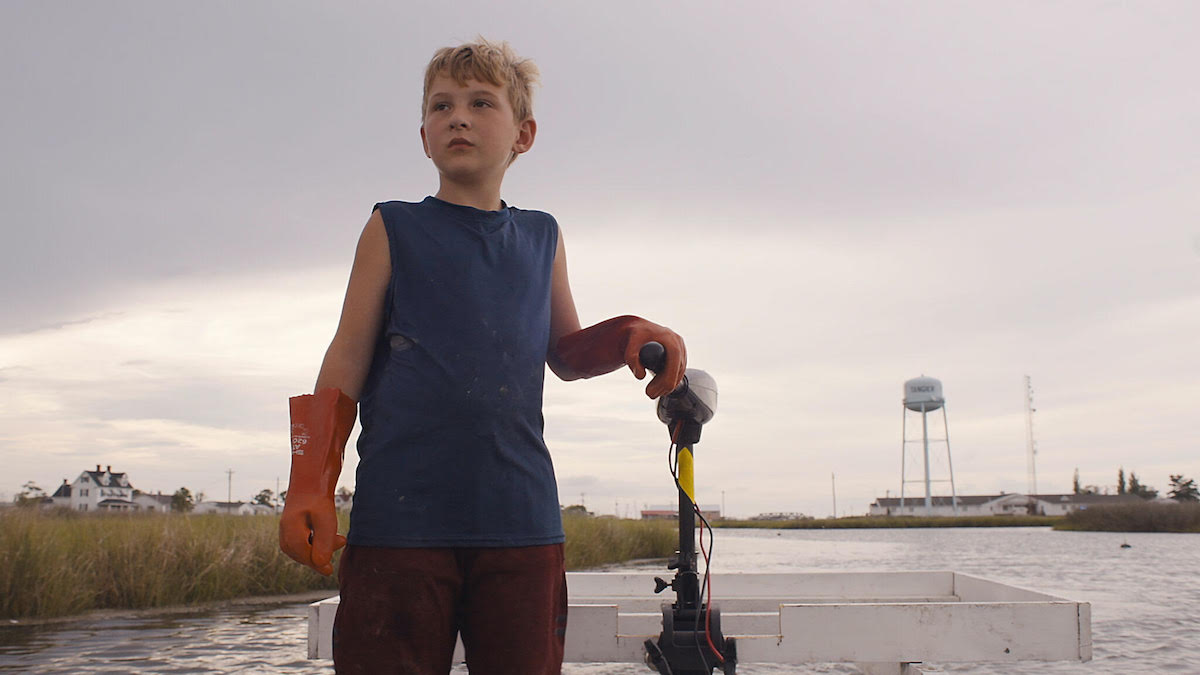
The depth of this belief gets explored through following three separate people; the mayor, James “Ooker” Eskridge, who works hard to keep the peace and advocate for the island on a wider scale; Cameron, a college-age student who is unsure about his future on Tangier Island; and Jacob, a seven-year-old boy who we watch enjoy his life on the island. We get to follow the three through their own paths, including Eskridge’s pleas for a second sea wall to prevent rising waters or Cameron spending time between college and the island, but the more important character seems to be Jacob. While he might not be doing anything remarkable, watching him enjoy his life acts as a microcosm for that childhood innocence, contrasted perfectly with the looming threat of rising sea levels. Jacob has no stake in the climate crisis, and he most likely does not understand it even if he knows it is happening.

“With documentaries, a lot of attention is oftentimes centered and anchored around the present, and obviously, the past. I think that including Jacob’s perspective and his story gave us the opportunity to future-cast a bit. What will his future look like? That’s the same motivator with Jane [Hirshfield’s] poem, that poem to me is so much about regret in thinking about the past, thinking about the decisions we’re making and the consequences of those decisions going forward,” says Usui. He closes out the film with a sequence of children running around and playing while a child reads Hirshfield’s poem Let Them Not Say, tying back to the dispelling of assumptive dialogue about the island or about the climate crisis. As the camera shows the final shot, bobbing in the water while eventually sinking, the line “we did not enough” plays, tying back to that theme of regret from the past while reckoning with the future. Will the island eventually fully sink? Only time will tell.
Fear of the future motivates several people throughout the film, especially Cameron. His time at college enlightens him to
“I think that the film was as much for me as it was for anyone else in what it is we chose to include, how we chose to approach it, the structure, the context. I think of it as a film that doesn’t ask explicit questions and doesn’t really provide specific answers in a way, but I feel like it gives us a chance to call our assumptions into question,” says Usui. He hopes that after watching Been Here Stay Here, viewers will be more aware of Tangier Island’s rising sea levels and be able to foster understanding and nuances that most people might not be willing to have.
Been Here Stay Here was recently screened at the Richmond International Film Festival this past October. It found several sold-out audiences across the Chesapeake region throughout late summer and fall, and its theatrical premiere is set to start on January 9th, 2026, at New York’s Quad Cinema.
Leave a Reply
You must be logged in to post a comment.