
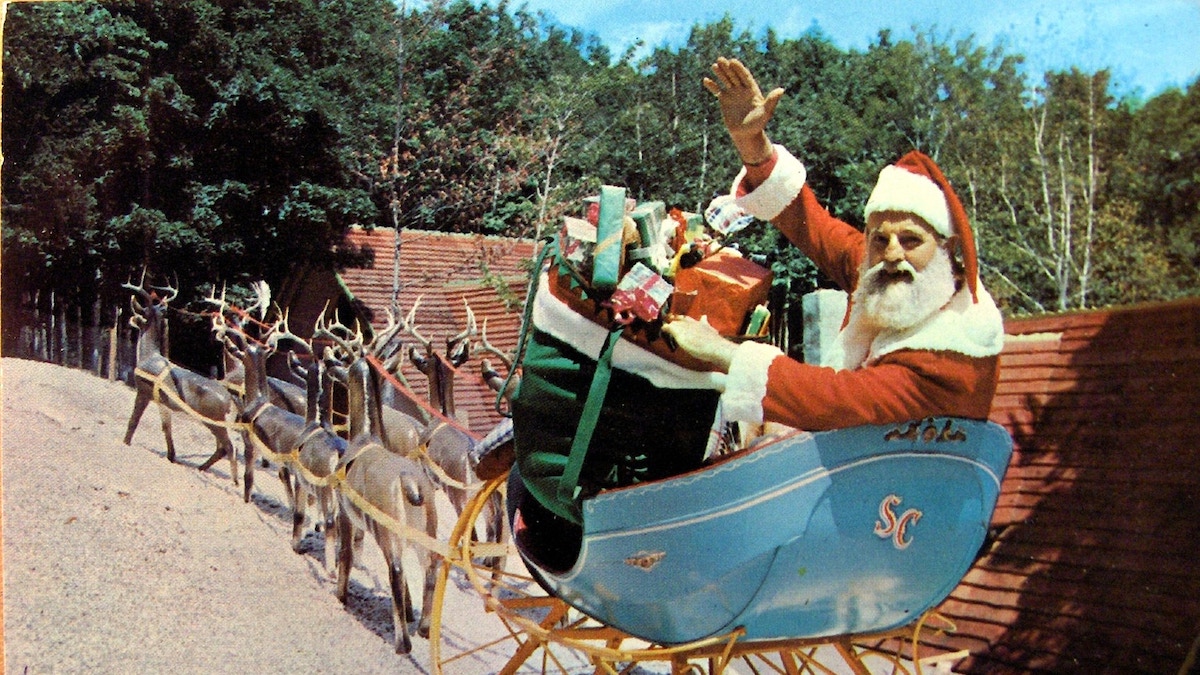
 North Pole, NY[/caption]
By the halfway point of North Pole, NY — an hour-long exposé on the history and hardships of the theme park known as ‘Santa’s Workshop’ in upstate New York — one thing is undeniably clear: director Ali Cotterill, who also served as co-writer, editor, and camera operator, has an unyielding affection for her subject matter. And why shouldn’t she? After all, the citizens of Wilmington, New York—a sleepy tourist town snug in the Adirondacks—couldn’t be more endearing in their devotion to Santa’s Workshop, the holiday theme park upon which their idyllic community has grown and, ultimately, come to rely.
It’s not all tinsel, though. The park, founded in the late 1940s by businessman Julian Reiss and later bequeathed to his son Bob, has been on a downward trajectory since the Eisenhower years, when theme parks and car trips were supplanted by the arrival of jet travel which took public interest elsewhere. These days Santa’s Workshop—which receives hundreds of letters to Kris Kringle each year—operates less as a commercial attraction and more as a gauzy piece of post-war nostalgia. See, in one particularly sobering sequence, as long-time park performer and historian Julie “Jingles” Robards drives her ’54 Dodge around Wilmington, pointing out what were once neighboring theme parks like “The Land of Make-Believe” but today resemble the sort of overgrown and decrepit structures you’d forbid your children from playing on.
Cotterill knows better than to wallow. After all, there is plenty of good to focus on here: the jobs for local teenagers, the decades of tradition kept alive by returning visitors, and the overall feeling that yes, magic still exists in the world, even if it doesn’t pay well. Never do the scales tip to full-blown despair. There is a villain, businessman Greg Cunningham, whose brief ownership of the park in the late 1990s turned sour after tales of his past criminal misconduct came to light, but even his story (which takes up less than four minutes of screen time) plays like a curious detour in a bigger tale of indomitable community spirit.
It’s the balance between the magical and melancholy that makes North Pole, NY such a compelling documentary. It operates on a two-fold illusion: the precious and short-lived one kids know as Santa Claus, and the existence of his workshop as a place of perpetual wonder in the face of bankruptcy, disinterest, and gentrification. Watching these awestruck children—whose interviews make up some of the funniest (and weirdest) parts of the film—react to a ‘talking’ tannenbaum or stand giddily in line for their moment with St. Nick, I found myself both moved by their innocence and depressed for the day when they’ll grow up and see behind the curtain.
Ultimately that’s what rounds out North Pole, NY and gives it such an engaging air: the people. Some of them, like Jingles Robards, seem at times almost too sincere to really exist in 2018. Others, like park manager Matt Stanley, are palpable in their believability. As he makes the morning rounds repairing broken games and reading customer complaints his cell phone erupts into a rock rendition of “Carol of the Bells.” It’s a moment that in a fictional film might feel cheap or obvious, but here rings true. Despite the daily grind, this guy really, truly loves Christmas. That’s how, after seven decades, Santa’s Workshop continues to survive: on the selflessness of people who believe in it. The park, just like this splendid little film, is a labor of love.
North Pole, NY premiered in New York on November 9th at IFC Center as part of DOC NYC.
North Pole, NY[/caption]
By the halfway point of North Pole, NY — an hour-long exposé on the history and hardships of the theme park known as ‘Santa’s Workshop’ in upstate New York — one thing is undeniably clear: director Ali Cotterill, who also served as co-writer, editor, and camera operator, has an unyielding affection for her subject matter. And why shouldn’t she? After all, the citizens of Wilmington, New York—a sleepy tourist town snug in the Adirondacks—couldn’t be more endearing in their devotion to Santa’s Workshop, the holiday theme park upon which their idyllic community has grown and, ultimately, come to rely.
It’s not all tinsel, though. The park, founded in the late 1940s by businessman Julian Reiss and later bequeathed to his son Bob, has been on a downward trajectory since the Eisenhower years, when theme parks and car trips were supplanted by the arrival of jet travel which took public interest elsewhere. These days Santa’s Workshop—which receives hundreds of letters to Kris Kringle each year—operates less as a commercial attraction and more as a gauzy piece of post-war nostalgia. See, in one particularly sobering sequence, as long-time park performer and historian Julie “Jingles” Robards drives her ’54 Dodge around Wilmington, pointing out what were once neighboring theme parks like “The Land of Make-Believe” but today resemble the sort of overgrown and decrepit structures you’d forbid your children from playing on.
Cotterill knows better than to wallow. After all, there is plenty of good to focus on here: the jobs for local teenagers, the decades of tradition kept alive by returning visitors, and the overall feeling that yes, magic still exists in the world, even if it doesn’t pay well. Never do the scales tip to full-blown despair. There is a villain, businessman Greg Cunningham, whose brief ownership of the park in the late 1990s turned sour after tales of his past criminal misconduct came to light, but even his story (which takes up less than four minutes of screen time) plays like a curious detour in a bigger tale of indomitable community spirit.
It’s the balance between the magical and melancholy that makes North Pole, NY such a compelling documentary. It operates on a two-fold illusion: the precious and short-lived one kids know as Santa Claus, and the existence of his workshop as a place of perpetual wonder in the face of bankruptcy, disinterest, and gentrification. Watching these awestruck children—whose interviews make up some of the funniest (and weirdest) parts of the film—react to a ‘talking’ tannenbaum or stand giddily in line for their moment with St. Nick, I found myself both moved by their innocence and depressed for the day when they’ll grow up and see behind the curtain.
Ultimately that’s what rounds out North Pole, NY and gives it such an engaging air: the people. Some of them, like Jingles Robards, seem at times almost too sincere to really exist in 2018. Others, like park manager Matt Stanley, are palpable in their believability. As he makes the morning rounds repairing broken games and reading customer complaints his cell phone erupts into a rock rendition of “Carol of the Bells.” It’s a moment that in a fictional film might feel cheap or obvious, but here rings true. Despite the daily grind, this guy really, truly loves Christmas. That’s how, after seven decades, Santa’s Workshop continues to survive: on the selflessness of people who believe in it. The park, just like this splendid little film, is a labor of love.
North Pole, NY premiered in New York on November 9th at IFC Center as part of DOC NYC.
Joe Zaydon
Joe Zaydon is a freelance writer whose work has appeared on such sites as Odyssey Online, Movie Rehab, and The Flounce. He currently resides in Brooklyn, New York.
-
FILM REVIEW: NORTH POLE, NY: A Fantasy Powered By Belief
[caption id="attachment_32505" align="aligncenter" width="1200"] North Pole, NY[/caption]
By the halfway point of North Pole, NY — an hour-long exposé on the history and hardships of the theme park known as ‘Santa’s Workshop’ in upstate New York — one thing is undeniably clear: director Ali Cotterill, who also served as co-writer, editor, and camera operator, has an unyielding affection for her subject matter. And why shouldn’t she? After all, the citizens of Wilmington, New York—a sleepy tourist town snug in the Adirondacks—couldn’t be more endearing in their devotion to Santa’s Workshop, the holiday theme park upon which their idyllic community has grown and, ultimately, come to rely.
It’s not all tinsel, though. The park, founded in the late 1940s by businessman Julian Reiss and later bequeathed to his son Bob, has been on a downward trajectory since the Eisenhower years, when theme parks and car trips were supplanted by the arrival of jet travel which took public interest elsewhere. These days Santa’s Workshop—which receives hundreds of letters to Kris Kringle each year—operates less as a commercial attraction and more as a gauzy piece of post-war nostalgia. See, in one particularly sobering sequence, as long-time park performer and historian Julie “Jingles” Robards drives her ’54 Dodge around Wilmington, pointing out what were once neighboring theme parks like “The Land of Make-Believe” but today resemble the sort of overgrown and decrepit structures you’d forbid your children from playing on.
Cotterill knows better than to wallow. After all, there is plenty of good to focus on here: the jobs for local teenagers, the decades of tradition kept alive by returning visitors, and the overall feeling that yes, magic still exists in the world, even if it doesn’t pay well. Never do the scales tip to full-blown despair. There is a villain, businessman Greg Cunningham, whose brief ownership of the park in the late 1990s turned sour after tales of his past criminal misconduct came to light, but even his story (which takes up less than four minutes of screen time) plays like a curious detour in a bigger tale of indomitable community spirit.
It’s the balance between the magical and melancholy that makes North Pole, NY such a compelling documentary. It operates on a two-fold illusion: the precious and short-lived one kids know as Santa Claus, and the existence of his workshop as a place of perpetual wonder in the face of bankruptcy, disinterest, and gentrification. Watching these awestruck children—whose interviews make up some of the funniest (and weirdest) parts of the film—react to a ‘talking’ tannenbaum or stand giddily in line for their moment with St. Nick, I found myself both moved by their innocence and depressed for the day when they’ll grow up and see behind the curtain.
Ultimately that’s what rounds out North Pole, NY and gives it such an engaging air: the people. Some of them, like Jingles Robards, seem at times almost too sincere to really exist in 2018. Others, like park manager Matt Stanley, are palpable in their believability. As he makes the morning rounds repairing broken games and reading customer complaints his cell phone erupts into a rock rendition of “Carol of the Bells.” It’s a moment that in a fictional film might feel cheap or obvious, but here rings true. Despite the daily grind, this guy really, truly loves Christmas. That’s how, after seven decades, Santa’s Workshop continues to survive: on the selflessness of people who believe in it. The park, just like this splendid little film, is a labor of love.
North Pole, NY premiered in New York on November 9th at IFC Center as part of DOC NYC.
-
FILM REVIEW: Heart-Wrenching Story “ELEPHANT PATH/NJAIA NJOKU”
[caption id="attachment_32709" align="aligncenter" width="1200"]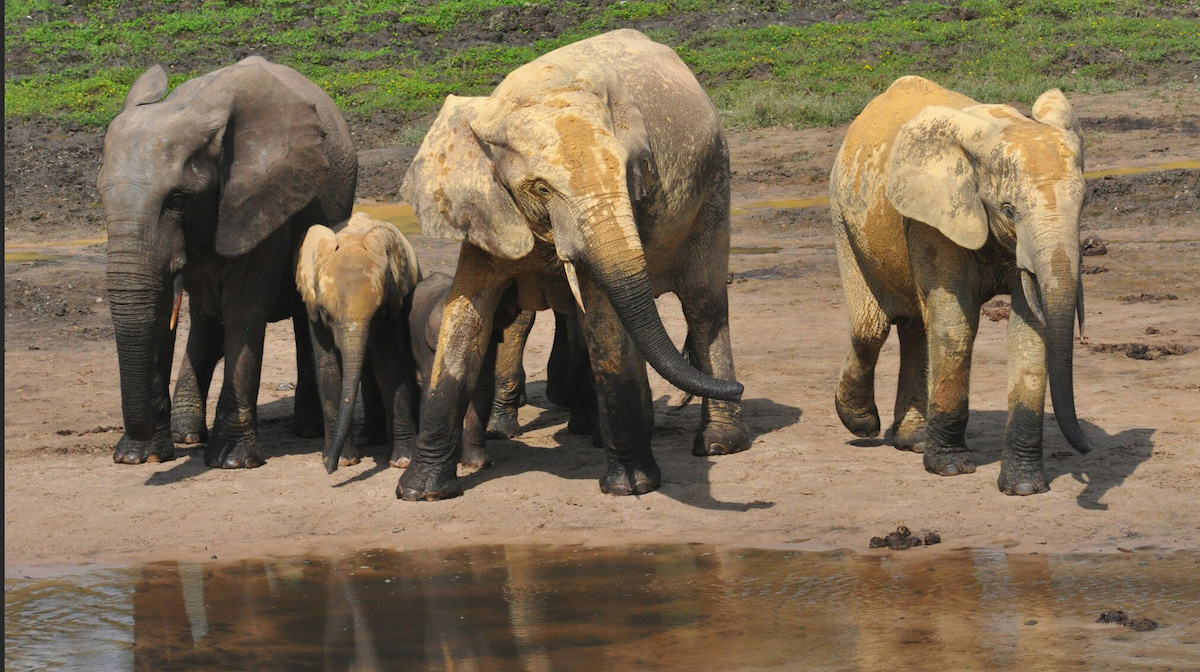 Elephant Path: Njaia Njoku[/caption]
Todd McGrain knows the importance of conservation. The artist turned filmmaker is best known for his Lost Bird Project, a series of larger-than-life sculptures dedicated to five extinct North American bird species. While this endeavor was chronicled in the 2012 film of the same name by Deborah Dickson, now McGrain himself has stepped behind the camera to bring us the story of another endangered species, one we might actually be able to save: the forest elephants of Bayanga, Central Africa. Elephant Path (or “Njaia Njoku” in the Bayaka language) has a lot going for it: a heart-wrenching story, impressive scope, engaging characters, and above all a sense of showmanship. McGrain’s storytelling approach is stylish and highly cinematic to the point where, by the end of the film’s 79 minute run-time, it’s a shock to realize how little has actually happened.
The story of “Dzanga Bai” (“Elephant Village”) is presented through a quartet of characters. Andrea Turkalo, an American biologist, has spent three decades observing elephants in their natural habitat. Aiding her efforts in Bayanga is local tracker Sessely Bernard, a village elder named for the river from which he first drank. Keeping watch over the elephants is Zephirine Sosso Mbele, one of a handful of “Eco Guards” tasked with warding off poachers. Late in the film, the guards receive additional defense training from Nir Kalron, an Israeli ex-military security contractor with a soft spot for animals.
Why the additional training? Because Bayanga, in fact the entire Central African Republic, is under siege by Séléka rebels and embroiled in a civil war. To the rebels, elephants are prime targets; the sale of ivory from their priceless tusks is how they fund their arsenal. At the start of the film they have not arrived at Dzanga, but from Turkalo’s foreboding narration we quickly gather it’s only a matter of time. Meanwhile, she and Sessely enjoy their work, the bulk of which is done from an observation deck and conducted via sketch pads and telephoto lenses, with minimal conversation. There is a sublime peace to this process.
That peace, of course, does not last. Eventually the Séléka arrive, guns blazing, and the region is plunged into oppression and terror. Turkalo is forced to flee to America while Sessely and the Bayangan community retreat into the forest to avoid persecution. I won’t detail what follows from here on out, sufficeth to say the elephants do not fare well. In one particularly haunting scene set back in America, Turkalo and a colleague review audio recordings of the forest, where distant gunfire produces cries of animal distress. A short while later, rhythmic tapping is heard. “They’re chopping off the tusks,” Turkalo observes coldly.
The human cruelty of Elephant Path is the film’s most striking element, despite the fact that none of it is ever shown happening. Early on, Sessely remarks to Turkalo how the behavior of elephants does not differ so much from that of humans; they flirt and fight, bathe each other, have children, play games. This salient observation returns with a vengeance when, in the aftermath of a Séléka poaching spree, Sessely inspects the demolished corpse of a slain elephant and angrily declares “This elephant was me.”
One of the inherent dangers of documentary filmmaking is arriving at an anticlimax. For a film shot and edited with the gusto of a narrative film, Elephant Path comes to an abrupt, somewhat underwhelming conclusion. Again I won’t spoil, but for all of Nir Kalron’s efforts in training up the Eco Guards to combat the bigger, better-armed Séléka poachers, the resolution of said problem feels like a non-ending, at least to the viewer. Little can be done about this, I know, but McGrain and crew (in particular cinematographer Scott Anger) set up such palpable villains in the occupying rebels that you can’t help but feel a little cheated out of a proper showdown. There is hope at the end of Elephant Path, even if only a modest amount, and that must be our reward. The remaining elephants saunter into Dzanga Bai, as always, and hose themselves down. Life goes on. For the living, anyway.
Elephant Path: Njaia Njoku[/caption]
Todd McGrain knows the importance of conservation. The artist turned filmmaker is best known for his Lost Bird Project, a series of larger-than-life sculptures dedicated to five extinct North American bird species. While this endeavor was chronicled in the 2012 film of the same name by Deborah Dickson, now McGrain himself has stepped behind the camera to bring us the story of another endangered species, one we might actually be able to save: the forest elephants of Bayanga, Central Africa. Elephant Path (or “Njaia Njoku” in the Bayaka language) has a lot going for it: a heart-wrenching story, impressive scope, engaging characters, and above all a sense of showmanship. McGrain’s storytelling approach is stylish and highly cinematic to the point where, by the end of the film’s 79 minute run-time, it’s a shock to realize how little has actually happened.
The story of “Dzanga Bai” (“Elephant Village”) is presented through a quartet of characters. Andrea Turkalo, an American biologist, has spent three decades observing elephants in their natural habitat. Aiding her efforts in Bayanga is local tracker Sessely Bernard, a village elder named for the river from which he first drank. Keeping watch over the elephants is Zephirine Sosso Mbele, one of a handful of “Eco Guards” tasked with warding off poachers. Late in the film, the guards receive additional defense training from Nir Kalron, an Israeli ex-military security contractor with a soft spot for animals.
Why the additional training? Because Bayanga, in fact the entire Central African Republic, is under siege by Séléka rebels and embroiled in a civil war. To the rebels, elephants are prime targets; the sale of ivory from their priceless tusks is how they fund their arsenal. At the start of the film they have not arrived at Dzanga, but from Turkalo’s foreboding narration we quickly gather it’s only a matter of time. Meanwhile, she and Sessely enjoy their work, the bulk of which is done from an observation deck and conducted via sketch pads and telephoto lenses, with minimal conversation. There is a sublime peace to this process.
That peace, of course, does not last. Eventually the Séléka arrive, guns blazing, and the region is plunged into oppression and terror. Turkalo is forced to flee to America while Sessely and the Bayangan community retreat into the forest to avoid persecution. I won’t detail what follows from here on out, sufficeth to say the elephants do not fare well. In one particularly haunting scene set back in America, Turkalo and a colleague review audio recordings of the forest, where distant gunfire produces cries of animal distress. A short while later, rhythmic tapping is heard. “They’re chopping off the tusks,” Turkalo observes coldly.
The human cruelty of Elephant Path is the film’s most striking element, despite the fact that none of it is ever shown happening. Early on, Sessely remarks to Turkalo how the behavior of elephants does not differ so much from that of humans; they flirt and fight, bathe each other, have children, play games. This salient observation returns with a vengeance when, in the aftermath of a Séléka poaching spree, Sessely inspects the demolished corpse of a slain elephant and angrily declares “This elephant was me.”
One of the inherent dangers of documentary filmmaking is arriving at an anticlimax. For a film shot and edited with the gusto of a narrative film, Elephant Path comes to an abrupt, somewhat underwhelming conclusion. Again I won’t spoil, but for all of Nir Kalron’s efforts in training up the Eco Guards to combat the bigger, better-armed Séléka poachers, the resolution of said problem feels like a non-ending, at least to the viewer. Little can be done about this, I know, but McGrain and crew (in particular cinematographer Scott Anger) set up such palpable villains in the occupying rebels that you can’t help but feel a little cheated out of a proper showdown. There is hope at the end of Elephant Path, even if only a modest amount, and that must be our reward. The remaining elephants saunter into Dzanga Bai, as always, and hose themselves down. Life goes on. For the living, anyway.