New York Film Festival

  • Alexander Payne’s THE DESCENDANTS is Closing Night Gala Selection for 2011 NY Film Festival and Main-Slate of 27 Features

    [caption id="attachment_1631" align="alignnone" width="550"]Alexander Payne’s THE DESCENDANTS[/caption]

    Alexander Payne’s THE DESCENDANTS will be the Closing Night Gala selection for the 49th New York Film Festival (September 30-October 16). NYFF also released the main slate of 27 feature films as well as a return to the festival stage of audience favorite, On Cinema (previously titled The Cinema Inside Me), featuring an in-depth, illustrated conversation with Alexander Payne.

    In his first film since the Oscar-winning SIDEWAYS, writer-director Alexander Payne once again proves himself a master of the kind of smart, sharp, deeply felt comedy that was once the hallmark of Billy Wilder and Jean Renoir. Based on the bestselling novel by Kaui Hart Hemmings, THE DESCENDANTS stars George Clooney as ‘Matt King’, the heir of a prominent Hawaiian land-owning family whose life is turned upside-down when his wife is critically injured in a boating accident. Accustomed to being “the back-up parent,” King suddenly finds himself center stage in the lives of his two young daughters (excellent newcomers Shailene Woodley and Amara Miller), while at the same time being forced to decide the fate of a vast plot of unspoiled land his family has owned since the 1860s. Rooted in Clooney’s beautifully understated performance, Payne’s film is an uncommonly perceptive portrait of marriage, family and community, suffused with humor and tragedy and wrapped in a warm human glow.

    Screening at Alice Tully Hall on Sunday, October 16, Alexander Payne’s THE DESCENDANTS marks the filmmakers 3rd visit to the New York Film Festival; previous titles presented were ABOUT SCHMIDT and SIDEWAYS. Fox Searchlight is releasing the film on November 23, 2011.

    The 49th New York Film Festival main-slate:

    Opening Night Gala Selection

    CARNAGE
    Director: Roman Polanski
    Country: France/Germany/Poland

    Centerpiece Gala Selection

    MY WEEK WITH MARILYN
    Director: Simon Curtis
    Country: UK

    Special Gala Presentations

    A DANGEROUS METHOD
    Director: David Cronenberg
    Country: UK/Canada/Germany

    THE SKIN I LIVE IN
    Director: Pedro Almodóvar
    Country: Spain

    Closing Night Gala Selection

    THE DESCENDANTS
    Director: Alexander Payne
    Country: USA

    4:44: LAST DAY ON EARTH
    Director: Abel Ferrara
    Country: USA

    THE ARTIST
    Director: Michel Hazanavicius
    Country: France

    CORPO CELESTE
    Director: Alice Rohrwacher
    Country: Italy/Switzerland/France

    FOOTNOTE
    Director: Joseph Cedar
    Country: Israel

    GEORGE HARRISON: LIVING IN THE MATERIAL WORLD
    Director: Martin Scorsese
    Country: USA

    GOODBYE FIRST LOVE
    Director: Mia Hansen-Løve
    Country: France/Germany

    THE KID WITH A BIKE
    Director: Jean-Pierre and Luc Dardenne
    Country: Belgium/France

    LE HAVRE
    Director: Aki Kaurismäki
    Country: Finland/France/Germany

    THE LONELIEST PLANET
    Director: Julia Loktev
    Country: USA/Germany

    MARTHA MARCY MAY MARLENE
    Director: Sean Durkin
    Country: USA

    MELANCHOLIA
    Director: Lars von Trier
    Country: Denmark/Sweden/France/Germany/Italy

    MISS BALA
    Director: Gerardo Naranjo
    Country: Mexico

    ONCE UPON A TIME IN ANATOLIA
    Director: Nuri Bilge Ceylan
    Country: Turkey

    PINA
    Director: Wim Wenders
    Country: Germany/France/UK

    PLAY
    Director: Ruben Östlund
    Country: Sweden/France/Denmark

    POLICEMAN
    Director: Nadav Lapid
    Country: Israel/France

    A SEPARATION
    Director: Asghar Farhadi
    Country: Iran

    SHAME
    Director: Steve McQueen
    Country: UK

    SLEEPING SICKNESS
    Director: Ulrich Köhler
    Country: Germany/France/Netherlands

    THE STUDENT
    Director: Santiago Mitre
    Country: Argentina

    THIS IS NOT A FILM
    Director: Jafar Panahi and Mojtaba Mirtahmasb
    Country: Iran

    THE TURIN HORSE
    Director: Béla Tarr and Agnes Hranitzky
    Country: Hungary/France/Germany/Switzerland/USA


    Read more


  • David Cronenberg’s A DANGEROUS METHOD and Pedro Almodovar’s THE SKIN I LIVE Added As Special Gala Presentations at 2011 New York Film Festival

    [caption id="attachment_1629" align="alignnone" width="550"]David Cronenberg’s A Dangerous Method[/caption]

    Two Galas will join the Opening, Centerpiece and Closing Night Galas for the upcoming 49th New York Film Festival (September 30 – October 16) with David Cronenberg’s A DANGEROUS METHOD set to screen on Wednesday, October 5 and Pedro Almodovar’s THE SKIN I LIVE IN on Wednesday, October 12.

    Scheduled at Alice Tully Hall on Wednesday, October 5 will be David Cronenberg’s A DANGEROUS METHOD.  Adapted by Christopher Hampton from his play The Talking Cure, the film chronicles the ever-shifting relationship between Carl Jung (Michael Fassbender) and Sigmund Freud (Viggo Mortensen). Basking at first in Freud’s approval and encouragement, Jung increasingly questions his theories and methods. At the heart of their dispute is their rival approaches to the beautiful yet deeply unbalanced Sabina Spielrein (Keira Knightly), who eventually draws each man under her spell. Produced by Jeremy Thomas, the Sony Pictures Classics release also stars Vincent Cassel and Sarah Gordon. The film is set for a November 23 release. Presented the following Wednesday, on October 12, will be Pedro Almodóvar’s THE SKIN I LIVE IN. Reuniting the director with Antonio Banderas, the star of several of his early films, this dramatic thriller was written by Almodovar in collaboration with brother and producer, Agustin, based on Thierry Jonquet’s novel Mygale. Dr. Robert Ledgard (Banderas) is a world famous plastic surgeon who argues for the development of new, tougher human skin; unbeknownst to others, Dr. Ledgard has been trying to put his theory into practice, keeping a young woman, Vera (Elena Anaya), imprisoned in his mansion while subjecting her to an increasingly bizarre regime of treatments. Fascinated by the thin layer of appearance that stands between our perception of someone and that person’s inner essence, Almodóvar here addresses that continuing theme in his work in a bold, unsettling exploration of identity. Almodóvar regular Marisa Paredes offers another winning performance as Marilia, Ledgard’s faithful assistant. A Sony Pictures Classics release is scheduled to open October 14.

    Read more


  • Simon Curtis’ MY WEEK WITH MARILYN is Centerpiece Gala selection for 2011 New York Film Festival

    Simon Curtis’ MY WEEK WITH MARILYN will make its World Premiere as the Centerpiece Gala selection, screening at Alice Tully Hall on Sunday, October 9 for the upcoming 49th New York Film Festival (September 30 – October 16).

    Based on Colin Clark’s diaries, MY WEEK WITH MARILYN, is set in the early summer of 1956, when a 23 year-old Colin Clark (Eddie Redmayne), just down from Oxford and determined to make his way in the film business, worked as a lowly assistant on the set of THE PRINCE AND THE SHOWGIRL. It was the film that famously united Sir Laurence Olivier (Kenneth Branagh) and Marilyn Monroe (Michelle Williams), who was also on honeymoon with her new husband, the playwright Arthur Miller (Dougray Scott).

    Nearly 40 years on, Clark’s diary account The Prince, the Showgirl and Me was published, but one week was missing – which was published some years later as My Week with Marilyn. This is the story of that week. When Arthur Miller leaves England, the coast is clear for Clark to introduce Monroe to some of the pleasures of British life; an idyllic week in which he escorted a Monroe who was desperate to get away from her retinue of Hollywood hangers-on and the pressures of work.   

    Produced by David Parfitt, the Weinstein Company release also stars Dominic Cooper, Judi Dench, Julia Ormond, Zoe Wanamaker, Emma Watson, Toby Jones, Philip Jackson, Geraldine Somerville, Derek Jacobi and Simon Russell Beale. The film is set for a November 4 release.

    NYFF will also feature an exciting lineup of Masterworks presentations including a special screening of an 8K Digital restored version of William Wyler’s sword and sandals epic BEN-HUR (1959), Nicholas Ray’s WE CAN’T GO HOME AGAIN (1973) and an ambitious celebration of the upcoming 100th Anniversary of Japan’s Nikkatsu Films featuring screenings of 36 films including classics such as Kon Ichikawa’s THE BURMESE HARP (1956), Masahiro Makino’s SINGING LOVE BIRDS (1936), Ko Nakahira’s CRAZED FRUIT (1956), Shohei Imamura’s PIGS AND BATTLESHIPS (1961) and Seijun Suzuki’s TOKYO DRIFTER (1966).

    The screening of the recently restored version of Wyler’s classic BEN-HUR will show off the epic starring Charlton Heston and arguably the greatest chariot race put on film via an 8K Digital print which returns the film back to its original aspect ratio. Ray’s seldom seen experimental film WE CAN’T GO HOME AGAIN was originally made in collaboration with the late director’s film students and was the subject of subsequent editing by Ray before his death in 1979. Ray’s widow supervised the restoration of the “multi-narrative” film, bordering between film and visual arts, which was conceived as a teaching tool – instructing filmmaking through practice versus theory.

    Founded upon the consolidation of several production companies and theater chains, Nikkatsu Corporation has enjoyed a rich history of film production and distribution since 1912. Since that time, notable directors such as Kenji Mizoguchi, Kon Ichikawa, Shozo Makino and his son Masahiro Makino, Ko Nakahira, Shohei Imamura and Seijun Suzuki have made films under the Nikkatsu banner.  During World War 2, Nikkatsu was forcibly combined with several other Japanese studios to form a large, government-influenced studio, but in 1954 the company resumed production under its own control.

    Searching for its own niche in the booming postwar Japanese film industry, Nikkatsu moved into the youth market with its stirring screen adaptation of Shintaro Ishihara’s SEASON OF THE SUN. An enormous success, Nikkatsu quickly followed up with a wave of similar works oriented for the youth market. As the vogue for these youth films began to wane in the early 60s, Nikkatsu launched a series of hard-boiled action films that remain perhaps the company’s best known period internationally. Led by such action stars as Shishedo Joe, Yujiro Ishihara and Hideaki Nitani, Nikkatsu action introduced a new kind of protagonist, often cynical and at odds with a society revealed to be totally corrupt. Influenced by American B movies, Nikkatsu action would itself be a key influence on the Hong Kong gunplay films years later.

    With aging action stars and a public looking for something new, Nikkatsu in the 70s created “Roman Porno,” romantic pornography, a series of soft-core erotic films that featured real (if often bizarre) plots and actors. The constant shift in production enabled Nikkatsu to stay profitable while other Japanese studios were either closing or switching to television. Yet by the 90s, Nikkkatsu was itself forced to declare bankruptcy and re-organize. Despite changes in ownership since then, Nikkatsu has remained continuously in production, branching out into new genre such as horror, martial arts and even family drama. As it approaches its centenary, Nikkatsu’s motto “We Make Fun Films” remains as true today as it was in its golden era. A new generation of filmgoers are discovering its classic films and filmmakers, inspiring not only the re-release of films from their catalogue but the production of remakes as well. Organized by the Film Society of Lincoln Center with Nikkatsu Corporation, the Japan Foundation and the National Film Center of Japan, this Centenary Celebration of Nikkatsu will be screened later this year at the Festival of 3 Continents in Nantes, France, as well as at the Cinematheque Française.

    Nikkatsu 100th Anniversary Retrospective Lineup

    AKANISHI KAKITA (1936) 77min
    Director: Mansaku Itami

    THE BURMESE HARP (Biruma no Tategoto) (1956) 115min
    Director: Kon Ichikawa

    CHARISMA (Karisuma) (1999) 103min
    Director: Kiyoshi Kurosawa

    COLD FISH (Tsumetai Nettaigyo) (2010) 144min
    Director: Sion Sono

    A COLT IS MY PASSPORT (Colt ha Oreno Passport) (1967) 85min
    Director: Takashi Nomura

    CRAZED FRUIT (Kurutta Kajitsu) (1956) 86min
    Director: Ko Nakahira

    DANCER IN IZU (Izo no Odoriko) (1963) 87min
    Director: Katsumi Nisikawa

    A DIARY OF CHUJI’S TRAVELS (Chiji Tabi Nikki: Part 1 and Part 2) (1927) 107min
    Director: Daisuke Ito

    EARTH (1939) 92min
    Director: Tomu Uchida

    GATE OF FLESH (Nikutai no Mon) (1964) 90min
    Director: Seijun Suzuki

    THE HELL-FATED COURTESAN (Maruhi: Joro Seme Jigoku) (1973) 77min
    Director: Noboru Tanaka

    HOMETOWN (1930) 86min
    Director: Kenji Mizoguchi

    I LOOK UP WHEN I WALK (aka KEEP YOUR CHIN UP) (Uewo Muite Arukou) (1962) 91min
    Director: Toshio Masuda

    INTENTIONS OF MURDER (Akai Satsui) (1964) 150min
    Director: Shohei Imamura

    INTIMIDATION (Aru Kyohaku) (1960) 65min
    Director: Koreyosji Kurahara

    LOVE HOTEL (1985) 88min
    Director: Shinji Somae

    MADE TO ORDER CLOTH (aka JIROKICHI THE RAT) (Oatsurae Jirokichi Koshi) (1931) 70min
    Director: Daisuke Ito
    **Screening with:
    JIRAIYA THE NINJA (Goketsu Jiraiya) (1921) 30min
    Director: Shozo Makino

    MUD AND SOLDIERS (Tsuchi to Heitai) (1936) 120min
    Director: Tomotaka Tasaka

    THE OLDEST PROFESSION (Maruhi: Shikiyo Mesu Ichiba) (1974) 83min
    Director: Noboru Tanaka

    PIGS AND BATTLESHIPS (Buta to Gunkan) (1961) 108min
    Director: Shohei Imamura

    A POT WORTH A MILLION RYO (Tange Sazen Hyakuman Ryou no Tsubo) (1935) 92min
    Director: Sadao Yamanaka

    RETALIATION (Shima ha Moratta) (1967) 94min
    Director: Yasuharu Hasebe

    RUSTY KNIFE (Sabita Knife) (1958) 90min
    Director: Toshio Masuda

    SEASON OF THE SUN (Taiyo no Kisetsu) (1956) 89min
    Director: Takumi Furukawa

    SINGING LOVE BIRDS (Oshidori Uta Gassen) (1936) 69min
    Director: Masahiro Makino

    STRAY CAT ROCK: SEX HUNTER (Noraneko Rock: Sex Hunter) (1970) 86min
    Director: Yasuharu Hasebe

    SUN IN THE LAST DAYS OF THE SHOGUNATE (aka Shinagawa Path) (Bakumatsu Taiyoden) (1957) 110min
    Director: Yuzo Kawashima

    SUZUKI PARADISE: RED LIGHT (Suzuki Paradise: Aka Shingo) (1956) 81min
    Director: Yuzo Kawashima

    TAKE AIM AT THE POLICE VAN (Jusango Taihisen Yori: Sono Gososha wo Nerae) (1960) 79min
    Director: Seijun Suzuki

    THE TATTOOED FLOWER VASE (Kashinno Irezumi: Ureta Tsubo) (1979) 74min
    Director: Masaru Konuma

    TEN NIGHTS OF DREAMS (Yume Juya) (2007) 110min
    Director: Various

    TILL WE MEET AGAIN (Ashita Kuru Hito) (1955) 115min
    Director: Yuzo Kawashima

    TOKYO DRIFTER (Tokyo Nagaremono) (1966) 83min
    Director: Seijun Suzuki

    THE WARPED ONES (1960) 108min
    Director: Koreyoshi Kurahara

    THE WOMAN WITH RED HAIR (Akai Kami no Onna) (1979) 73min
    Director: Tatsumi Kumashiro

    A WORLD OF GEISHA (Yojyohan Fusuma no Urabari) (1973) 77min
    Director: Tatsumi Kumashiro


    Read more


  • New York Film Festival Review: The Lonliest Planet

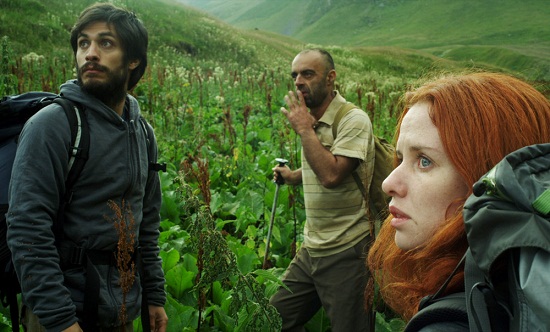
    A critical fave at the Toronto Intl. Film Festival, Julia Loktev’s follow-up to her 2006 “Day Night Day Night,” “Lonliest Planet” starts hunky Mexican star Gael Garcia Bernal as Alex and the fresh faced, confident Nica (Hani Furstenberg)- a couple playfully back-packing through the Caucasus mountains together in Georgia (formerly part of Russia) , led by their wary guide Dato (local, hired guide Bidzina Gujabidze.)

    Young, sexy and in love, these two appear to be cozying into a very happy, hipster future together. Until the middle of their trek, when the trio is casually ambushed by two peasants. No t to give the story away, this seemingly quiet yet very impactful event stretches the limits of their relationship, as it comes apart as gently as a tissue thrown away after a good cry before our very eyes.


    Hani Furstenberg is a truly great find-she’s a dynamic actress. Her hair as red as flame, she exudes an almost beguiling confidence, realizing without fully realizing, in the end,  who her lover really is. Bernal is also terrific at portraying her boyfriend who seems to know before Nica does that he is out of his depth altogether, in terms of her strength and courage.

    Supposedly, the title is poking fun at those “Lonely Planet” guides for the young and carefree traveler. Loktev doesn’t seem as much to be commenting about a generation, the state of the world itself, or the blithely Western ignorance of what it means to have your country fall apart after a war. It seems she just wants to show us how our perceptions, if we are fortunate enough, can change on a dime. She seems to be encouraging us not to wait for a life-threatening moment to occur before analyzing who and what it is we really love.

    The film is overall pretty slow moving, but the terrific score keeps us moving right along with vast long shots of the trio pilgrimming through the sharp terrain. The dialogue is sparse but overall the film is sharp, enjoyable, and really stays with you-the Lonliest Planet is a vivid character portrait of a relationship unraveling. Check it out next week at the New York Film Festival.


    Read more


  • New York Fim Festival Review: Melancholia

    Lars von Trier was banned from Cannes this year, after a ridiculously off-handed remark about “understanding Hitler” blew up to epic proportions.

    “Melancholia,” the latest film in the bratty bad boy’s ever-expanding oeuvre, is truly epic in its own right.

    The film opens with a bolt of sound that is Wagner and a truly mesmerizing and lush montage of gorgeous set pieces, which play themselves out later in the film. From there, we dive jumpily right into the wedding day of Kristin Dunst’s Justine, who is marrying an aw-shucks guy who still can’t believe his great luck (Alexander Skarsgard) and is contending with simmering guests and relatives -sharky but cordial boss Stellan Skarsgard, hilariously pissed off wedding planner Udo Kier, truly viperous mom Charlotte Rampling, exasperatingly careless and adorable dad John Hurt, had-it-up-to-here brother-in-law John played by Kiefer Sutherland, (neatly carrying the film on his back at one point,) and ready to explode, and weary, martyrish sis Claire, played by Charlotte Gainsbourg. Justine is also battling, we see as the day wares thin to evening, severe manic depression.


    Claire and John are throwing this wedding for Justine on their estate which could be in England, (Denmark) could be somewhere in the US, we have no idea- one thing we learn right away- that there is a mysterious, new planet called Melancholia is due to pass right by Earth, and the entire wedding party seems entirely disconnected from what could be the end of the world.

    Seeing as John and Claire have no discernable occupation and are simply “filthy rich,” and seeing that weeks after the wedding, which melted down to ashes by the end of the night, Justine can barely make it into a cab to go and visit her sister, she is so entrenched in her own sadness, it is easy to see this film as some sort of statement on the vapidness and futility of our time spent on earth, or depth of the human condition as we know it now. It is said that von Trier has and was battling his own depression when making this film. It really doesn’t matter hat his bad boy antics or state of mind is- he has made an honest to goodness masterpiece, both visually and emotionally, and one which relies heavily on American narrative filmmaking-without the morality injected into practically all of it today.

    Because as the inhabitants of this tiny family come together, in their own way, we are to ponder not “what we do, and how would we do it?” How would we survive knowing, as Claire’s young son says at one point, “there is nowhere to hide?” But rather, we are allowed to bear witness to the strange voluptuousness of giving entirely into one’s own emotions, rather than being tousled by the gridlock of despair itself.

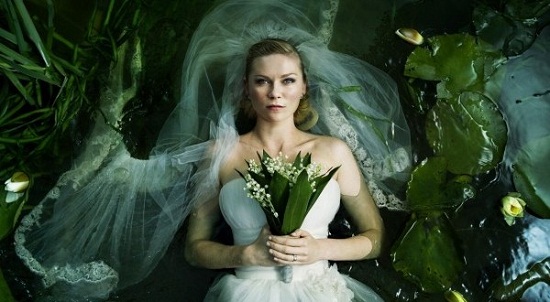
    Justine, even near paralyzed with what looks like grief, has the upper hand when the end of days grows near. Why? Well, it is curious that her nephew calls her “Auntie Steel-Breaker,” but it is really the fact that she is able to languish, and languish so beautifully (there is even a scene, shot long, with a nude Dunst prostrate on the bank of a small river, as she looks at the approaching, gloriously CGI-ed Melancholia approaching Earth, that looks like a far-out, breath-taking version of an Old Master portrait) that draws even her fed-up, patient sister into muttering “You have it so easy, don’t you?” Because Claire is only and always in a general state of anxiety and mild despair. The type most of us are in point or another. The kind that takes energy, that takes willpower to overcome, that takes an earnest desire to change. All traits which are vividly anti-death. All traits which are, as well, rather exhausting, after awhile. Even at the the end of the film, as Justine not only is able to face death with a calm serenity, but soothes her nephew over her hysterical sister’s ultimately useless cries of anguish, she is the strong one. She “knows,” ultimately, that we are alone, and we must deal with our imminent demise alone.

    It is the very voluptuousness of both Justine’s “sickness” and Dunst’s performance, which one simply cannot say enough about, which gives the film a strange vitality I can never recall experiencing before when watching a film. Actually, the closest thing would be the last half of “2001, A Space Odyssey”- when image, narrative (and in this case truly beguilingly perfect and spot-on performances by Dunst, Gainsbourgh and Sutherland) combine to allow the viewer to feel something is being fed into the head and soul by entirely different channels. As Justine says at the end of the film, “I know things.” Well, I’m not quite what von Trier really knows, but there is nothing of the fable, parable or moral to this film. It’s a meticulously orchestrated slate to appear clean, although it’s quite loaded at the same time. As Justine is able to do, von Trier seems to be encouraging us to give in to whatever feelings we may too frightened of releasing. But not for any particular reason, of course. Just because, as Dunst’s Justine inflicts her own sorry state on everyone who knows her, he can.Go and see this film, which plays at this week’s upcoming New York Film Festival. It’s a marvel of image, idea and performance.

    -Francesca McCaffery


    Read more


  • Roman Polanski’s CARNAGE to make its North American Premiere as the Opening Night film for 2011 New York Film Festival

    Roman Polanski’s ‘Carnage’ will open the upcoming 49th New York Film Festival scheduled to run September 30 – October 16, 2011.

    Based on Yasmina Reza’s “God of Carnage”, the 2009 Tony Award-winner for Best Play, ‘Carnage’ follows the events of an evening when two Brooklyn couples are brought together after their children are involved in a playground fight. Produced by Said Ben Said, the Sony Pictures Classics release stars Academy Award winners Jodie Foster, Kate Winslet and Christoph Waltz and Academy Award nominee John C. Reilly.

    Read more