[caption id="attachment_1595" align="alignnone" width="602"]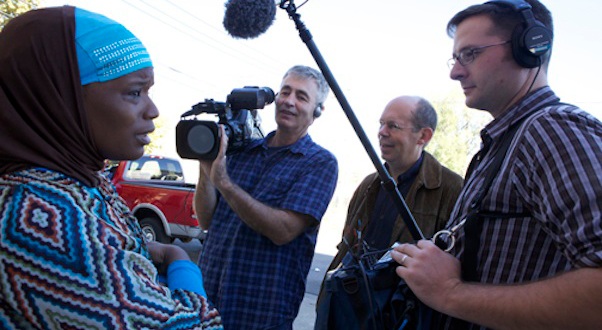 From left to right: violence interrupter Ameena Matthews, Producer/Director Steve James, Producer Alex Kotlowitz, and Co-Producer/Sound Recordist Zak Piper. [Photo: Cinema Guild][/caption]
Francesca McCaffery had the great pleasure of speaking with Steve James (Director) and Alex Kotlowitz (producer), who are the creative team who put together the riveting new documentary “The Interrupters,” about gang intervention specialists working the Chicago streets with the unique non-profit, CeaseFire.
CeaseFire was founded by epidermologist Gary Slutkin. Slutkin, who battled the cholera and AIDs epidemic in Africa for years, believes that the spread of violence mimics that of infectious diseases. This innovative approach, combined with the fact that CeaseFire not only employs former gang members, but gang members with major street credibility, gives CeaseFire the unique opportunity to penetrate into the daily lives of some potential violent perpetrators, illuminating the audience to the great humanity hidden beneath the darkest of disguises.
Steve James is an icon of documentary filmmaking, directing the astounding “Hoop Dreams” in 1994, “Stevie,” “The War Tapes,” and “At the Death House Door,” among others. Steve became interested in the work of CeaseFire after reading a piece about them in the “NY Times Magazine” article by Alex Kotlowitz, author of the legendary best seller “There Are No Children Here.”
Together, they set out to document the work of these brave violence “interrupters” over the course of one year in Chicago. Here, they set out to tell us about their journey creating by far one of the most riveting, inspiring documentaries you will see this year, or any:
VIMOOZ: It is such a pleasure and an honor to meet both of you. I read in the press notes that it took almost four months for you to film an actual violence “interruption.” Can you tell us about that?
Steve James: We met with the Interrupters before we even tried to do the movie, to see if we could film the mediations. Ameena was one of the people we met with (Ameena Matthews is the highly charismatic daughter of Jeff Fort, one of Chicago’s most infamous gang leaders; she is also a former gang member.) And there was a real feeling that we could get some of these things. Not every one, not every time at all, but some. So, when we got underway, we strategically thought that it would be good to go to those Wednesday meetings (At CeaseFire.) After Wednesday, to just get those meetings around the table, get them familiar with us, and comfortable with us, so we could get a finger on the pulse of what was going on. So, we did quite a bit of “meeting filming” in the beginning. And we had identified this one Interrupter that we thought would be great, and he would have been great, so we started really spending some time with him, filming his back story, aspects of his life, in church, his kids, I mean…We were actually pretty deep into his story, when it started to become to clear to Alex and me that the farther that we went along….He …he just wasn’t going to give us a mediation. He kept saying he was going to…And he was the nicest guy in the world! He couldn’t tell us “no.” But it just wasn’t happening. He just wasn’t picking up the film and calling us when something was going on.
Alex Kotlowitz: And I think he just felt too uncomfortable with us going out there with him. And he was such a nice guy, he couldn’t bring himself to tell us.
SJ: We were out with him one night, after he went to the scene of a double murder, you know, over on the west side. And he let us film him trying to sort of sort things out with people. But we had to keep a tremendous distance, we had to have him on a wireless mic and everything…It was just very clear, that, you know, this wasn’t going to work for him.
The work was the most important thing. And we always tried to keep that very clear with people. With Tio Hardiman (CeaseFire’s Executive Director) he would try to encourage them (The Interrupters) …I mean, encourage them was a nice way to put it…(laughs)
AK: He would berate them! (laughs) And I think the first interruption we did was really Flamo. (With violence Interrupter Ricardo “Cobe” Williams, who tries to calm “Flamo” down after a rival gang rats out his mother and brother, getting them arrested.)
SJ: We had filmed two interruptions with Cobe before, but he was the one was really started to make it happen, and kind of led the way in terms of that.
VIMOOZ: Speaking of the Flamo scene, it was so beautiful to see that what he really wanted was to just go out to lunch with Cobe! It sounds so cliché, but really, he wanted to know and feel that someone really cares. To me, that’s the whole narrative right there.
SJ: What you don’t see in the film is that Cobe had built up a real relationship with Flamo before hand- calling him, taking him out, checking in.
AK: Cobe kind of instinctively knows what’s needed. I mean, he’s got this great sixth sense about what’s really needed.
VIMOOZ: How did you find that these Interrupters would recharge personally?
Did that ever come up? How draining this type of work really is for them…?
AK: Yeah, I think it’s incredibly draining. For Ameena, for example, she has her family, And Cobe, as well. I mean, his family really is a source…
SJ: …A real balance.
AK: Yes. And Cobe of course lives, you know, and hour, and hour and a half outside of the city. So, he really is able to get away. I think it’s toughest for Eddie. ( Eddie Bocanegra, an Interrupter and former gang member who served time in prison for a murder he committed at age 17.) I mean, he talks about it in the film, where he has to just stay busy. He knows that about himself, that he can’t slow down. Otherwise it’s all going to start bearing down on him. But even he has something…He loves baseball cards! It’s a passion of his. He must have five thousand baseball cards in his basement. But, it’s a concern of his, he really tried to talk about it at he table. The stress of it. Some of the guys actually are runners. So I think everybody sort of finds their own way. But it is very problematic.
SJ: And it is a burn out kind of job, too. It’s one of those jobs that a lot of people may do for a few years, and then, that’s it. They move on. You know, it’s the nature of the beast.
AK: Cobe is now a national trainer. He’s now off the streets. And I think that’s a really good move for him.
VIMOOZ: Alex, how did you come of across the organization CeaseFire for your article?
AK: I had written that book almost twenty years ago. And I had been wrestling with the violence issue here for many years. I had heard about CeaseFire, and thought they were another gang-intervention program. And we’ve seen plenty of those. And someone urged me to go spend some time there. And I did. And I think what impressed me were two things. One, if gave us this different prism to look at the violence, to think about it as a public health matter. And Gary Slutkin uses this analogy of violence as an infectious disease, which I think it’s really helpful. It has its limitations, but I think it’s really helpful to think about. And to think about treating it like that. But then I began spending time at that Wednesday meeting. They really are heroes out on the street. And I became really intrigued by their work, and by their own personal journeys. And you can look it like they’ve had this transformative moment in their lives. But I think it’s just that they’ve figured out who they really are. I mean, Eddie, Cobe and Ameena are probably not much different from they were when they were younger. It’s just the choices they make now. What they do with all the energy and skills that they have.
SJ: You look at guy like Eddie, when he was in the streets. And he’s got this posture. And it’s like, when you talk to his mom, or somebody, that’s not the Eddie they remember, right? The Eddie they remember is really the Eddie that you see today. The sensitive soul. It’s hard to imagine having committing that crime. Now, Ameena, on the other hand! (he smiles.) You see who she was back then. And she’s turned all that charisma and power to good! (laughs.)
VIMOOZ: She must meditate a lot!
(Laughter.)
SJ: She’s a very spiritual person, that’s true.
VIMOOZ: How did you guys find the original funding for “The Interrupters?”
SJ: You know, every film is different. And they’re usually very surprising. You usually think one film’s going to be easy to fund, and then it’s hard to fund, and then vice-versa, sometimes. In this case, it actually worked out pretty easily, especially in terms of getting a basic amount of money in place to get the movie started. I mean, a substantial amount, actually. We started by filming the meetings and that original guy for a few days, and put together a short demo. Do you know about the pitch forum at IDFA? (International Documentary Film Festival of Amsterdam) They have these everywhere, but they pioneered this. They get a lot of commissioning editors and broadcasters and foundations in there. And they get projects which they think have real merit into pitch these folks. It’s like really getting everybody in a room. We went to pitch this at IDFA, and we were able to attract both ITVS and Frontline coming out of that, as well as a few European broadcasters, like the BBC and a few others. We were on our way. And later on in the project, we were able to get a substantial grant from the MacArthur Foundation, and they kind of helped us get the completion funds that we needed.
VIMOOZ: Were you guys ever nervous at all? As in the scene with Ameena with the large group of young people?
AK: We were always with the Interrupters, and they were our entre into this community. We had a clear understanding that. We urged them to call us at all hours of the night…And we agreed that, if once we got out there and it was dangerous, or, they felt that they would compromise themselves, or – the people didn’t want to be filmed, that we would walk away. So they always had that understand. They’re cautious, too. I mean, they’re savvy about where they are, what they do. We were always with them. I think the only moment that we felt even a tinge of nervousness was with Flamo. And not about him, Flamo, but about the fact that he was looking up and down the street. We were thinking that somebody might drive by.
SJ: I also think that when you’re in the moment, and you’re filming…It’s that idea that once you’re behind the camera, you’re protected, somehow? But you’re not really. But you feel protected. I think when we with these Interrupters that we felt fairly bullet-proof, because they command such respect in the community. It’s a different kind of respect. (Than fear.) It’s like, “I know who she or he used to be, and I respect that.” And I think it bought a lot of tremendous goodwill for us, by being with them.
VIMOOZ: Do you think the advent of reality has helped your work, in the fact that people may be more amenable to you filming them?
SJ: I think it’s hurt it. But it’s a mixed bag. On the one hand, yes, people are more familiar with media being around, and all that. And so you could maybe say it has increased the level of comfort? But you know, I actually think that’s not true. I think that what reality television has done has made a place for people who just wanna be famous. So they’re willing to say and do whatever they need to do to make this happen. And I don’t think that’s the motivation in the case of documentary films for people to be involved. With Ameena, we really had to win her over a bit. It took awhile. She wasn’t sure of our motives, even though we explained them pretty thoroughly. And if you go into the west side of Chicago, which was easy to shoot in ten years ago, people will now see the cameras and say “What are you doing?!” You know? They’re much more savvy now.
AK: And I hear that in my reporting, too! You know, people will say “no comment,” or “off the record.” I also think people are much savvier.
SJ: And I actually think it’s a very good thing. That’s a good result. I think filmmakers have often gone into neighborhoods, and in that sense sort of stealing people’s images, and not even bother going in, and ask their permission and explain what it is they’re doing. We’ve found that if you really explain to people what you’re doing, it works. We were shooting a lot around the neighborhoods of Chicago where the film takes place., Once we explained, they were like “Sure. Fine!”
VIMOOZ: The Barbershop scene is really extraordinary.
AK: When Little Mikey got out, it was clearly one of the first things he wanted to do. (…to apologize to the family whose place of business he had robbed.) who were present at the time of the robbery. They were very reluctant to be filmed, and very suspicious. At one point, Steve and I went there, and told them, “Look. This is very important to Little Mikey. If it’s our presence that bothers you, we’ll stay back, we won’t film.” And I think in some ways, it definitely helped us.
SJ: It definitely did…
AK:…Because they trusted our intent. And then they told Cobe that they were going to let Little Mikey visit. We still didn’t know what to expect when we were filming, who was going to be there… We were surprised that the mother was there. And she does not let Little Mikey off the hook. I mean, Little Mikey walks in there, you know, stoic…
SJ: He’s got a rehearsed speech…How many times had he said that speech to himself before he walked into that barbershop?
AK: And then this woman just…launches into him. She walks him through, step by step, what he did. Won’t let him off the hook. And then, she’s got it in her to forgive him. It was an amazing moment to be a part of.
SJ: And the way he took it, too. I mean, he didn’t know what to expect, like Alex says. And I bet, in his imaginings of it, he didn’t expect that. But it was a measure of just how sincere he was about this. He took it. He stood there, totally respectful, and he didn’t get angry, he didn’t get defensive. None of that. He took every bit of it.
VIMOOZ: How does CeaseFire go about hiring the Interrupters?
AK: Well, Tio, who founded the Interrupters, he kind of has his ear to the ground about who’s coming out of prison. So…having that said that, being in prison doesn’t give you the bonafides to be sitting around that table. He finds out who’s interested in going back to the streets, and who isn’t, and then the guys around the table get all these referrals. But I mean, they do a pretty rigorous interviewing process. In fact, we filmed some of that. At one point, it didn’t make it into the film…
SJ: By the end of filming, Little Mikey actually became an Interrupter. He’s working with them right now. So, in a way, we got something much more inspirational.