Skip to content
VIMooZ

  • Home
  • Film Festival News
  • VIMooZ Cinema

Film Reviews


  • REVIEW: Vergiss mein nicht (Forget Me Not)

    by Christopher McKittrick

    Though there are hundreds of terrible diseases, perhaps there is none as cruel as Alzheimer’s disease, which not only slowly robs the sufferer of their mind, but tremendously impacts the sufferer’s loved ones terribly as the sufferer gradually no longer recognizes them as they slip further and further into dementia.  German documentarian David Sieveking explores the impact that Alzheimer’s disease has not only on his mother, but his entire family in Vergiss mein nicht (Forget Me Not).
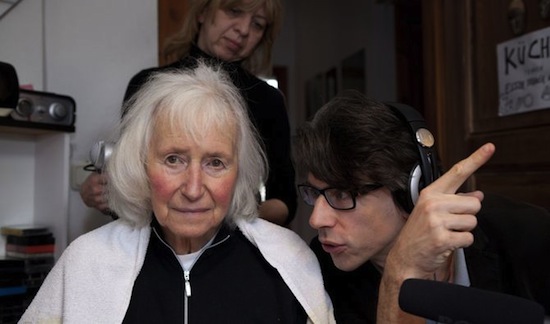
    By the time David started filming this documentary his mother, Gretel, had forgotten him.  The pain David feels from this is made visually symbolic during the credits when “Mein” (Me) fades from title slower than rest of the words.  Now that he has only a frail connection with his mother, David is determined to learn as much as he can about her life before she passes away.

    David admits he knows very little about his mother’s past.  For instance, he finds out from his father, Malte, that his parents had an open marriage and Gretel was politically active in radical socialist causes in her youth.  Though their marriage was very atypical, now that Gretel is helpless they have taken on more traditional roles.  Though Malte, who was a renowned math professor, wanted to study and travel after retiring, he is now a full-time caretaker.



    Watching Gretel is heartbreaking as she alternates between childlike confusion to bewildered fear at her surroundings.  Gretel has also deteriorated physically.  Though only seventy-three, Gretel resembles a woman decades older (especially when compared to Malte’s ninety-six year old mother, who appears late in the film).  She becomes increasingly stubborn, and though David’s arrival to begin the documentary allows Malte to take a brief vacation to Switzerland it seems to do no favors for Gretel’s condition.

    There is very little that is “artistic” in this documentary – this is an honest, fly-on-the-wall, straight-forward chronicle of how Gretel’s worsening condition affects David and his family.  Toward the end of the film the family weighs the decision on whether or not to put Gretel into a home for Alzheimer’s patients, and Malte feels conflicted about his responsibility for Gretel’s condition for not being as good of a husband to her as he could have.  One of the more curious choices is the vaguely child-like musical score, which I feel somewhat belittles Gretel’s condition.



    Vergiss mein nicht is a very personal story, but also universal to the millions of people who have someone suffering from the same disease as Gretel in their own family.  Though the ending is surprisingly upbeat, being that this film is about a woman with Alzheimer’s there is naturally no happy ending.  This is not a film that anyone would consider enjoyable or entertaining, but as a chronicle of a woman’s failing dementia and the effect it has on her family; it is definitely moving.

    RATING: 3 / 5 See it … It’s Good

    Read more


  • REVIEW: KALIFORNIA

    by Kelsey Straight

    Laura Mahlberg’s illustration of an old man who starts walking towards California from his caravan entire countries away (in Russia!) is a new take on the classic road movie, except here our protagonist is fifty years past coming-of-age and still in pursuit of better prospects in the west. One could say that the film has come a few decades after its genre’s peak, and the main character coincides with that reality. Visually stunning cinematography offers an array of sensations to the film, and despite a slow-going pace and essentially meek protagonist, audiences will revel in the look and the stories in the eyes of this character, a man full from his years and still searching for more.

    The landscapes evoke in audiences the magic of the countryside when seen in widescreen formats, and the protagonist’s trek through fields of green – full of sheep and ideas for the future – offers a lot to cinema, especially coming from such a niche project. If one’s grandfather confessed that he was going to walk across the entire world in search of California, he’d probably be admitted to an old folk’s home, but Mahlberg’s film sets this man free from his age and into an old world made new again. Change clicks on and off inside of him and proves that coming-of-age is a process that occurs over and over again throughout our lives. We’re never too old to dial a friend across the world and confess to needing something new before everything feels done forever and for always.

    Rating 3 / 5 : See it …..  It’s Good

    http://youtu.be/h4s-sJBRVDA

    Read more


  • REVIEW: Silvi (Maybe Love)


    by Christopher McKittrick

    During a routine, 47 year-old Silvia (Lina Wendel) is told by her husband that he is moving out. Silvia knew their passionless marriage was essentially over anyway, but it still comes as a shock.  With little to call her own and never being with anyone besides her husband, Silvia begins her search for love, because, as she tells someone else, “Actually, everyone wants someone to hold…someone who loves and comforts you. If that’s not happening… something inside withers away. You become a lone warrior.”

    However, each one of Silvia’s subsequent relationships goes awry, even when she opens herself up to new experiences.  These relationships are bridged with scenes in which she is speaking with someone whose identity isn’t made exactly clear, but they almost seem like therapy sessions.  What she can’t find is a normal relationship.  She tries personal ads, but her date with her first caller goes downhill pretty quickly although they overcome their awkward introduction.  Each relationship she gets in seems to hold great potential, but they all fade for various reasons.  She also has to come to terms with the truth that she has been treated unfairly by her husband during their whole life together.


    Silvi explores the trouble faced by a middle-aged woman just out of a lengthy, loveless marriage trying to find true love. I suppose this is sort of a dramatic German version How Stella Got Her Groove Back, meaning I may be the wrong audience for this.  Still, Silvia’s difficulties and deep sadness is affecting, as is the fact that she never gives up.


    There were certainly some confusing moments – Silvia’s son is briefly introduced in the film, makes out with his girlfriend, and then disappears from the narrative.  I guess this was supposed to be a contrast with Silvia’s love life (or lack thereof), but her sadness is clear from Wendel’s emotive acting.  The “talking head” sequences could have probably been more effective if it was clear who she was speaking to (Silvia has a close friend in the film, so why not use her?)  Director/co-writer Nico Sommer has a great actress and a universal story – one doesn’t have to be a 47 year-old recently-separated woman to connect with Silvia’s search for love – but I can’t say I found much more to connect with beyond Wendel’s strong performance and her character’s admirable persistence.

    Rating 3 / 5 : See it …..  It’s Good

    Read more


  • REVIEW: Nor’easter

    by Christopher McKittrick 

    Father Erik (David Call) is a young priest on an island off the coast of Maine who is new to the island after the previous priest left under less-than-holy circumstances.  Along with the problem of a dwindled congregation, he is confronted by a family torn apart by the disappearance of their son.  Josh went missing when he was eleven years old and his father, Richard (Richard Berkins) is adamant that his son is still alive, but his long-suffering wife Ellen (Haviland Morris) enlists Erik’s help in convincing Richard to have a funeral for Josh.  After Richard finally agrees to finally “bury” his son, Josh (Liam Aiken), now sixteen, reappears.  When asked where he has been the only response he offers his parents and the police is, “I heard I was dead. I didn’t like that.”  However, he reveals the truth to Erik before disappearing again, and Erik, bound by his vows, is unable to reveal Josh’s whereabouts.  However, Erik will not let that prevent him from returning Josh home again.

    Nor’easter features some remarkable performances.  Call’s Erik plays hockey on the mainland as an escape and joined the priesthood to find answers for problems in his own life, though there are indications that he questions his decision.  Call conveys Erik’s doubt without making Nor’easter overdramatic or melodramatic, and though he has been acting for years it’s clear he is only a lucky role away from a major breakthrough.  On the same level, veteran actor Danny Burstein turns in an extraordinary performance in a role that I don’t want to spoil.  His character is a major part of the film despite his limited screen time, and it was an extraordinarily brave decision on his part to take on the role of such a manipulatively heinous character.  However, a majority of the praise is due to writer/director Andrew Brotzman, who has created a refreshing thriller that pits the sacred rules of the clergy versus the rule of law and the moral obligation to save a boy’s life.  In particular, the staging of the climax is particularly clever.


    However, there were a few bits that confused me.  After being a key character in the beginning of the film, Ellen is hardly present after the funeral.  Likewise Josh’s sister, Abby (Rachel Brosnahan) is a vastly underdeveloped character.  Her relationship to Josh is ambiguous, but again she only seems to exist to move a single scene along.  Instead of complete characters, they seem to be dashed “offstage” as soon as they serve their purpose.  I was also taken aback by the editing.  Nor’easter contains some beautiful scenery of snowy Maine that are rapidly cut, and I’m not sure why the pace was so quick in some parts because this 85 minute film mostly has an otherwise effectively slow pace.  Were these cuts a technical issue?

    Still, Nor’easter is a rookie winner for Brotzman.  Although some might be turned off by the subject matter, there is so much potential here that it’s definitely worth a look.

    RATING: A slow-paced, slow-burning thriller that reveals a lot of fresh talent (4 : See it ……. It’s Very Good / 5).


    Nor’easter Trailer from David Lowery on Vimeo.

    Read more


  • REVIEW: Lotus Eaters

    by Chris McKittrick

    The Lotus Eaters of Homer’s Odyssey spent their days indulging in food that made them ignore all of their wants and needs in order to pursue ultimate leisure. The aptly-titled film Lotus Eaters, directed and co-written by Alexandra McGuinness (Paris Noir), follows the modern equivalent of that mythological race, a group of young London models, actors, and rock stars whose society lives are filled with drug and booze fueled parties, yet all seem to suffer from the first-world problem of being profoundly bored with their lifestyle.

    Lotus Eaters has an ensemble cast, but it primarily focuses on Alice (Antonia Campbell-Hughes), a model-turned-actress (though not a very good actress) who is dating Charlie (musician Johnny Flynn), a drug addict.  They run in the same circle with Felix (Benn Northover), a rock musician whose career is taking off.  In turn, Felix is involved with the manipulative, slightly-older Orna (Cynthia Fortune Ryan), who intertwines her life with Alice’s with unclear motives.  The film explores how this group and their other friends hide behind their lives of sex, drugs, and rock and roll to prevent themselves from having to deal with their actual feelings.


    The film explores the self-destruction caused by luxurious idleness, yet in many ways Lotus Eaters as a whole has just as little substance as its characters.  On one hand, the actors pull off their characters really well, they look great in their stylish clothes, and the gorgeous black and white cinematography lends a timeless quality to the film, which could easily have been set in London in the 60s or 70s (though after a while it seems like you’re watching a 78 minute long Calvin Klein commercial with all these good-looking people).  However, it’s really only mildly amusing watching these superficial characters interact in their drunken and drugged stupors. In that sense, it’s a less clever version of the “young people with access with too much money” theme Whit Stillman did in Metropolitan back in 1990.


    That doesn’t mean audiences aren’t due another film touching on that theme, but Lotus Eaters is simply less interesting than it could be considering how strong these characters are.  The “fly on the wall” storytelling style of Lotus Eaters doesn’t seem to be the best way to explore these personalities, and I believe that McGuinness and co-writer Brendan Grant could have said so much more with these characters.  As a result, the 78 minutes tend to drag because there isn’t much story to push the audience along, and that’s a bad sign for such a short film.

    RATING: Though Lotus Eaters makes beautiful people doing nothing interesting, there is probably a lot more that could have been done with these characters (4/10).

    Lotus Eaters opens in New York on April 5th and Los Angeles on April 12th. It will also be available on VOD on April 12th.

    http://youtu.be/rACt1o5Uzmk

    Read more


  • Interior. Leather Bar.

    Click here for MORE FILM DETAILS

    Read more


  • Big Words

    Click here for MORE FILM DETAILS

    Read more


  • Beasts of the Southern Wild


    Click here for MORE FILM DETAILS

    Read more


  • Red Flag

    Click here for FILM DETAILS

    Read more


  • The Jeffrey Dahmer Files

    Click here for FILM DETAILS

    Read more


  • REVIEW: The Sapphires

    by Lauren McBride

    As an African-American woman, I have seen my fair share of films about the Civil Rights Movement. The America of the 1960s, torn apart by racism, sexism and a violent war, is well documented in film. The names, faces and perspectives that populate these films are rarely unique, but always poignant. It’s a history that America, white and black, constantly re-lives — perhaps in an effort to come to terms with its horrors or to prematurely congratulate ourselves on how far we’ve come. Either way, it’s rare to see a film that frames the Civil Rights Movement in a global perspective — that reminds its viewers that the message of the movement’s leaders reached far beyond the molehills of Mississippi and the slopes of California. For some, it reached all the way to shores of Melbourne, Australia.

    The Sapphires tells the true story of three Aboriginal sisters and their fairer-skinned cousin who venture to Vietnam in 1968 to perform soul music for African-American troops. The film was powerful and dramatic at times, and hilarious and exciting at others. It brilliantly bears the weight of its place in history. Watching The Sapphires and seeing a similar struggle happen thousands of miles away at the very same moment makes it difficult to divorce the two histories: the struggle of African-Americans in the US, and that of Aborigines in Australia. As the film plays out it’s clear that the blending of histories and depiction of a shared experience is precisely what Wayne Blair intends. In some ways, it’s where the film succeeds the most.

    It also shines is in the development of its characters and the performance of its stars. Gail (Deborah Mailman), Cynthia (Miranda Tapsell), Julie (Jessica Mauboy) and Kay (Shari Sebbens) master the sisterly dynamic — with its complex mix of love, jealousy, and a deep sense of responsibility. Chris O’Dowd’s Dave is completely flawless. O’Dowd, known to American audiences from his turns in Bridesmaids and a 5-episode arc in HBO’s Girls, is both hilariously tragic and totally transfixing.

    While The Sapphires does have its occasional trite moments, it remains a must-see. Audiences will walk away with the songs of Marvin Gaye and James Brown swimming in their heads, and the words of Dr. Martin Luther King echoing in their hearts.

    http://www.youtube.com/watch?v=ywAGVfuFzxA

    Read more


  • REVIEW: Somebody Up There Likes Me

    somebody up there likes me

    by Lauren McBride

    Bob Byington’s Somebody Up There Likes Me covers about 20 years in the life of Max Youngman (Keith Poulson). Through marriages, divorces, the loss of parents and birth of children, Max doesn’t seem to mature — physically or mentally. He is eternally in his late-twenties, gawky, awkward and much like the film itself, meandering without a destination.

    We meet Max peering into a mysterious blue suitcase and driving toward the end of his first marriage. Wives and mistresses come and go; even his best friend Sal (Nick Offerman) matures and greys. But Max and his suitcase go on. The suitcase, which contains far more than the music and floating animations the audience sees each time it is opened, is the only constant thing in Max’s life. Its origins are unknown, as is its meaning to Max. He keeps it stuffed in trunks and closets, but it is undoubtedly magical — perhaps the secret to his eternal youth.

    Max’s suitcase and its mysterious contents bring an air of whimsy to the film. The film’s bright colors and intermittent animations sharply contrast its characters’ darkness. Their selfishness and meanness seems absurd in the pretty world that Byington creates. That the story unfolds in a nameless American town makes it even more fantastical. Less film than fable.

    The film has winning moments, often thanks to Offerman’s comedic timing and Jess Weixler’s masterful ability to be adorably awkward. As a whole, however, it lacks meaning and direction. And for such a brief film (with a runtime of only 76 minutes), it feels tedious and unending. Of course this could be intentional; Byington’s attempt to mirror that experience we all have in common: life.

    http://youtu.be/BCsMykvQG3A

    Read more


←Previous Page
1 … 4 5 6 7 8 … 10
Next Page→

Film News

Animation | Anime

Documentary

Foreign Language Films

Independent Film

SciFi + Horror

Short Films

Thriller

More Film News

Awards

Film Reviews

Trailers

Interviews

People

Film Release Calendar

Film Festivals

Film Festivals News

Film Festivals (List)

Film Festivals Calendar

Company

Home

About Us

Privacy Policy

Terms Of Use

Contact Us

Internship Program

Cookie Policy (EU)

Opt-out preferences

  • Bluesky
  • YouTube
  • Instagram
  • Facebook
  • Pinterest
  • LinkedIn
  • Threads
  • X

Copyright © 2026 — VIMooZ LLC | Designed by TTHINKS

Manage Cookie Consent
To provide the best experiences, we use technologies like cookies to store and/or access device information. Consenting to these technologies will allow us to process data such as browsing behavior or unique IDs on this site. Not consenting or withdrawing consent, may adversely affect certain features and functions.
Functional Always active
The technical storage or access is strictly necessary for the legitimate purpose of enabling the use of a specific service explicitly requested by the subscriber or user, or for the sole purpose of carrying out the transmission of a communication over an electronic communications network.
Preferences
The technical storage or access is necessary for the legitimate purpose of storing preferences that are not requested by the subscriber or user.
Statistics
The technical storage or access that is used exclusively for statistical purposes. The technical storage or access that is used exclusively for anonymous statistical purposes. Without a subpoena, voluntary compliance on the part of your Internet Service Provider, or additional records from a third party, information stored or retrieved for this purpose alone cannot usually be used to identify you.
Marketing
The technical storage or access is required to create user profiles to send advertising, or to track the user on a website or across several websites for similar marketing purposes.
  • Manage options
  • Manage services
  • Manage {vendor_count} vendors
  • Read more about these purposes
View preferences
  • {title}
  • {title}
  • {title}