[caption id="attachment_31380" align="aligncenter" width="1200"]

Diamantino[/caption]
The Film Society of Lincoln Center announced the complete lineup for the Projections section of the 56th New York Film Festival – comprised of seven features, seven shorts programs, and two short works.
Drawing on a broad range of innovative modes and techniques, including experimental narratives, avant-garde poetics, crossovers into documentary realms, and contemporary art practices, Projections brings together a diverse offering of short, medium, and feature-length work by some of today’s most essential and groundbreaking filmmakers and artists.
Among the highlights are Gabriel Abrantes and Daniel Schmidt’s
Diamantino, Projections Opening Night film and winner of the top prize at Cannes Critics Week this year; the North American premiere of Roi Soleil by Albert Serra (The Death of Louis XIV, NYFF54); and the fifth NYFF appearance from Tsai Ming-liang, who returns for the first time since 2013 with Your Face. The lineup also features the NYFF debuts of several Film Society of Lincoln Center alumni: Laura Huertas Millán (The Labyrinth), whose work was previously shown in Art of the Real and Neighboring Scenes; Akosua Adoma Owusu (Mahogany Too), whose short films have played both the New York African Film Festival and New Directors/New Films; Mariana Caló & Francisco Queimadela (Luminous Shadow), who screened as part of Art of the Real in 2016; and Ted Fendt (Classical Period) and Helena Wittmann (Ada Kaleh), both alum of New Directors/New Films.
Two films in Projections will be shown on 35mm, including James Benning’s 1977 debut feature 11×14, in a new restoration by the Austrian Film Museum, and eight will be exhibited on 16mm celluloid, including a rare screening of Ericka Beckman’s short films Cinderella and You The Better, restored by the Academy Film Archive.
A number of contemporary artists are featured in Projections, including new work from Jeremy Shaw, whose Quantification Trilogy imagines a dystopian social order; Ben Thorp Brown, studying Walter Gropius’s shoe warehouse in Gropius Memory Palace; Lawrence Abu Hamdan, whose Walled, Unwalled is staged within two soundproof booths; Beatrice Gibson, intimately reframing the current political climate in I Hope I’m Loud When I’m Dead; Andrew Norman Wilson, whose Kodak imagines a dialogue between George Eastman and a blind former film technician; James Richards, collaborating for the second time with Steve Reinke for their mid-length film What Weakens the Flesh Is the Flesh Itself; and Dora Garcia, making her feature film debut with Second Time Around, which shared the grand prize at FIDMarseille with Roi Soleil. Projections also showcases returning filmmakers Laida Lertxundi (Words, Planets), Ben Rivers (Trees Down Here), Janie Geiser (Valeria Street), Sylvia Schedelbauer (Wishing Well), Sky Hopinka (Fainting Spells), Mary Helena Clark (The Glass Note), and Jodie Mack, making her fifth Projections appearance with her debut feature The Grand Bizarre.
56th New York Film Festival Projections Lineup
FEATURES
Opening Night
Diamantino by Daniel Schmidt and Gabriel Abrantes
U.S. Premiere, Portugal/France/Brazil, 2018, 92m
When he misses the big goal on the world’s largest stage, chiseled fútbol star Diamantino (Carloto Cotta) flees the public eye; no longer able to conjure the giant fluffy puppies that guided him to superstardom, he is rendered a vessel without a purpose. And thus begins an unexpected journey toward love and enlightenment that involves cloning, the CIA, a Syrian refugee, and Diamantino’s nefarious twin sisters. A perversely pleasurable sendup of Brexit, genetic science, and the ongoing refugee crises, this dazzlingly original feature from longtime collaborators Daniel Schmidt and Gabriel Abrantes skewers its subjects with loving cinematic gusto. Walter Reade Theater, 165 W. 65th St.
11 x 14 by James Benning
USA, 1977, 35mm, 82m
James Benning’s first feature-length film announced the arrival of a radical new voice in the evolution of moving image art, and remains a landmark of the American avant-garde. Composed of 65 beautifully framed shots of provincial life and suburban domesticity, this 16mm-shot travelogue of the Midwestern United States advanced notions of structuralist cinema while forming a visual tapestry of the American heartland in all its rugged glory. Restored by the Austrian Film Museum in collaboration with Arsenal – Institute for Film and Video Art.
Classical Period by Ted Fendt
North American Premiere, USA, 2018, 16mm, 62m
A group of young intellectuals partake in playful rounds of academic sparring in Fendt’s second feature, an über-cinephilic treatise on language, literature, and theology. Between Dante discussion groups and solitary linguistic exercises, Cal (Calvin Engime) engages his friends in a series of discursive debates that, while reaching far and wide across history, eventually correlate to more interpersonal concerns. Shot on rough-hewn 16mm with a formal rigor to match its characters’ studied personas, Fendt’s encyclopedic take on cinema stimulates the mind as much as it does the senses.
The Grand Bizarre by Jodie Mack
U.S. Premiere, USA, 2018, 16mm, 61m
A film of boundless energy and ingenuity, the first feature by American animator Jodie Mack is a color-coordinated, rhythmically tuned fantasia for the senses. Filmed over five years and in as many countries, this all-analog travelogue finds thousands of textiles and printed designs dancing across locations from Mexico to Morocco to India. With handmade charm and a topical touch, Mack traces the industrial cogs of fabric production and consumption that make our material world turn. A motion picture in the truest sense.
Roi Soleil by Albert Serra
North American Premiere, Spain/Portugal, 2018, 62m
Catalan director Albert Serra’s follow-up to his magisterial The Death of Louis XIV (NYFF54) is another forensic documentation of the Sun King’s final breaths. Here, however, Versailles is replaced with the glow of the gallery. Featuring Lluís Serrat (Sancho from Serra’s Honor of the Knights) in a filmed performance of a 2017 installation, Roi Soleil boldly crossbreeds performance art and observational cinema. As we watch the King writhe and moan—sometimes painfully, sometimes humorously—in mortal agony, his prone body bathed in bloodred fluorescents, the spectator’s role is increasingly called into question, implicating the viewer in the public consumption of this very private experience.
Second Time Around / Segunda Vez by Dora García
North American Premiere, Belgium/Norway, 2018, 94m
Spanish contemporary artist Dora García’s first feature explores the intersection of politics, psychoanalysis, and performance as developed through various texts and artistic stagings of the 1960s and ’70s. Through evocative reconstructions of Argentinian theorist Oscar Masotta’s storied “happenings,” and lightly dramatized vignettes based on contemporaneous writings by Macedonio Fernández and Julio Cortázar (whose story “Segunda Vez” lends the film its title), García nimbly interweaves narrative and nonfiction devices to arrive at something wholly distinct from either––cinema as historical intervention.
Your Face by Tsai Ming-liang
North American Premiere, Taiwan, 2018, 76m
Radically rethinking the tired talking-heads template, Tsai Ming-liang’s latest digital experiment turns the human face into a subject of dramatic intrigue. Comprised of a series of portrait shots of mostly anonymous individuals (Tsai devotees will no doubt recognize his long-time muse, Lee Kang-sheng), the film shrewdly deemphasizes language while reducing context to a bare minimum. In their place, the beauty and imperfections of each face take center stage. Accompanied by Ryuichi Sakamoto’s soundtrack of dynamically modulating drone frequencies, Tsai’s subjects variously speak, stare, and, at one point, sleep as the camera quietly registers the weight of personal history and accumulated experience writ beautifully across every last pore and crevasse.
SHORTS
Ericka Beckman Program
Cinderella, USA, 1986, 16mm, 27m
You The Better, USA, 1983, 16mm, 31m
TRT: 58m
Incorporating elements of theater, dance, and performative fantasy, the films of Ericka Beckman are unique documents of the conjoined trajectory of Pop Art and the American avant-garde. Whimsically examining issues of self-image, gender, and female sexuality, Beckman’s surrealist odysseys employ universal narrative threads as allegorical building blocks for ambitiously staged productions that variously utilize optical printing, in-camera editing, and early 3D mapping technology. Following a number of Super 8 shorts made while studying at CalArts, Beckman moved to 16mm for the proto-interactive gameplay adventure You The Better (1983) and a musical reimagining of Cinderella (1986), pocket epics that speak to her infectious creativity. Restored by the Academy Film Archive and BB Optics.
Quantification Trilogy by Jeremy Shaw
Quickeners, Germany, 2014, 37m
Liminals, Germany, 2017, 31m
I Can See Forever, Germany, 2018, 43m
U.S. Premiere, TRT: 111m
Under the guise of nonfiction, Shaw’s vérité-style trilogy imagines a dystopian—and increasingly familiar—social order in which marginalized societies strive against extinction. Through transcendental experiments and cathartic rituals, these future humans seek feelings of desire and faith that have been expunged from the species’ capacities. The medium-length Quickeners (2014), Liminals (2017), and his latest, I Can See Forever (2018), redefine the bounds of archival cinema, conveying sci-fi narratives through various retro-analogue formats and clinical voiceover narration.
Program 1: Place Revisited
A Return by James Edmonds
Germany, 2018, 16mm, 6m
James Edmonds’s intricately constructed 16mm montage film brings two disparate settings—Berlin and a village in the South of England—into the same cinematic headspace. Locating likenesses between soft light and overcast coasts, the comfort of sun-dappled interiors and the warmth of a tree-lined field, Edmonds both summons natural juxtapositions and creates unexpected harmony through deft superimpositions.
Valeria Street by Janie Geiser
North American Premiere, USA, 2018, 11m
Initiated by an unearthed photograph of her father and his colleagues around a conference table in a generic mid-century office, Geiser’s evocative collage film charts a personal-political path through the recesses of America’s industrial ecosystem. Using animation and re-photography effects, Geiser presents an array of images (geometric diagrams, blueprints, live-action landscape shots) in a prismatic reflection on power structures in the workplace.
Mahogany Too by Akosua Adoma Owusu
USA/Ghana, 2018, 3m
This vibrant, Nollywood-inspired spin on the 1975 Motown-produced movie Mahogany, features actress Esosa E vogueing through the city streets under the sign of Diana Ross’s iconic fashionista Tracy Chambers. Shot on warm 16mm, Akosua Adoma Owusu’s contemporary gloss on a beloved character celebrates her ever-progressive sense of style and self-assurance.
Between Relating and Use by Nazli Dinçel
Argentina/USA, 2018, 16mm, 9m
In this ethical examination of ethnographic art, Dinçel dissects the thin line separating unconscious fantasy from cultural appropriation. Pairing the words of scholars Laura Mark and D.W. Winnicott with sensual 16mm images of the human body in direct contact with the natural environment, the film slowly turns the notion of fetishization into a tool for reflexive thought.
Trees Down Here by Ben Rivers
U.S. Premiere, UK, 2018, 35mm, 14m
Ben Rivers investigates the oak-paneled buildings and birch-lined grounds of Cowan’s Court at Churchill College in this serene architectural study. His rhythmic montage—comprising site plans and construction models, images of animals and architecture—sketches an expansive view of a solitary environment.
Eye of a Needle by Katherin McInnis
World Premiere, USA, 2018, 5m
Archival stills of the Great Depression come shuddering to life in Katherin McInnis’s work of photographic montage. Rapidly alternating, minutely offset images of young farm laborers in the American South create the illusion of movement around a cut-out focal point, matched by a scratch beat built on chasms of negative space.
Wishing Well by Sylvia Schedelbauer
Germany, 2018, 13m
Sylvia Schedelbauer’s previously monochrome world comes bursting forth in full color in this hypnotic trip through the landscape of memory and adolescence, which conjoins original HD imagery and 16mm found footage of an anonymous young boy in the throes of discovery. Through superimpositions and flicker effects, the film traces a simultaneously interior and exterior path across disparate temporalities that nonetheless retains a bracing immediacy.
Program 2: Strategies for Renewal
Key, washer, coin by Alan Segal
World Premiere, Argentina, 2018, 14m
The formal and semantic languages of advertisements are dissected in this investigative essay that breaks the marketing model down to its component parts, highlighting the complex capitalist infrastructure that fuels our economic reality.
Words, Planets by Laida Lertxundi
U.S. Premiere, USA/Spain, 2018, 10m
An ode to motherhood and nature’s cosmic energies, Laida Lertxundi’s enchanting diary film presents disparate scenes gathered from rural locales ranging from Havana to Devil’s Punchbowl. Inspired by the compositional strategies of Chinese painter Shih-t’ao, Lertxundi links her warmly saturated imagery through the words of Lucy Lippard and R.D. Laing and the recurrent skip of an infectious pop song, and in the process offers a gentle reminder of (mother) Earth’s boundless gifts.
Life After Love by Zachary Epcar
North American Premiere, USA, 2018, 8m
In this serene study of lost love and natural light, parked cars in public spaces become sanctuaries for emotional renewal. Paired with reflective voiceover and strangely comforting self-help recordings, Zachary Epcar’s casually inventive images, highlighting sun-baked glass and asphalt surfaces, imbue the mid-afternoon heat with the promise of a better tomorrow.
I Hope I’m Loud When I’m Dead by Beatrice Gibson
U.S. Premiere, UK, 2018, 20m
Reframing our current political moment in intimate terms, Gibson’s urgent snapshot of worldwide social calamities doubles as a document of practical resistance. In Gibson’s hands, the music of Pauline Oliveros and the words of poets CA Conrad and Eileen Myles imbue images of street riots, the Grenfell Fire, and the mass refugee migration with complexity and grace.
The Air of the Earth in Your Lungs by Ross Meckfessel
U.S. Premiere, USA/Japan, 2018, 16mm, 11m
The real and the virtual fold together and apart until space itself is rendered immaterial in this slipstream of digital-modulated environments that brings together landscape photography, video game interfaces, and drone-conducted land surveys in brisk montage.
Program 3: Trips to the Interior
Fainting Spells by Sky Hopinka
World Premiere, USA, 2018, 11m
Sky Hopinka looks to native lore to take up the legend of the Xąwįska, or Indian Pipe Plant, a root used by the Ho-Chunk tribe to revive people who have fainted. Framed as an epistolary correspondence between imagined subjects, the film braids apocalyptic imagery and elegantly scrolling text into a hypnotic consideration of myth and memory.
Chooka by Parastoo Anoushahpour, Faraz Anoushahpour, and Ryan Ferko
U.S. Premiere, Iran/Canada, 2018, 21m
Shot in the Gilan Province of northern Iran, a region that saw the influx of hundreds of North American engineers commissioned to build a paper factory in 1973, Chooka meditates on the lingering effects of the era’s industrial expansion. Guided by the recollections of those whose roots stretch back to before the Revolution, the film creates illuminating connections between archival footage, new images of the factory ruins, and excerpts from a pair of contemporaneous films shot in the same area by Bahram Beyzaie.
Ada Kaleh by Helena Wittmann
U.S. Premiere, Germany, 2018, 14m
This precisely calibrated domestic diorama alights upon the imagined futures of a group of anonymous young adults. In Helena Wittmann’s warmly rendered feat of formalist filmmaking, questions of time and the realities of space convene in languid interior pans, incremental shifts in light, and the private reflections of her subjects.
The Labyrinth / El Laberinto by Laura Huertas Millán
U.S. Premiere, Colombia/France, 2018, 21m
A notorious drug lord leads the viewer on a tour of the bloodstained Colombian jungle and a most curious architectural landmark: an exact replica of the villa from ’80s soap opera Dynasty. Seamlessly intercutting enigmatic clips from the show with original 16mm landscape imagery, this revealing ethnographic study bridges an uncanny pop-historical divide.
Program 4: Form and Function
Mixed Signals by Courtney Stephens
North American Premiere, USA, 2018, 16mm, 8m
Stricken with an undisclosed illness, the narrator of this reflexive work draws evocative parallels between the darkened hulls of an industrial ocean liner and an increasingly disorienting mental state. Courtney Stephens was inspired by the nautical imagery and turbulent inner monologue of Hannah Weiner’s maritime code poems.
Luminous Shadow / Sombra Luminosa by Mariana Caló and Francisco Queimadela
North American Premiere, Portugal, 2018, 22m
A meditation on the human form and its many representations over the centuries, this archaeological essay compiles images of statues, photos, sketches, and news clippings from Portugal’s Jose de Guimarães International Arts Centre. The filmmakers conjure a slipstream of interrelated origin stories via brief bits of narration and tableaux of various animal and mineral elements.
The Glass Note by Mary Helena Clark
U.S. Premiere, USA, 2018, 9m
In this elliptical audiovisual diary, cinema’s extrasensory capacity is given surprising form. Here, what we see (the human throat, Gothic statuary, digitally generated furniture) often contradicts what we hear (birdsong, tightly wound rope, lithophonic stones), but the combined effect speaks to a utopian and universal ideal of filmic language.
Walled, Unwalled by Lawrence Abu Hamdan
U.S. Premiere, Germany, 2018, 21m
Lawrence Abu Hamdan finds in a former GDR state radio station a perfect conduit for his ongoing cinematic interrogation of the political dimensions of sound. Centered on a series of court cases that used auditory or sensory evidence based on information gathered through walls, the film is staged within two soundproof booths, in which a live narrator recites witness testimonies while projected text and images create organic superimpositions. It’s an exploration of the fundamental abstractions of seeing and listening.
Program 5: Persistent Analogues
Kodak by Andrew Norman Wilson
World Premiere, USA, 2018, 29m
A semi-biographical fiction inspired by his father’s work at one of Kodak’s first processing labs, Wilson’s speculative gloss on the evolution of photochemical science entwines multiple perspectives and personas. Co-written by James N. Kienitz Wilkins, Kodak imagines a dialogue between a blind, mentally unstable former film technician and George Eastman himself, recordings of whom play out over a procession of photographs, home video footage, vintage Kodak ads, and animations.
What Weakens the Flesh Is the Flesh Itself by Steve Reinke and James Richards
U.S. Premiere, Wales/Germany/USA/Canada, 2017, 40m
The second collaborative work by Steve Reinke and James Richards begins as an intimate look at the autoerotic photography of Albrecht Becker, an artist imprisoned by the Nazis for homosexual behavior. Soundtracked by a mix of free jazz percussion, acoustic balladry, and droning synth patches, the work blossoms into a meditation on masculinity and the relationship between the human form and its persistent analogues, forever preserved in archives.
AMPHITHEATER
From Its Mouth Came a River of High-End Residential Appliances by Jon Wang
U.S. Premiere, USA, 2018, 13m
Hundreds of feet in the air, a drone approaches a row of skyscrapers along Hong Kong’s affluent southern coast. The target: giant holes in the buildings’ facades kept clear for the passage of mythological dragons. Over three successive trips, an affectless voice offers thoughts on feng shui architecture, ideological resistance, and notions of queer identity.
Gropius Memory Palace by Ben Thorp Brown
North American Premiere, USA, 2017, 20m
Part architectural film, part ASMR exercise, this observational study of Walter Gropius’s famed shoe warehouse, The Fagus Factory, is a meditation in every sense. Opening against soft white light and the soothing sounds of a hypnotherapist’s voice, Ben Thorp Brown’s film transports the audience inside Gropius’s landmark. Droning ambience and languid images of laborers at work foster a psychoanalytic space through which the viewer may deeply consider the nature of memory and its constant negotiation between context and content.
Read more

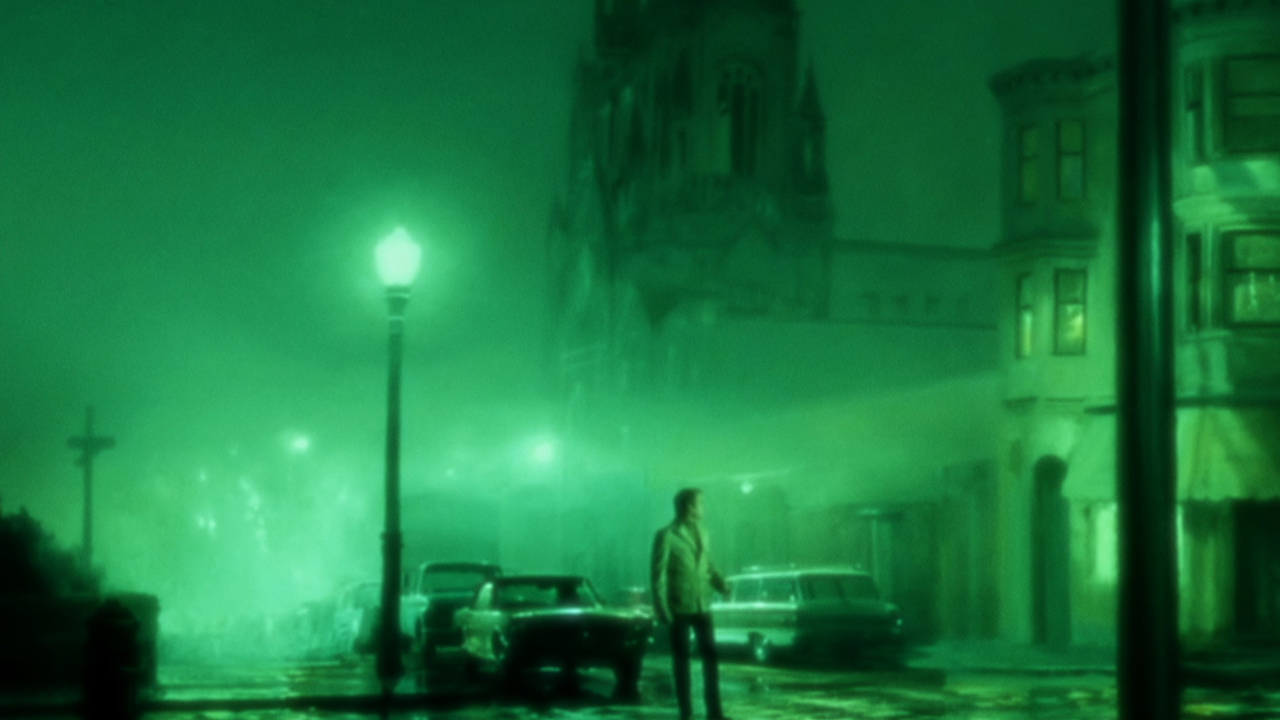 The Green Fog. Regie/directors: Guy Maddin, Evan Johnson, Galen Johnson[/caption]
The Forum program of the 2018 Berlin International Film Festival will feature 44 films, 35 of which world premieres. This year, Arsenal – Institute for Film and Video Art is putting on the Forum as part of the Berlinale for the 48th time.
21 years after his directorial debut The Day a Pig Fell into the Well, Korean director Hong Sangsoo makes a more auspicious return to the Forum. Grass is another cheerfully melancholy story about the guests at a small café whose owner loves classical music. Kim Minhee, who won the Silver Bear for Best Actress in 2017, plays a café regular who always seems to be at the table in the corner writing on her laptop. She repeatedly draws inspiration from what’s happening around her, picking up the threads of the dialogue and spinning them further and sometimes even actively intervening in conversations. Is she perhaps the author of these relationship dramas in miniature, whose stores and themes mirror one another?
French director Claire Simon is equally willing to try out new experiments in her documentary works. In her new film Premières solitudes (Young Solitude), she creates a cinematographic space for open, intimate discussion together with pupils from a school in the Paris suburbs. As they talk together about their backgrounds, parents, first loves, longings and fears for the future, ten ordinary teenagers forge ever closer bonds. It’s good to realise you’re not alone.
For his part, Ukrainian director Sergei Loznitsa is showing a film at the Berlinale for the very first time. In Den’ Pobedy (Victory Day), he observes the huge crowds that gather each year at the Soviet War Memorial in Berlin-Treptow on May 9th and records the hustle and bustle with quiet precision, as different moods come to the fore: pride, contemplation, patriotism, curiosity, the desire for recognition.
Two films from this year’s program draw on video material shot by their directors in periods of political upheaval and imbue it with new significance. At the end of the 1980s, Kristina Konrad collected opinions on the streets of Uruguay in relation to a referendum to be held on a law granting impunity to those responsible for the military dictatorship. Unas preguntas (One or Two Questions) takes a magnifying glass to the democratic process.
Around the same time, the scandal surrounding the Nazi past of former UN General Secretary and Austrian president Kurt Waldheim was making headlines worldwide. Edited together entirely from archive footage, Ruth Beckermann’s Waldheims Walzer (The Waldheim Waltz) is a documentary essay of frightening topicality.
Julien Faraut also works with material largely shot in the 80s in L’empire de la perfection (In the Realm of Perfection). Back then, tennis-obsessed director Gil de Kermadec attempted to use film as means of analysing the game. His meticulously shot footage of John McEnroe matches during the French Open forms the starting point for an ironic look at the parallels between film and the sporting world: cinema lies, sport does not.
Corneliu Porumboiu’s Fotbal Infinit (Infinite Football) takes an equally peculiar look at the world of sport, this time in provincial Romania, following a local official’s attempts to bequeath the world an improved version of the beautiful game. But does everything here really just revolve around football?
Two features from the US shine a light on intellectual escapism. Ted Fendt’s second feature Classical Period is once again shot in Philadelphia on 16mm and tells a drolly melancholy story about intellectualism and loneliness. The members of a reading group exchange cultural and literary references with such vigour that there’s little room for anything else: an attempt to leave the modern world behind or merely their own solitary existences?
Ricky D’Ambrose’s debut Notes On an Appearance may be set in Brooklyn, but unfolds in a similar milieu. Before the backdrop of the disquiet spread by the followers of a controversial philosopher, the film uses both real-life documents and smartly falsified writings to tell the story of a young man who one day disappears without warning. An eerie look at modern life with shades of dystopia.
Josephine Decker’s Madeline’s Madeline on the other hand plunges into the analogies of creativity and insanity. The young titular heroine doesn’t like spending time with her mother, played by actress Miranda July, and feels far freer when with her theatre group. But where does the border lie between personality and role?
Two features from Morocco explore gender relations. Jahilya by Hicham Lasri (the title alludes to the pre-Islamic “time of ignorance”) is a furious condemnation of the misogyny of Moroccan society and all its attendant malice.
Narjiss Nejjar’s Apatride (Stateless) gives an account of a historical event from a female perspective, an event that still dictates the relationship between Morocco and Algeria to this day. Full of beguiling images, her feature shows how a gentle, yet determined woman attempts to prevail over the border between the two countries.
It would be more than appropriate to refer to the electrifying directorial debut An Elephant Sitting Still as a new hope for Chinese cinema. But its 29-year-old director Ho Bu, who had previously made a name for himself with two novels, took his own life soon after the film was completed. This visually stunning work links together the biographies of a range of different protagonists in virtuoso fashion, narrating the course of one single, tension-filled day from dawn until dusk, painting a portrait of a society marked by selfishness in the process.
The Green Fog. Regie/directors: Guy Maddin, Evan Johnson, Galen Johnson[/caption]
The Forum program of the 2018 Berlin International Film Festival will feature 44 films, 35 of which world premieres. This year, Arsenal – Institute for Film and Video Art is putting on the Forum as part of the Berlinale for the 48th time.
21 years after his directorial debut The Day a Pig Fell into the Well, Korean director Hong Sangsoo makes a more auspicious return to the Forum. Grass is another cheerfully melancholy story about the guests at a small café whose owner loves classical music. Kim Minhee, who won the Silver Bear for Best Actress in 2017, plays a café regular who always seems to be at the table in the corner writing on her laptop. She repeatedly draws inspiration from what’s happening around her, picking up the threads of the dialogue and spinning them further and sometimes even actively intervening in conversations. Is she perhaps the author of these relationship dramas in miniature, whose stores and themes mirror one another?
French director Claire Simon is equally willing to try out new experiments in her documentary works. In her new film Premières solitudes (Young Solitude), she creates a cinematographic space for open, intimate discussion together with pupils from a school in the Paris suburbs. As they talk together about their backgrounds, parents, first loves, longings and fears for the future, ten ordinary teenagers forge ever closer bonds. It’s good to realise you’re not alone.
For his part, Ukrainian director Sergei Loznitsa is showing a film at the Berlinale for the very first time. In Den’ Pobedy (Victory Day), he observes the huge crowds that gather each year at the Soviet War Memorial in Berlin-Treptow on May 9th and records the hustle and bustle with quiet precision, as different moods come to the fore: pride, contemplation, patriotism, curiosity, the desire for recognition.
Two films from this year’s program draw on video material shot by their directors in periods of political upheaval and imbue it with new significance. At the end of the 1980s, Kristina Konrad collected opinions on the streets of Uruguay in relation to a referendum to be held on a law granting impunity to those responsible for the military dictatorship. Unas preguntas (One or Two Questions) takes a magnifying glass to the democratic process.
Around the same time, the scandal surrounding the Nazi past of former UN General Secretary and Austrian president Kurt Waldheim was making headlines worldwide. Edited together entirely from archive footage, Ruth Beckermann’s Waldheims Walzer (The Waldheim Waltz) is a documentary essay of frightening topicality.
Julien Faraut also works with material largely shot in the 80s in L’empire de la perfection (In the Realm of Perfection). Back then, tennis-obsessed director Gil de Kermadec attempted to use film as means of analysing the game. His meticulously shot footage of John McEnroe matches during the French Open forms the starting point for an ironic look at the parallels between film and the sporting world: cinema lies, sport does not.
Corneliu Porumboiu’s Fotbal Infinit (Infinite Football) takes an equally peculiar look at the world of sport, this time in provincial Romania, following a local official’s attempts to bequeath the world an improved version of the beautiful game. But does everything here really just revolve around football?
Two features from the US shine a light on intellectual escapism. Ted Fendt’s second feature Classical Period is once again shot in Philadelphia on 16mm and tells a drolly melancholy story about intellectualism and loneliness. The members of a reading group exchange cultural and literary references with such vigour that there’s little room for anything else: an attempt to leave the modern world behind or merely their own solitary existences?
Ricky D’Ambrose’s debut Notes On an Appearance may be set in Brooklyn, but unfolds in a similar milieu. Before the backdrop of the disquiet spread by the followers of a controversial philosopher, the film uses both real-life documents and smartly falsified writings to tell the story of a young man who one day disappears without warning. An eerie look at modern life with shades of dystopia.
Josephine Decker’s Madeline’s Madeline on the other hand plunges into the analogies of creativity and insanity. The young titular heroine doesn’t like spending time with her mother, played by actress Miranda July, and feels far freer when with her theatre group. But where does the border lie between personality and role?
Two features from Morocco explore gender relations. Jahilya by Hicham Lasri (the title alludes to the pre-Islamic “time of ignorance”) is a furious condemnation of the misogyny of Moroccan society and all its attendant malice.
Narjiss Nejjar’s Apatride (Stateless) gives an account of a historical event from a female perspective, an event that still dictates the relationship between Morocco and Algeria to this day. Full of beguiling images, her feature shows how a gentle, yet determined woman attempts to prevail over the border between the two countries.
It would be more than appropriate to refer to the electrifying directorial debut An Elephant Sitting Still as a new hope for Chinese cinema. But its 29-year-old director Ho Bu, who had previously made a name for himself with two novels, took his own life soon after the film was completed. This visually stunning work links together the biographies of a range of different protagonists in virtuoso fashion, narrating the course of one single, tension-filled day from dawn until dusk, painting a portrait of a society marked by selfishness in the process.