
 Touch Me Not by Adina Pintilie[/caption]
It’s awards time at the 68th Berlin International Film Festival, and Touch Me Not by Romanian artist and director, Adina Pintilie, won the top prize, the Golden Bear for Best Film. Touch Me Not follows a filmmaker and her protagonists in a personal research project on intimacy. The film takes us on a journey of discovery through the emotional worlds of Laura, Tómas and Christian, blurring the boundaries between fiction and reality, and providing profoundly insightful insights into their lives.
Touch Me Not by Adina Pintilie[/caption]
It’s awards time at the 68th Berlin International Film Festival, and Touch Me Not by Romanian artist and director, Adina Pintilie, won the top prize, the Golden Bear for Best Film. Touch Me Not follows a filmmaker and her protagonists in a personal research project on intimacy. The film takes us on a journey of discovery through the emotional worlds of Laura, Tómas and Christian, blurring the boundaries between fiction and reality, and providing profoundly insightful insights into their lives.
Everywhere We Are
-
Berlinale 2018 Awards: TOUCH ME NOT Wins Golden Bear | Complete List
[caption id="attachment_27237" align="aligncenter" width="1200"] Touch Me Not by Adina Pintilie[/caption]
It’s awards time at the 68th Berlin International Film Festival, and Touch Me Not by Romanian artist and director, Adina Pintilie, won the top prize, the Golden Bear for Best Film. Touch Me Not follows a filmmaker and her protagonists in a personal research project on intimacy. The film takes us on a journey of discovery through the emotional worlds of Laura, Tómas and Christian, blurring the boundaries between fiction and reality, and providing profoundly insightful insights into their lives.
-
Berlinale 2018: Veronika Kaserer’s “Everywhere We Are” Wins Compass-Perspektive-Award
[caption id="attachment_27229" align="aligncenter" width="1200"]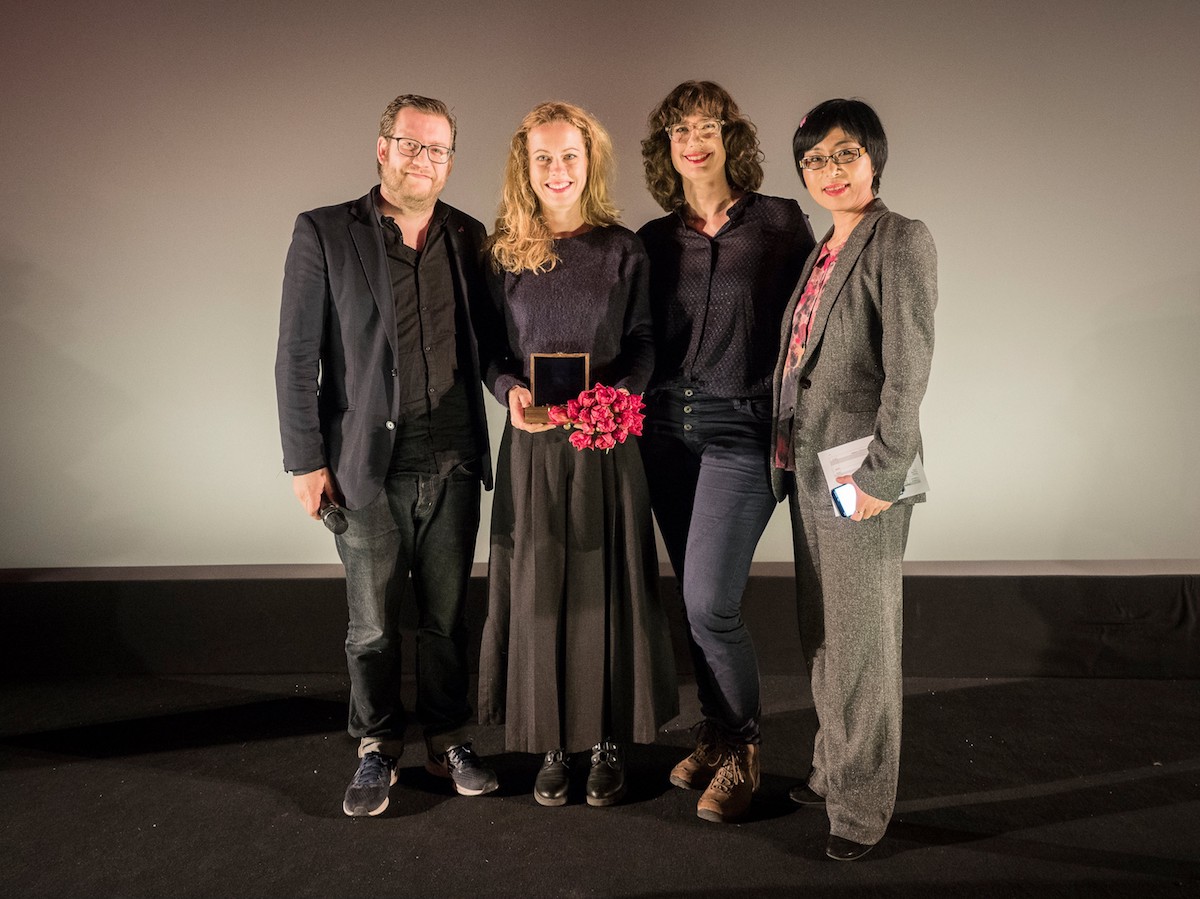 Compass Perspektive Award
Winner Veronika Kaserer and the jury from left to right Sol Bondy, Veronika Kaserer, Jules Herrmann, Sung-Hyung Cho.[/caption] On the closing night of Perspektive Deutsches Kino program of the 2018 Berlin International film festival, the Compass-Perspektive-Award 2018 for the best film was presented to Überall wo wir sind (Everywhere We Are) by Veronika Kaserer. Endowed with 5,000 euro, this year is the second time the prize has been awarded. The filmmaker received a compass as trophy, symbolically it should serve to provide orientation and direction. During the festival, the jury members watched all 14 entries in the competition of the Perspektive Deutsches Kino section and, after deliberating intensively, picked their favourite. As the jury members stated: “The prize goes to a film that divided our jury and sparked heated debates. But we decided to honour precisely this film, rather than settle on a compromise, as we firmly believe that consensus films are not where the future of German cinema lies.” Jury Statement – Überall wo wir sind (Everywhere We Are): Veronika Kaserer has made a film about grief, which at the same reminds us that life is worth living. With an astonishing closeness, unconventional montage, and many surprising moments, she portrays the last weeks and days of Heiko Lekutat, a 29-year-old Berlin dance instructor, and, most notably, his wonderful, big-hearted family. Does the film cause us pain because the family’s sorrow distresses us so, or do we suffer because we feel that the great intimacy to those grieving oversteps a line and in doing so impinges on our own sense of well-being? The editing constantly flashes back and forth between “before” and “after” Heiko’s death. Is it legitimate to disrupt the process of dying in this way in order to arouse, on an abstract level, empathy for the psychological and emotional process of grieving? The fact that a film triggers fierce sentiments and debates is a fine quality. We congratulate director, producer, and camerawoman Veronika Kaserer. Image/credit: © Daniel Seiffert / Berlinale 2018
-
14 Films to Compete in Perspektive Deutsches Kino 2018 at Berlin International Film Festival
[caption id="attachment_26432" align="aligncenter" width="1200"] Whatever Happens Next[/caption]
14 films, including six full-length fiction and four documentary films, will compete for the Kompass-Perspektive-Preis, endowed with 5,000 euros, at the 2018 Berlin International Film Festival. In addition, a neighborhood film project that focuses on Rosa-Luxemburg-Platz in Berlin will be a guest at Perspektive Deutsches Kino 2018.
Sure, you can always take off. Soon. Right now. Or later. You could just be gone, just steal away from a fully furnished life. But then what happens? Everyone has thought about it but very few actually do it: leave their intended path. It’s risky, it’s exciting, it’s brave and whimsical. Paul Zeise (Sebastian Rudolph) goes for it in the debut film Whatever Happens Next (produced by The StoryBay, Salzwedel) by director Julian Pörksen. Paul travels across the country crashing funerals and parties, moves in with off-the-wall Nele (Lilith Stangenberg) for a while, and generally floats around in the wonderland we call life. A short film by director Julian Pörksen was presented at Perspektive Deutsches Kino in 2012. Whatever Happens Next is his first feature-length fiction work.
Director Susan Gordanshekan is also returning to Perspektive Deutsches Kino with her debut feature Die defekte Katze (A Dysfunctional Cat, produced by Glory Film, Munich). The film tells the story of an Iranian couple who only begin to get to know each other after entering traditional marriage, and then fall short of success when faced with the challenges of life together in Germany. The story is about liberating oneself from different lifestyle ideals and giving love a second chance.
The debut film Verlorene (Lost Ones, produced by VIAFILM, Munich) by Felix Hassenfratz takes us deep into provincial Baden, where everyone knows everybody and the siblings Maria (Maria Dragus) and Hannah (Anna Bachmann) live alone with their father (Clemens Schick) following the death of their mother. Director Felix Hassenfratz is well acquainted with the environment and tells a small town story where fear of the unknown is just as strong as a yearning for it.
The horror/love story Luz is the graduation film by director Tilman Singer and production designer Dario Méndez Acosta from the Academy of Media Arts Cologne. Luz, a young taxi driver from Latin America, stumbles into a police headquarters with the last of her strength. She’s being pursued by a demon, who is determined to finally be close to his beloved. Tilman Singer describes the work as an erotic 16mm thriller that plays with audience perception.
Three more documentary films have also been selected for the Perspektive program. In The Best Thing You Can Do With Your Life (produced by Zita Erffa, Petruvski Films, in Tegernsee, with co-production by the HFF Munich), director Zita Erffa asks her brother László about his motivation for entering a Legion of Christ monastery. Eight years after his departure, she can finally visit him and ask why he left her alone in her family. For both, the camera functions as a catalyst to find harmony. The political documentary Impreza – Das Fest (Impreza – The Celebration, produced by DREIFILM, Munich) also takes a highly personal approach. Her aunt’s 50th wedding anniversary is an opportunity for director Alexandra Wesolowski to visit her family in Poland. But instead of being about the party, the conversations she documents soon focus completely on politics. In Überall wo wir sind (Everywhere We Are, produced by Veronika Kaserer) director Veronika Kaserer follows a family after the death of one of its members – the parents who lost a son and a sister who lost a brother. In the organisation of daily activities and the narratives of the protagonists, battling or grieving, we see the “pact with death” become a “pact with life”.
The 22-minute fiction film Kein sicherer Ort (No Safe Place, produced by Filmmagnet, Munich, with co-production by the HFF Munich) by director Antje Beine supplements the mostly mid-length program with one more young protagonist. Through the eyes of 10-year-old Marie (Lucia Stickel), we see what it means when you’re not allowed to be a child in the place you call home.
The series Film Wanderungen (Film Walks) completes the Perspektive Deutsches Kino program. The project was invited to Perspektive 2018 as a guest. What does “neighborhood” mean? And what is “home”? In the summer of 2017, 140 residents of the Rosa-Luxemburg-Platz area in the Mitte district of Berlin were interviewed. On the second Berlinale weekend, audiences are invited to take a trip through the living rooms of those residents to watch films together, and engage in conversation.
On Berlinale Publikumstag, February 25, 2018, Perspektive Deutsches Kino will present the winning work in the fiction film competition “Max-Ophüls-Preis 2018”, and the winner of the documentary film competition First Steps Award 2017 (Ohne diese Welt, directed by Nora Fingscheidt).
Whatever Happens Next[/caption]
14 films, including six full-length fiction and four documentary films, will compete for the Kompass-Perspektive-Preis, endowed with 5,000 euros, at the 2018 Berlin International Film Festival. In addition, a neighborhood film project that focuses on Rosa-Luxemburg-Platz in Berlin will be a guest at Perspektive Deutsches Kino 2018.
Sure, you can always take off. Soon. Right now. Or later. You could just be gone, just steal away from a fully furnished life. But then what happens? Everyone has thought about it but very few actually do it: leave their intended path. It’s risky, it’s exciting, it’s brave and whimsical. Paul Zeise (Sebastian Rudolph) goes for it in the debut film Whatever Happens Next (produced by The StoryBay, Salzwedel) by director Julian Pörksen. Paul travels across the country crashing funerals and parties, moves in with off-the-wall Nele (Lilith Stangenberg) for a while, and generally floats around in the wonderland we call life. A short film by director Julian Pörksen was presented at Perspektive Deutsches Kino in 2012. Whatever Happens Next is his first feature-length fiction work.
Director Susan Gordanshekan is also returning to Perspektive Deutsches Kino with her debut feature Die defekte Katze (A Dysfunctional Cat, produced by Glory Film, Munich). The film tells the story of an Iranian couple who only begin to get to know each other after entering traditional marriage, and then fall short of success when faced with the challenges of life together in Germany. The story is about liberating oneself from different lifestyle ideals and giving love a second chance.
The debut film Verlorene (Lost Ones, produced by VIAFILM, Munich) by Felix Hassenfratz takes us deep into provincial Baden, where everyone knows everybody and the siblings Maria (Maria Dragus) and Hannah (Anna Bachmann) live alone with their father (Clemens Schick) following the death of their mother. Director Felix Hassenfratz is well acquainted with the environment and tells a small town story where fear of the unknown is just as strong as a yearning for it.
The horror/love story Luz is the graduation film by director Tilman Singer and production designer Dario Méndez Acosta from the Academy of Media Arts Cologne. Luz, a young taxi driver from Latin America, stumbles into a police headquarters with the last of her strength. She’s being pursued by a demon, who is determined to finally be close to his beloved. Tilman Singer describes the work as an erotic 16mm thriller that plays with audience perception.
Three more documentary films have also been selected for the Perspektive program. In The Best Thing You Can Do With Your Life (produced by Zita Erffa, Petruvski Films, in Tegernsee, with co-production by the HFF Munich), director Zita Erffa asks her brother László about his motivation for entering a Legion of Christ monastery. Eight years after his departure, she can finally visit him and ask why he left her alone in her family. For both, the camera functions as a catalyst to find harmony. The political documentary Impreza – Das Fest (Impreza – The Celebration, produced by DREIFILM, Munich) also takes a highly personal approach. Her aunt’s 50th wedding anniversary is an opportunity for director Alexandra Wesolowski to visit her family in Poland. But instead of being about the party, the conversations she documents soon focus completely on politics. In Überall wo wir sind (Everywhere We Are, produced by Veronika Kaserer) director Veronika Kaserer follows a family after the death of one of its members – the parents who lost a son and a sister who lost a brother. In the organisation of daily activities and the narratives of the protagonists, battling or grieving, we see the “pact with death” become a “pact with life”.
The 22-minute fiction film Kein sicherer Ort (No Safe Place, produced by Filmmagnet, Munich, with co-production by the HFF Munich) by director Antje Beine supplements the mostly mid-length program with one more young protagonist. Through the eyes of 10-year-old Marie (Lucia Stickel), we see what it means when you’re not allowed to be a child in the place you call home.
The series Film Wanderungen (Film Walks) completes the Perspektive Deutsches Kino program. The project was invited to Perspektive 2018 as a guest. What does “neighborhood” mean? And what is “home”? In the summer of 2017, 140 residents of the Rosa-Luxemburg-Platz area in the Mitte district of Berlin were interviewed. On the second Berlinale weekend, audiences are invited to take a trip through the living rooms of those residents to watch films together, and engage in conversation.
On Berlinale Publikumstag, February 25, 2018, Perspektive Deutsches Kino will present the winning work in the fiction film competition “Max-Ophüls-Preis 2018”, and the winner of the documentary film competition First Steps Award 2017 (Ohne diese Welt, directed by Nora Fingscheidt).
The Best Thing You Can Do With Your Life By Zita Erffa Documentary World premiere
Die defekte Katze (A Dysfunctional Cat) By Susann Gordanshekan With Pegah Ferydoni, Hadi Khanjanpour, Henrike von Kuick, Constantin von Jascheroff, Arash Marandi Feature film World premiere
Impreza – Das Fest (Impreza – The Celebration) By Alexandra Wesolowski Documentary German premiere
Kein sicherer Ort (No Safe Place) By Antje Beine With Lucia Stickel, Kristina Pauls, Robin Sondermann Medium-long feature films World premiere
Luz By Tilman Singer With Luana Velis, Jan Bluthardt, Julia Riedler, Nadja Stübiger, Johannes Benecke Feature film World premiere
Verlorene (Lost Ones) By Felix Hassenfratz With Maria Dragus, Anna Bachmann, Clemens Schick, Enno Trebs, Meira Durand Feature film World premiere
Whatever Happens Next By Julian Pörksen With Sebastian Rudolph, Lilith Stangenberg, Peter René Lüdicke, Christine Hoppe, Eike Weinreich Feature film World premiere
Überall wo wir sind (Everywhere We Are) By Veronika Kaserer Documentary World premiere
Films announced so far:
draußen (outside) By Johanna Sunder-Plassmann, Tama Tobias-Macht Documentary World premiere
Feierabendbier (After-Work Beer) By Ben Brummer With Tilman Strauß, Julia Dietze, Johann Jürgens, Christian Tramitz Feature film World premiere
Kineski zid (Great Wall of China) By Aleksandra Odić With Elena Matić, Tina Keserović, Faketa Salihbegović-Avdagić, Anja Stanić, Mugdim Avdagić Medium-long feature film German premiere
Rå By Sophia Bösch With Sofia Aspholm, Lennart Jähkel, Lars T. Johansson, Ingmar Virta, Ivan Mathias Petersson Medium-long feature film World premiere
Rückenwind von vorn (Away You Go) By Philipp Eichholtz With Victoria Schulz, Aleksandar Radenković, Daniel Zillmann, Angelika Waller Feature film World premiere
Storkow Kalifornia By Kolja Malik With Daniel Roth, Lana Cooper, Franziska Ponitz Medium-long feature film World premiere
Guest Projects:
Film Wanderungen (Film Walks) 27 participants Doc-series
Ohne diese Welt (Without This World) By Nora Fingscheidt Documentary
Award winner “Max-Ophüls-Preis 2018” for Best Feature Film