
 The Film Society of Lincoln Center announced the lineup for the 16th edition of Film Comment magazine’s annual festival, 2016 Film Comment Film Festival taking place February 17 to 24, 2016.
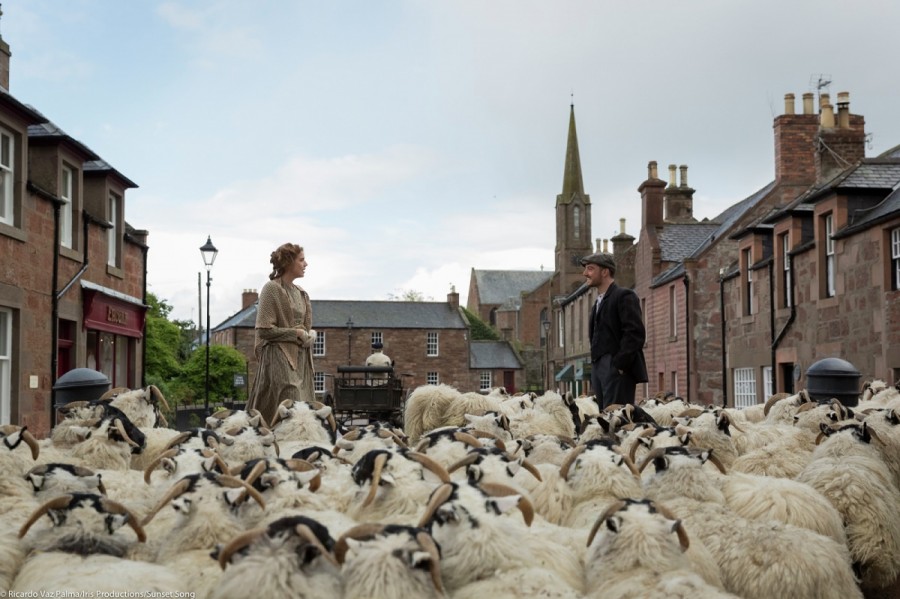
Opening the festival is the New York premiere of Sunset Song (pictured above), the long-awaited must-see from Terence Davies, a glorious study in hardship and romantic loss starring Agyness Deyn and Peter Mullan. Closing night is a tribute to the late Chantal Akerman, with a revival of her rare, utterly delightful musical Golden Eighties.
Among the hard-hitters are a pair of wrenching discoveries from Serbia and Iran, No One’s Child by Vuk Rsumovic and The Paternal House by Kianoush Ayyari; Damien Odoul’s The Fear, a harrowing yet serene vision of World War I; plus the latest work from Benoît Jacquot, Alexei German Jr., and Hirokazu Kore-eda.
A sidebar of restored works by the Polish master Andrzej Żuławski features a selection of new digital restorations of his landmark Polish films, including his debut, The Third Part of the Night; his towering film maudit On the Silver Globe; and the U.S. premiere of his new film, Cosmos.
Revivals featured in the 16th edition also include a two-film spotlight on Charles Bronson, taking its cue from Film Comment’s November/December issue, and a rare glimpse of The Kinks singer-songwriter Ray Davies’s 1984 Return to Waterloo (also featured in the magazine’s November/December issue).
FILMS & DESCRIPTIONS
Opening Night
Sunset Song
Terence Davies, UK/Luxembourg, 2015, DCP, 135m
The much-anticipated new film by contemporary British cinema’s reigning master, Sunset Song is the story of Chris (Agyness Deyn), the bright daughter of a brutish farmer (Peter Mullan in top form) who lives with on the family farm in northern Scotland on the cusp of World War I. When her mother commits suicide, Chris sees her educational prospects and hopes of a teaching career evaporate. She faces a bleak future as her father’s housekeeper, but an unexpected turn of events opens up new possibilities. As a study in hardship and romantic loss, Davies returns to territory with which he is intimately familiar. This adaptation of a 1932 novel by Lewis Grassic Gibbon is a long-standing passion project for the director, and showcases a wondrous central performance by Deyn. As deeply felt as The House of Mirth and The Long Day Closes, Sunset Song is an emotionally devastating film that’s nothing short of sublime. A Magnolia Pictures release.
https://www.youtube.com/watch?v=6X946THCqdQ
Closing Night
Chantal Akerman Tribute:
Golden Eighties
Chantal Akerman, France/Belgium/Switzerland, 1986, 35mm, 96m
French with English subtitles
After her successes in the 1970s, Chantal Akerman turned toward the pleasures of popular cinema with a playful series of comedies and love stories, culminating in this extraordinary multi-character musical, set entirely in a shopping mall. A stylish, bittersweet look at the romantic tribulations of an assortment of shop owners and retail workers, the film evokes The Umbrellas of Cherbourg in its charm, but with a distinctly feminist bent. With songs co-written by Akerman and Marc Herouet, the film leads us through the tangled predicaments of clothing-shop owner Jeanne (Delphine Seyrig), who finds herself torn when her long-lost G.I. love, Eli (filmmaker John Berry), looks her up after 40 years; her son Robert (Nicolas Tronc), who is infatuated with Lili (Fanny Cottençon), a salon manager who in turn is having an affair with its owner, married gangster Monsieur Jean (Jean-François Balmer); hairdresser Mado (pop singer Lio), who has a crush on Robert; and coffee-bar proprietor Sylvie (Myriam Boyer), who pines for her boyfriend who’s gone to work in America. For this utterly delightful passion project, which she described as a postmodern cross between women’s cinema, Jewish literature, and musicals, Akerman collaborated with an extraordinary/unlikely dream team of writers—Desperately Seeking Susan screenwriter Leora Barish, veteran Truffaut/Rivette/Resnais scenarist Jean Gruault, former Cahiers du Cinéma critic Pascal Bonitzer, and filmmaker Henry Bean (The Believer).
Blood of My Blood / Sangue del mio sangue
Marco Bellocchio, Italy/France/Switzerland, 2015, DCP, 107m
Italian with English subtitles
From Italian master Marco Bellocchio, FIPRESCI prizewinner Blood of My Blood pairs two haunting stories from the past and the present, bound together by a convent prison in Bobbio (the director’s hometown and setting of his 1965 debut masterpiece, Fists in the Pocket). During the Inquisition period, Federico (Pier Giorgio Bellocchio) witnesses the harrowing trial of Benedetta (Lidiya Liberman), an alluring nun accused of seducing and driving his brother to suicide. Centuries later, a vampiric old man (Roberto Herlitzka) hides within the convent’s abandoned walls and faces eviction when a tax investigator and Russian millionaire come to purchase the property. Amid painterly lensing and an expressive score, the film is a gothic, shrewdly comic, and, above all, mystifying tapestry that mines the complexities of Italian life—whether in the cloistered darkness of the 17th century or in the confused, garish revelry of the present.
https://www.youtube.com/watch?v=kS-RqI3ws_Y
Diary of a Chambermaid / Journal d’une femme de chambre
Benoît Jacquot, France/Belgium, 2015, DCP, 96m
French with English subtitles
Léa Sedoux follows in the footsteps of Paulette Goddard and Jeanne Moreau as Célestine, a resentful young Parisian chambermaid who finds herself exiled to a position in the provinces where she immediately chafes against the noxious iron rules and pettiness of her high-handed bourgeois mistress (Clotilde Mollet), must rebuff the groping advances of Monsieur (Hervé Pierre), and reckon with her fascination with the earthy, brooding gardener Joseph (Vincent Lindon). Backtracking past the fetishism and peculiarities of Buñuel’s version to Octave Mirbeau’s original 1900 novel, Benoît Jacquot has one eye on 21st-century France: the sense of social stiflement, Célestine’s humiliating submission to Madame’s onerous terms of employment, Joseph’s virulent anti-Semitism. But he keeps his other on the turn-of-the-century setting, when psychoanalysis, a discipline that he holds dear, burst forth: at all times he strikes a balance between appearances and what lies beneath them, between the sadism of the bourgeois employers and their repression, the social codes and the compulsions they conceal. As class-conscious as ever, Jacquot has found some material he can really sink his teeth into. A Cohen Media Group release. U.S. Premiere
The Fear / La peur
French with English subtitles
Damien Odoul, France, 2015, DCP, 93m
Summer 1914. Imagining the war to be “a great spectacle not to be missed,” 19-year-old Gabriel (Nino Rocher) volunteers for the French Army—more out of curiosity than the mad, virulent nationalism that consumes the populace. Accompanied by his best friend Bertrand (Eliott Margueron) and young poet Théo (Théo Chazal), he arrives at the battlefront within a few days and is soon engulfed in the horrors of trench warfare. Recounting his experiences in a series of voiceover letters to his sweetheart back home, Gabriel maintains a detached and rational view of the ordeal of war, which is complemented by the anarchic rabble-rousing of the sardonic Sergeant Négre (Pierre Martial Gaillard). Meanwhile, offsetting the film’s emphasis on the inner life and dissent of its protagonist, Damien Odoul’s direction, which earned him the 2015 Prix Jean Vigo, supplies a relentlessly physical depiction of the realities of life and death in the killing fields. Based on Gabriel Chevallier’s 1930 autobiographical novel, The Fear moves at a fast clip, replete with painterly landscape shots and images of startling, surreal horror. Never less than gripping, this is not so much a film about combat than a series of dispatches from a war zone, warts and all. A Wild Bunch release. U.S. Premiere
https://www.youtube.com/watch?v=bjtdBjjEEj4
Malgré la nuit / Despite the Night
Philippe Grandrieux, France, 2015, DCP, 154m
French with English subtitles
The director of Sombre, La Vie nouvelle, and Un lac returns with his latest investigation of extreme experience, a darkly erotic psychodrama. English musician Lenz (Kristian Marr) searches for his lover Madeleine, aka Lena (Roxane Mesquida), who has mysteriously disappeared, but tumbles into an amour fou with troubled, self-destructive Héléne (French indie It-Girl Ariane Labed). Grieving the loss of her infant son, Héléne seeks oblivion in the murky subterranean world of a brutal sex ring, followed by Lenz. A stark, elliptical, hauntingly spectral narrative co-written by Grand Central director Rebecca Zlotowski, in which Grandrieux continues his exploration of the body initiated with White Epilepsy in scenes of sensual abandon and raw carnality.
No One’s Child / Nicije dete
Vuk Rsumovic, Serbia/Croatia, 2014, DCP, 95m
Serbian with English subtitles
Vuk Rsumovic’s debut film begins in late-’80s Yugoslavia with the discovery of a feral boy running on all fours in the woods of central Bosnia—abandoned years before to survive or perish, unable to walk or talk. Sent to an orphanage in Belgrade, with the help of a teacher and another boy he slowly acquires the trappings of civilized behavior. But as war breaks out between Serbia and Bosnia, his future suddenly becomes uncertain as he’s assumed to be a Bosnian Muslim. No One’s Child is unabashedly pro the former Yugoslavia—a state that maintained a civil society and took care of its citizens. With its discreet, muscular, no-nonsense style, Rsumovic’s film gives us an update of Truffaut’s The Wild Child for a grim new era. (Olaf Möller, Film Comment, May/June 2014)
https://www.youtube.com/watch?v=4ueugMq1Gxo
Notfilm
Ross Lipman, USA/UK, 2015, DCP, 130m
In 1964, playwright Samuel Beckett, Buster Keaton, cinematographer Boris Kaufman, and director Alan Schneider came together to make a short, dialogue-free work simply titled Film. An investigation of both the cinematic medium and the nature of human consciousness, it premiered at the Venice Film Festival and screened at the 2nd New York Film Festival to mixed critical response. In Beckett’s scenario, Keaton plays “O,” who tries desperately to evade the reality of the maxim esse est percipi (to be is to be seen) but finds his every effort futile. Beckett judged the final result “an interesting failure”—interesting enough for Ross Lipman to devote two-plus hours to this remarkable exploration of the making of a 22-minute film. Featuring audio recordings of Beckett in discussion with Schneider, Kaufman, and producer and Grove Press head Barney Rosset, this fascinating and unprecedented “making-of” also gives us interviews with Rosset and actress and Beckett muse Billie Whitelaw. As Scott Eyman puts it in a soon-to-be-published Film Comment piece: “As we witness Rossett and Whitelaw struggling beneath the oppressive weight of age, the documentary becomes about memory and its fading. In other words, the obliteration that waits for us all—the foundation of Beckett’s art.” A Milestone Films release.
https://www.youtube.com/watch?v=vaqX9b_B6rA
Our Little Sister
Hirokazu Kore-eda, Japan, 2015, DCP, 128m
Japanese with English subtitles
Based on Umimachi Diary, a manga by Akimi Yoshida, Hirokazu Kore-eda’s latest subtle and moving exploration of family ties centers on three twentysomething sisters, Sachi (Haruka Ayase), Yoshino (Masami Nagasawa), and Chika (Kaho), who live together in their grandmother’s house. Traveling to the countryside to attend the funeral of their estranged father, they discover that they have a teenage half-sister, Suzu (Suzu Hirose). Quickly sizing up their stepmother as someone unfit to take care of the young girl, the trio impulsively invite their newfound sibling to come and live with them. Suzu soon settles in and her elder sisters’ placid but quietly discontented lives continue as before, but her presence—and the unexpected arrival of their long-absent mother Miyako (Shinobu Otake), who departed 15 years ago leaving Sachi to raise her younger sisters—finally bring into the open the three women’s unresolved feelings about being abandoned by their parents and the frustrations that burden their unfulfilled lives. As ever with Kore-eda, the performances are beautifully understated and down to earth and the filmmaking is delicate and graceful. A Sony Pictures Classics release.
https://www.youtube.com/watch?v=1GNjSKcBkoE
The Paternal House / Khanéh Pedari
Kianoush Ayyari, Iran, 2012, DCP, 97m
Farsi with English subtitles
Beginning in 1929 and ending in the present day, Kianoush Ayyari’s powerful drama is about so-called honor killing, a taboo subject in modern Iran. The action, which is confined to the closed-off world of a family house and its grounds, with outside reality only impinging in the form of sounds and rumors, starts with a father murdering his daughter in an act of honor killing. With the complicity of his wife and son, he buries her corpse in the cellar. Family life continues, haunted by the shared knowledge of the murder across several generations. This conspiracy of silence and the film’s exploration of the nature of complicity make for a powerful commentary on life in Iran, but Ayyari constructs his fable in such a fashion that ultimately it transcends nationality, culture, and religion and comes to depict the structure and inner workings of totalitarianism itself. (Olaf Möller, Film Comment, November/December 2012) An Iranian Independents release. U.S. Premiere
Return to Waterloo
Ray Davies, UK, 1984, 35mm, 58m
The little-seen first and only film by Ray Davies, songwriter and lead singer of The Kinks, is an offbeat musical that takes off from and expands the possibilities of the then-newly emergent music-video format while revisiting many of the themes of Davies’s songs of modern discontent and nostalgia. The reverie of a middle-aged man (Kenneth Colley) over the course of his train commute plays out memories of tarnished dreams, regrets, and unsettling imaginings and intimations of dark impulses, accompanied by nine Davies compositions that together encapsulate a life of quiet desperation. Modestly mounted but made with great assurance, with camerawork by Roger Deakins, it’s a time capsule of 1980s London that could almost be a rebuke to the bombast of Pink Floyd The Wall and its more overblown vision of modern discontent. Bonus early appearance by Tim Roth.
Under Electric Clouds
Aleksei German Jr., Russia/Ukraine/Poland, 2015, DCP, 138m
Russian with English subtitles
A work of epic ambition, this vision of near-future Russia consists of seven vignettes centered on an unfinished building whose architect perhaps went mad. In some of the segments the building is seen, in others merely mentioned. Its ensemble of characters mainly represent Russia’s “superfluous” people (artists, intellectuals). Many voices are heard, ranging from Kyrgyz migrant workers to the children of a deceased oligarch; some sections are only loosely connected to the story of the ruin, one turns out to be a flashback, and others recapitulate events seen earlier from slightly different angles. Of course Under Electric Clouds is a meditation on today’s Russia: a country torn to shreds by delusions of grandeur, corruption, an unquestioning belief in authority, and a fatal passion for the past that goes hand in hand with an outrageous obsession with the future—making for an empty present. Like his late father, German Jr. favors wildly meandering plan-séquences, expansive choreographies of actors milling in and out of scenes, blasted landscapes, and dialogue delivered with fierce panache, but in place of German Sr.’s fury, there’s a playful, lighthearted, dreamy and almost earnest quality here that’s a joy to behold. (Olaf Möller, Film Comment May/June 2015)
https://www.youtube.com/watch?v=oqSsHILSGZQ
Spotlight on Andrzej Żuławski:
On the occasion of the U.S. premiere of his latest feature, Cosmos, we’re pleased to spotlight the work of legendary maverick director Andrzej Żuławski, featuring a selection of new digital restorations of his landmark Polish films, including his debut, The Third Part of the Night, and his towering film maudit On the Silver Globe. Presented in partnership with the Polish Cultural Institute New York, with additional support from the Polish Film Institute. Organized by Florence Almozini. Restorations courtesy of the Polish Film Institute.
Acknowledgments:
Andrzej Żuławski; Paolo Branco, Alfama Films; Polish Cultural Institute New York; Polish Film Institute
Cosmos
Andrzej Żuławski, France/Portugal, 2015, DCP, 97m
French with English subtitles
Andrzej Żuławski’s first film in 15 years, a literary adaptation suffused with his trademark freneticism, transforms Polish writer Witold Gombrowicz’s novel of the same name into an ominous and manic exploration of desire. Witold (Jonathan Genet), who has just failed the bar, and his companion Fuchs (Johan Libéreau), who has recently quit his fashion job, are staying at a guesthouse run by the intermittently paralytic Madame Woytis (Sabine Azéma). Upon discovering a sparrow hanged in the woods near the house, Witold’s reality mutates into a whirlwind of tension, histrionics, foreboding omens, and surrealistic logic as he becomes obsessed with Madame Woytis’s daughter Lena (Victoria Guerra), newly married to Lucien (Andy Gillet)—in other words, he finds himself starring in a Żuławski film. The Polish master’s auspicious return bears his imprimatur at all times. Winner of the Best Director prize at this year’s Locarno Film Festival. U.S. Premiere
The Devil / Diabeł
Andrzej Żuławski, Poland, 1972, DCP, 112m
Polish with English subtitles
This thoroughly unhinged period film by Andrzej Żuławski is a hellish tour of late 18th-century Poland that more than makes good on the demonic promise of its title. A murderous nobleman who has just escaped from prison returns to his family’s home, which has become a desiccated, barbaric realm in his absence. It’s not long before a black-clad Satanic proxy appears on the scene, roping the nobleman into a series of political intrigues that rapidly assumes the form of a frenzied, vengeful killing spree. Deservedly controversial for its violence (rendered via Żuławski’s customary wild, free-ranging cinematography), The Devil winds up as a fascinating meditation on the soul in the crucible of madness. New digital restoration courtesy of the Polish Film Institute.
On the Silver Globe / Na srebrnym globie
Andrzej Żuławski, Poland, 1988, DCP, 166m
Polish with English subtitles
After a 16-year absence, Andrzej Żuławski returned to Polish cinema with On the Silver Globe, which proved to be the most ambitious and difficult project of his career. The largest Polish production of all time when shooting began in 1976, it was halted by the Ministry of Culture for two years due to it its alleged subversiveness, before finally being reconstituted and completed after the fall of communism over a decade later. The resulting sci-fi epic follows a group of astronauts who, after crash-landing on the moon, forge a new society. As the first generation dies off, their children devise new rituals and mythologies to structure the emergent civilization, until a politician from Earth arrives and is hailed as the Messiah… An inexhaustibly inventive and absorbing film maudit that quite literally creates a new cinematic world, On the Silver Globe is perhaps the grandest expression of Żuławski’s visionary artistry. New digital restoration courtesy of the Polish Film Institute.
The Third Part of the Night / Trzecia część nocy
Andrzej Żuławski, Poland, 1972, DCP, 105m
Polish with English subtitles
The first feature by Andrzej Żuławski immediately established his emotionally charged, fast-and-furious style. Drawing from the biography of his father, particularly his experiences in Nazi German-occupied Poland, the film follows a fugitive whose reality implodes when he witnesses the murders of his family, propelling him into a nightmarish world filled with doppelgängers, fluid identities, pervasive dread, and an enigmatic Nazi vaccine laboratory. In all its fantastic and macabre glory, The Third Part of the Night is a delirious portrayal of the chaos wrought upon the psyche by the horrors of war, and one of the most remarkable directorial debuts of all time. New digital restoration courtesy of the Polish Film Institute.
Spotlight on Charles Bronson:
Breakout
Tom Gries, USA, 1974, 35mm, 96m
An underrated thriller from journeyman director Tom Gries, Breakout ranks among the highlights of Charles Bronson’s ’70s superstardom phase. Bronson plays pilot Nick Colton, bankrolled by a tycoon (John Huston) to rescue his son Jay Wagner (Robert Duvall) who’s been imprisoned in Mexico on trumped-up charges. Aided by Wagner’s wife Ann (Jill Ireland) and an assortment of cohorts (Randy Quaid, Sheree North, Alan Vint), Colton soon discovers that it’s a tough proposition in part due to a phony escape-route scheme run by corrupt warders in which escapees wind up dead. Featuring top-notch action sequences and superior technical credits (cinematography by Lucien Ballard, music by Jerry Goldsmith).
Rider on the Rain / Le Passager de la pluie
René Clément, France/Italy, 1969, 35mm, 119m
Smack in the middle of Charles Bronson’s four-year, 10-film stint starring in European productions of variable quality came this stylish, small-scale Hitchcockian thriller from French director René Clément, who demonstrated his flair for tense drama with 1960’s Purple Noon. In the South of France, Mellie (Marlène Jobert) is stalked and then raped by a stranger while her husband is away, and then kills her attacker and disposes of his body. Soon after, a mysterious American (Bronson) who seems to know everything begins a game of cat and mouse with the young woman.
The Film Society of Lincoln Center announced the lineup for the 16th edition of Film Comment magazine’s annual festival, 2016 Film Comment Film Festival taking place February 17 to 24, 2016.
Opening the festival is the New York premiere of Sunset Song (pictured above), the long-awaited must-see from Terence Davies, a glorious study in hardship and romantic loss starring Agyness Deyn and Peter Mullan. Closing night is a tribute to the late Chantal Akerman, with a revival of her rare, utterly delightful musical Golden Eighties.
Among the hard-hitters are a pair of wrenching discoveries from Serbia and Iran, No One’s Child by Vuk Rsumovic and The Paternal House by Kianoush Ayyari; Damien Odoul’s The Fear, a harrowing yet serene vision of World War I; plus the latest work from Benoît Jacquot, Alexei German Jr., and Hirokazu Kore-eda.
A sidebar of restored works by the Polish master Andrzej Żuławski features a selection of new digital restorations of his landmark Polish films, including his debut, The Third Part of the Night; his towering film maudit On the Silver Globe; and the U.S. premiere of his new film, Cosmos.
Revivals featured in the 16th edition also include a two-film spotlight on Charles Bronson, taking its cue from Film Comment’s November/December issue, and a rare glimpse of The Kinks singer-songwriter Ray Davies’s 1984 Return to Waterloo (also featured in the magazine’s November/December issue).
FILMS & DESCRIPTIONS
Opening Night
Sunset Song
Terence Davies, UK/Luxembourg, 2015, DCP, 135m
The much-anticipated new film by contemporary British cinema’s reigning master, Sunset Song is the story of Chris (Agyness Deyn), the bright daughter of a brutish farmer (Peter Mullan in top form) who lives with on the family farm in northern Scotland on the cusp of World War I. When her mother commits suicide, Chris sees her educational prospects and hopes of a teaching career evaporate. She faces a bleak future as her father’s housekeeper, but an unexpected turn of events opens up new possibilities. As a study in hardship and romantic loss, Davies returns to territory with which he is intimately familiar. This adaptation of a 1932 novel by Lewis Grassic Gibbon is a long-standing passion project for the director, and showcases a wondrous central performance by Deyn. As deeply felt as The House of Mirth and The Long Day Closes, Sunset Song is an emotionally devastating film that’s nothing short of sublime. A Magnolia Pictures release.
https://www.youtube.com/watch?v=6X946THCqdQ
Closing Night
Chantal Akerman Tribute:
Golden Eighties
Chantal Akerman, France/Belgium/Switzerland, 1986, 35mm, 96m
French with English subtitles
After her successes in the 1970s, Chantal Akerman turned toward the pleasures of popular cinema with a playful series of comedies and love stories, culminating in this extraordinary multi-character musical, set entirely in a shopping mall. A stylish, bittersweet look at the romantic tribulations of an assortment of shop owners and retail workers, the film evokes The Umbrellas of Cherbourg in its charm, but with a distinctly feminist bent. With songs co-written by Akerman and Marc Herouet, the film leads us through the tangled predicaments of clothing-shop owner Jeanne (Delphine Seyrig), who finds herself torn when her long-lost G.I. love, Eli (filmmaker John Berry), looks her up after 40 years; her son Robert (Nicolas Tronc), who is infatuated with Lili (Fanny Cottençon), a salon manager who in turn is having an affair with its owner, married gangster Monsieur Jean (Jean-François Balmer); hairdresser Mado (pop singer Lio), who has a crush on Robert; and coffee-bar proprietor Sylvie (Myriam Boyer), who pines for her boyfriend who’s gone to work in America. For this utterly delightful passion project, which she described as a postmodern cross between women’s cinema, Jewish literature, and musicals, Akerman collaborated with an extraordinary/unlikely dream team of writers—Desperately Seeking Susan screenwriter Leora Barish, veteran Truffaut/Rivette/Resnais scenarist Jean Gruault, former Cahiers du Cinéma critic Pascal Bonitzer, and filmmaker Henry Bean (The Believer).
Blood of My Blood / Sangue del mio sangue
Marco Bellocchio, Italy/France/Switzerland, 2015, DCP, 107m
Italian with English subtitles
From Italian master Marco Bellocchio, FIPRESCI prizewinner Blood of My Blood pairs two haunting stories from the past and the present, bound together by a convent prison in Bobbio (the director’s hometown and setting of his 1965 debut masterpiece, Fists in the Pocket). During the Inquisition period, Federico (Pier Giorgio Bellocchio) witnesses the harrowing trial of Benedetta (Lidiya Liberman), an alluring nun accused of seducing and driving his brother to suicide. Centuries later, a vampiric old man (Roberto Herlitzka) hides within the convent’s abandoned walls and faces eviction when a tax investigator and Russian millionaire come to purchase the property. Amid painterly lensing and an expressive score, the film is a gothic, shrewdly comic, and, above all, mystifying tapestry that mines the complexities of Italian life—whether in the cloistered darkness of the 17th century or in the confused, garish revelry of the present.
https://www.youtube.com/watch?v=kS-RqI3ws_Y
Diary of a Chambermaid / Journal d’une femme de chambre
Benoît Jacquot, France/Belgium, 2015, DCP, 96m
French with English subtitles
Léa Sedoux follows in the footsteps of Paulette Goddard and Jeanne Moreau as Célestine, a resentful young Parisian chambermaid who finds herself exiled to a position in the provinces where she immediately chafes against the noxious iron rules and pettiness of her high-handed bourgeois mistress (Clotilde Mollet), must rebuff the groping advances of Monsieur (Hervé Pierre), and reckon with her fascination with the earthy, brooding gardener Joseph (Vincent Lindon). Backtracking past the fetishism and peculiarities of Buñuel’s version to Octave Mirbeau’s original 1900 novel, Benoît Jacquot has one eye on 21st-century France: the sense of social stiflement, Célestine’s humiliating submission to Madame’s onerous terms of employment, Joseph’s virulent anti-Semitism. But he keeps his other on the turn-of-the-century setting, when psychoanalysis, a discipline that he holds dear, burst forth: at all times he strikes a balance between appearances and what lies beneath them, between the sadism of the bourgeois employers and their repression, the social codes and the compulsions they conceal. As class-conscious as ever, Jacquot has found some material he can really sink his teeth into. A Cohen Media Group release. U.S. Premiere
The Fear / La peur
French with English subtitles
Damien Odoul, France, 2015, DCP, 93m
Summer 1914. Imagining the war to be “a great spectacle not to be missed,” 19-year-old Gabriel (Nino Rocher) volunteers for the French Army—more out of curiosity than the mad, virulent nationalism that consumes the populace. Accompanied by his best friend Bertrand (Eliott Margueron) and young poet Théo (Théo Chazal), he arrives at the battlefront within a few days and is soon engulfed in the horrors of trench warfare. Recounting his experiences in a series of voiceover letters to his sweetheart back home, Gabriel maintains a detached and rational view of the ordeal of war, which is complemented by the anarchic rabble-rousing of the sardonic Sergeant Négre (Pierre Martial Gaillard). Meanwhile, offsetting the film’s emphasis on the inner life and dissent of its protagonist, Damien Odoul’s direction, which earned him the 2015 Prix Jean Vigo, supplies a relentlessly physical depiction of the realities of life and death in the killing fields. Based on Gabriel Chevallier’s 1930 autobiographical novel, The Fear moves at a fast clip, replete with painterly landscape shots and images of startling, surreal horror. Never less than gripping, this is not so much a film about combat than a series of dispatches from a war zone, warts and all. A Wild Bunch release. U.S. Premiere
https://www.youtube.com/watch?v=bjtdBjjEEj4
Malgré la nuit / Despite the Night
Philippe Grandrieux, France, 2015, DCP, 154m
French with English subtitles
The director of Sombre, La Vie nouvelle, and Un lac returns with his latest investigation of extreme experience, a darkly erotic psychodrama. English musician Lenz (Kristian Marr) searches for his lover Madeleine, aka Lena (Roxane Mesquida), who has mysteriously disappeared, but tumbles into an amour fou with troubled, self-destructive Héléne (French indie It-Girl Ariane Labed). Grieving the loss of her infant son, Héléne seeks oblivion in the murky subterranean world of a brutal sex ring, followed by Lenz. A stark, elliptical, hauntingly spectral narrative co-written by Grand Central director Rebecca Zlotowski, in which Grandrieux continues his exploration of the body initiated with White Epilepsy in scenes of sensual abandon and raw carnality.
No One’s Child / Nicije dete
Vuk Rsumovic, Serbia/Croatia, 2014, DCP, 95m
Serbian with English subtitles
Vuk Rsumovic’s debut film begins in late-’80s Yugoslavia with the discovery of a feral boy running on all fours in the woods of central Bosnia—abandoned years before to survive or perish, unable to walk or talk. Sent to an orphanage in Belgrade, with the help of a teacher and another boy he slowly acquires the trappings of civilized behavior. But as war breaks out between Serbia and Bosnia, his future suddenly becomes uncertain as he’s assumed to be a Bosnian Muslim. No One’s Child is unabashedly pro the former Yugoslavia—a state that maintained a civil society and took care of its citizens. With its discreet, muscular, no-nonsense style, Rsumovic’s film gives us an update of Truffaut’s The Wild Child for a grim new era. (Olaf Möller, Film Comment, May/June 2014)
https://www.youtube.com/watch?v=4ueugMq1Gxo
Notfilm
Ross Lipman, USA/UK, 2015, DCP, 130m
In 1964, playwright Samuel Beckett, Buster Keaton, cinematographer Boris Kaufman, and director Alan Schneider came together to make a short, dialogue-free work simply titled Film. An investigation of both the cinematic medium and the nature of human consciousness, it premiered at the Venice Film Festival and screened at the 2nd New York Film Festival to mixed critical response. In Beckett’s scenario, Keaton plays “O,” who tries desperately to evade the reality of the maxim esse est percipi (to be is to be seen) but finds his every effort futile. Beckett judged the final result “an interesting failure”—interesting enough for Ross Lipman to devote two-plus hours to this remarkable exploration of the making of a 22-minute film. Featuring audio recordings of Beckett in discussion with Schneider, Kaufman, and producer and Grove Press head Barney Rosset, this fascinating and unprecedented “making-of” also gives us interviews with Rosset and actress and Beckett muse Billie Whitelaw. As Scott Eyman puts it in a soon-to-be-published Film Comment piece: “As we witness Rossett and Whitelaw struggling beneath the oppressive weight of age, the documentary becomes about memory and its fading. In other words, the obliteration that waits for us all—the foundation of Beckett’s art.” A Milestone Films release.
https://www.youtube.com/watch?v=vaqX9b_B6rA
Our Little Sister
Hirokazu Kore-eda, Japan, 2015, DCP, 128m
Japanese with English subtitles
Based on Umimachi Diary, a manga by Akimi Yoshida, Hirokazu Kore-eda’s latest subtle and moving exploration of family ties centers on three twentysomething sisters, Sachi (Haruka Ayase), Yoshino (Masami Nagasawa), and Chika (Kaho), who live together in their grandmother’s house. Traveling to the countryside to attend the funeral of their estranged father, they discover that they have a teenage half-sister, Suzu (Suzu Hirose). Quickly sizing up their stepmother as someone unfit to take care of the young girl, the trio impulsively invite their newfound sibling to come and live with them. Suzu soon settles in and her elder sisters’ placid but quietly discontented lives continue as before, but her presence—and the unexpected arrival of their long-absent mother Miyako (Shinobu Otake), who departed 15 years ago leaving Sachi to raise her younger sisters—finally bring into the open the three women’s unresolved feelings about being abandoned by their parents and the frustrations that burden their unfulfilled lives. As ever with Kore-eda, the performances are beautifully understated and down to earth and the filmmaking is delicate and graceful. A Sony Pictures Classics release.
https://www.youtube.com/watch?v=1GNjSKcBkoE
The Paternal House / Khanéh Pedari
Kianoush Ayyari, Iran, 2012, DCP, 97m
Farsi with English subtitles
Beginning in 1929 and ending in the present day, Kianoush Ayyari’s powerful drama is about so-called honor killing, a taboo subject in modern Iran. The action, which is confined to the closed-off world of a family house and its grounds, with outside reality only impinging in the form of sounds and rumors, starts with a father murdering his daughter in an act of honor killing. With the complicity of his wife and son, he buries her corpse in the cellar. Family life continues, haunted by the shared knowledge of the murder across several generations. This conspiracy of silence and the film’s exploration of the nature of complicity make for a powerful commentary on life in Iran, but Ayyari constructs his fable in such a fashion that ultimately it transcends nationality, culture, and religion and comes to depict the structure and inner workings of totalitarianism itself. (Olaf Möller, Film Comment, November/December 2012) An Iranian Independents release. U.S. Premiere
Return to Waterloo
Ray Davies, UK, 1984, 35mm, 58m
The little-seen first and only film by Ray Davies, songwriter and lead singer of The Kinks, is an offbeat musical that takes off from and expands the possibilities of the then-newly emergent music-video format while revisiting many of the themes of Davies’s songs of modern discontent and nostalgia. The reverie of a middle-aged man (Kenneth Colley) over the course of his train commute plays out memories of tarnished dreams, regrets, and unsettling imaginings and intimations of dark impulses, accompanied by nine Davies compositions that together encapsulate a life of quiet desperation. Modestly mounted but made with great assurance, with camerawork by Roger Deakins, it’s a time capsule of 1980s London that could almost be a rebuke to the bombast of Pink Floyd The Wall and its more overblown vision of modern discontent. Bonus early appearance by Tim Roth.
Under Electric Clouds
Aleksei German Jr., Russia/Ukraine/Poland, 2015, DCP, 138m
Russian with English subtitles
A work of epic ambition, this vision of near-future Russia consists of seven vignettes centered on an unfinished building whose architect perhaps went mad. In some of the segments the building is seen, in others merely mentioned. Its ensemble of characters mainly represent Russia’s “superfluous” people (artists, intellectuals). Many voices are heard, ranging from Kyrgyz migrant workers to the children of a deceased oligarch; some sections are only loosely connected to the story of the ruin, one turns out to be a flashback, and others recapitulate events seen earlier from slightly different angles. Of course Under Electric Clouds is a meditation on today’s Russia: a country torn to shreds by delusions of grandeur, corruption, an unquestioning belief in authority, and a fatal passion for the past that goes hand in hand with an outrageous obsession with the future—making for an empty present. Like his late father, German Jr. favors wildly meandering plan-séquences, expansive choreographies of actors milling in and out of scenes, blasted landscapes, and dialogue delivered with fierce panache, but in place of German Sr.’s fury, there’s a playful, lighthearted, dreamy and almost earnest quality here that’s a joy to behold. (Olaf Möller, Film Comment May/June 2015)
https://www.youtube.com/watch?v=oqSsHILSGZQ
Spotlight on Andrzej Żuławski:
On the occasion of the U.S. premiere of his latest feature, Cosmos, we’re pleased to spotlight the work of legendary maverick director Andrzej Żuławski, featuring a selection of new digital restorations of his landmark Polish films, including his debut, The Third Part of the Night, and his towering film maudit On the Silver Globe. Presented in partnership with the Polish Cultural Institute New York, with additional support from the Polish Film Institute. Organized by Florence Almozini. Restorations courtesy of the Polish Film Institute.
Acknowledgments:
Andrzej Żuławski; Paolo Branco, Alfama Films; Polish Cultural Institute New York; Polish Film Institute
Cosmos
Andrzej Żuławski, France/Portugal, 2015, DCP, 97m
French with English subtitles
Andrzej Żuławski’s first film in 15 years, a literary adaptation suffused with his trademark freneticism, transforms Polish writer Witold Gombrowicz’s novel of the same name into an ominous and manic exploration of desire. Witold (Jonathan Genet), who has just failed the bar, and his companion Fuchs (Johan Libéreau), who has recently quit his fashion job, are staying at a guesthouse run by the intermittently paralytic Madame Woytis (Sabine Azéma). Upon discovering a sparrow hanged in the woods near the house, Witold’s reality mutates into a whirlwind of tension, histrionics, foreboding omens, and surrealistic logic as he becomes obsessed with Madame Woytis’s daughter Lena (Victoria Guerra), newly married to Lucien (Andy Gillet)—in other words, he finds himself starring in a Żuławski film. The Polish master’s auspicious return bears his imprimatur at all times. Winner of the Best Director prize at this year’s Locarno Film Festival. U.S. Premiere
The Devil / Diabeł
Andrzej Żuławski, Poland, 1972, DCP, 112m
Polish with English subtitles
This thoroughly unhinged period film by Andrzej Żuławski is a hellish tour of late 18th-century Poland that more than makes good on the demonic promise of its title. A murderous nobleman who has just escaped from prison returns to his family’s home, which has become a desiccated, barbaric realm in his absence. It’s not long before a black-clad Satanic proxy appears on the scene, roping the nobleman into a series of political intrigues that rapidly assumes the form of a frenzied, vengeful killing spree. Deservedly controversial for its violence (rendered via Żuławski’s customary wild, free-ranging cinematography), The Devil winds up as a fascinating meditation on the soul in the crucible of madness. New digital restoration courtesy of the Polish Film Institute.
On the Silver Globe / Na srebrnym globie
Andrzej Żuławski, Poland, 1988, DCP, 166m
Polish with English subtitles
After a 16-year absence, Andrzej Żuławski returned to Polish cinema with On the Silver Globe, which proved to be the most ambitious and difficult project of his career. The largest Polish production of all time when shooting began in 1976, it was halted by the Ministry of Culture for two years due to it its alleged subversiveness, before finally being reconstituted and completed after the fall of communism over a decade later. The resulting sci-fi epic follows a group of astronauts who, after crash-landing on the moon, forge a new society. As the first generation dies off, their children devise new rituals and mythologies to structure the emergent civilization, until a politician from Earth arrives and is hailed as the Messiah… An inexhaustibly inventive and absorbing film maudit that quite literally creates a new cinematic world, On the Silver Globe is perhaps the grandest expression of Żuławski’s visionary artistry. New digital restoration courtesy of the Polish Film Institute.
The Third Part of the Night / Trzecia część nocy
Andrzej Żuławski, Poland, 1972, DCP, 105m
Polish with English subtitles
The first feature by Andrzej Żuławski immediately established his emotionally charged, fast-and-furious style. Drawing from the biography of his father, particularly his experiences in Nazi German-occupied Poland, the film follows a fugitive whose reality implodes when he witnesses the murders of his family, propelling him into a nightmarish world filled with doppelgängers, fluid identities, pervasive dread, and an enigmatic Nazi vaccine laboratory. In all its fantastic and macabre glory, The Third Part of the Night is a delirious portrayal of the chaos wrought upon the psyche by the horrors of war, and one of the most remarkable directorial debuts of all time. New digital restoration courtesy of the Polish Film Institute.
Spotlight on Charles Bronson:
Breakout
Tom Gries, USA, 1974, 35mm, 96m
An underrated thriller from journeyman director Tom Gries, Breakout ranks among the highlights of Charles Bronson’s ’70s superstardom phase. Bronson plays pilot Nick Colton, bankrolled by a tycoon (John Huston) to rescue his son Jay Wagner (Robert Duvall) who’s been imprisoned in Mexico on trumped-up charges. Aided by Wagner’s wife Ann (Jill Ireland) and an assortment of cohorts (Randy Quaid, Sheree North, Alan Vint), Colton soon discovers that it’s a tough proposition in part due to a phony escape-route scheme run by corrupt warders in which escapees wind up dead. Featuring top-notch action sequences and superior technical credits (cinematography by Lucien Ballard, music by Jerry Goldsmith).
Rider on the Rain / Le Passager de la pluie
René Clément, France/Italy, 1969, 35mm, 119m
Smack in the middle of Charles Bronson’s four-year, 10-film stint starring in European productions of variable quality came this stylish, small-scale Hitchcockian thriller from French director René Clément, who demonstrated his flair for tense drama with 1960’s Purple Noon. In the South of France, Mellie (Marlène Jobert) is stalked and then raped by a stranger while her husband is away, and then kills her attacker and disposes of his body. Soon after, a mysterious American (Bronson) who seems to know everything begins a game of cat and mouse with the young woman.Under Electric Clouds (2015)
-
Film Society of Lincoln Center Announces Lineup for 2016 Film Comment Selects Festival
The Film Society of Lincoln Center announced the lineup for the 16th edition of Film Comment magazine’s annual festival, 2016 Film Comment Film Festival taking place February 17 to 24, 2016.
Opening the festival is the New York premiere of Sunset Song (pictured above), the long-awaited must-see from Terence Davies, a glorious study in hardship and romantic loss starring Agyness Deyn and Peter Mullan. Closing night is a tribute to the late Chantal Akerman, with a revival of her rare, utterly delightful musical Golden Eighties.
Among the hard-hitters are a pair of wrenching discoveries from Serbia and Iran, No One’s Child by Vuk Rsumovic and The Paternal House by Kianoush Ayyari; Damien Odoul’s The Fear, a harrowing yet serene vision of World War I; plus the latest work from Benoît Jacquot, Alexei German Jr., and Hirokazu Kore-eda.
A sidebar of restored works by the Polish master Andrzej Żuławski features a selection of new digital restorations of his landmark Polish films, including his debut, The Third Part of the Night; his towering film maudit On the Silver Globe; and the U.S. premiere of his new film, Cosmos.
Revivals featured in the 16th edition also include a two-film spotlight on Charles Bronson, taking its cue from Film Comment’s November/December issue, and a rare glimpse of The Kinks singer-songwriter Ray Davies’s 1984 Return to Waterloo (also featured in the magazine’s November/December issue).
FILMS & DESCRIPTIONS
Opening Night
Sunset Song
Terence Davies, UK/Luxembourg, 2015, DCP, 135m
The much-anticipated new film by contemporary British cinema’s reigning master, Sunset Song is the story of Chris (Agyness Deyn), the bright daughter of a brutish farmer (Peter Mullan in top form) who lives with on the family farm in northern Scotland on the cusp of World War I. When her mother commits suicide, Chris sees her educational prospects and hopes of a teaching career evaporate. She faces a bleak future as her father’s housekeeper, but an unexpected turn of events opens up new possibilities. As a study in hardship and romantic loss, Davies returns to territory with which he is intimately familiar. This adaptation of a 1932 novel by Lewis Grassic Gibbon is a long-standing passion project for the director, and showcases a wondrous central performance by Deyn. As deeply felt as The House of Mirth and The Long Day Closes, Sunset Song is an emotionally devastating film that’s nothing short of sublime. A Magnolia Pictures release.
https://www.youtube.com/watch?v=6X946THCqdQ
Closing Night
Chantal Akerman Tribute:
Golden Eighties
Chantal Akerman, France/Belgium/Switzerland, 1986, 35mm, 96m
French with English subtitles
After her successes in the 1970s, Chantal Akerman turned toward the pleasures of popular cinema with a playful series of comedies and love stories, culminating in this extraordinary multi-character musical, set entirely in a shopping mall. A stylish, bittersweet look at the romantic tribulations of an assortment of shop owners and retail workers, the film evokes The Umbrellas of Cherbourg in its charm, but with a distinctly feminist bent. With songs co-written by Akerman and Marc Herouet, the film leads us through the tangled predicaments of clothing-shop owner Jeanne (Delphine Seyrig), who finds herself torn when her long-lost G.I. love, Eli (filmmaker John Berry), looks her up after 40 years; her son Robert (Nicolas Tronc), who is infatuated with Lili (Fanny Cottençon), a salon manager who in turn is having an affair with its owner, married gangster Monsieur Jean (Jean-François Balmer); hairdresser Mado (pop singer Lio), who has a crush on Robert; and coffee-bar proprietor Sylvie (Myriam Boyer), who pines for her boyfriend who’s gone to work in America. For this utterly delightful passion project, which she described as a postmodern cross between women’s cinema, Jewish literature, and musicals, Akerman collaborated with an extraordinary/unlikely dream team of writers—Desperately Seeking Susan screenwriter Leora Barish, veteran Truffaut/Rivette/Resnais scenarist Jean Gruault, former Cahiers du Cinéma critic Pascal Bonitzer, and filmmaker Henry Bean (The Believer).
Blood of My Blood / Sangue del mio sangue
Marco Bellocchio, Italy/France/Switzerland, 2015, DCP, 107m
Italian with English subtitles
From Italian master Marco Bellocchio, FIPRESCI prizewinner Blood of My Blood pairs two haunting stories from the past and the present, bound together by a convent prison in Bobbio (the director’s hometown and setting of his 1965 debut masterpiece, Fists in the Pocket). During the Inquisition period, Federico (Pier Giorgio Bellocchio) witnesses the harrowing trial of Benedetta (Lidiya Liberman), an alluring nun accused of seducing and driving his brother to suicide. Centuries later, a vampiric old man (Roberto Herlitzka) hides within the convent’s abandoned walls and faces eviction when a tax investigator and Russian millionaire come to purchase the property. Amid painterly lensing and an expressive score, the film is a gothic, shrewdly comic, and, above all, mystifying tapestry that mines the complexities of Italian life—whether in the cloistered darkness of the 17th century or in the confused, garish revelry of the present.
https://www.youtube.com/watch?v=kS-RqI3ws_Y
Diary of a Chambermaid / Journal d’une femme de chambre
Benoît Jacquot, France/Belgium, 2015, DCP, 96m
French with English subtitles
Léa Sedoux follows in the footsteps of Paulette Goddard and Jeanne Moreau as Célestine, a resentful young Parisian chambermaid who finds herself exiled to a position in the provinces where she immediately chafes against the noxious iron rules and pettiness of her high-handed bourgeois mistress (Clotilde Mollet), must rebuff the groping advances of Monsieur (Hervé Pierre), and reckon with her fascination with the earthy, brooding gardener Joseph (Vincent Lindon). Backtracking past the fetishism and peculiarities of Buñuel’s version to Octave Mirbeau’s original 1900 novel, Benoît Jacquot has one eye on 21st-century France: the sense of social stiflement, Célestine’s humiliating submission to Madame’s onerous terms of employment, Joseph’s virulent anti-Semitism. But he keeps his other on the turn-of-the-century setting, when psychoanalysis, a discipline that he holds dear, burst forth: at all times he strikes a balance between appearances and what lies beneath them, between the sadism of the bourgeois employers and their repression, the social codes and the compulsions they conceal. As class-conscious as ever, Jacquot has found some material he can really sink his teeth into. A Cohen Media Group release. U.S. Premiere
The Fear / La peur
French with English subtitles
Damien Odoul, France, 2015, DCP, 93m
Summer 1914. Imagining the war to be “a great spectacle not to be missed,” 19-year-old Gabriel (Nino Rocher) volunteers for the French Army—more out of curiosity than the mad, virulent nationalism that consumes the populace. Accompanied by his best friend Bertrand (Eliott Margueron) and young poet Théo (Théo Chazal), he arrives at the battlefront within a few days and is soon engulfed in the horrors of trench warfare. Recounting his experiences in a series of voiceover letters to his sweetheart back home, Gabriel maintains a detached and rational view of the ordeal of war, which is complemented by the anarchic rabble-rousing of the sardonic Sergeant Négre (Pierre Martial Gaillard). Meanwhile, offsetting the film’s emphasis on the inner life and dissent of its protagonist, Damien Odoul’s direction, which earned him the 2015 Prix Jean Vigo, supplies a relentlessly physical depiction of the realities of life and death in the killing fields. Based on Gabriel Chevallier’s 1930 autobiographical novel, The Fear moves at a fast clip, replete with painterly landscape shots and images of startling, surreal horror. Never less than gripping, this is not so much a film about combat than a series of dispatches from a war zone, warts and all. A Wild Bunch release. U.S. Premiere
https://www.youtube.com/watch?v=bjtdBjjEEj4
Malgré la nuit / Despite the Night
Philippe Grandrieux, France, 2015, DCP, 154m
French with English subtitles
The director of Sombre, La Vie nouvelle, and Un lac returns with his latest investigation of extreme experience, a darkly erotic psychodrama. English musician Lenz (Kristian Marr) searches for his lover Madeleine, aka Lena (Roxane Mesquida), who has mysteriously disappeared, but tumbles into an amour fou with troubled, self-destructive Héléne (French indie It-Girl Ariane Labed). Grieving the loss of her infant son, Héléne seeks oblivion in the murky subterranean world of a brutal sex ring, followed by Lenz. A stark, elliptical, hauntingly spectral narrative co-written by Grand Central director Rebecca Zlotowski, in which Grandrieux continues his exploration of the body initiated with White Epilepsy in scenes of sensual abandon and raw carnality.
No One’s Child / Nicije dete
Vuk Rsumovic, Serbia/Croatia, 2014, DCP, 95m
Serbian with English subtitles
Vuk Rsumovic’s debut film begins in late-’80s Yugoslavia with the discovery of a feral boy running on all fours in the woods of central Bosnia—abandoned years before to survive or perish, unable to walk or talk. Sent to an orphanage in Belgrade, with the help of a teacher and another boy he slowly acquires the trappings of civilized behavior. But as war breaks out between Serbia and Bosnia, his future suddenly becomes uncertain as he’s assumed to be a Bosnian Muslim. No One’s Child is unabashedly pro the former Yugoslavia—a state that maintained a civil society and took care of its citizens. With its discreet, muscular, no-nonsense style, Rsumovic’s film gives us an update of Truffaut’s The Wild Child for a grim new era. (Olaf Möller, Film Comment, May/June 2014)
https://www.youtube.com/watch?v=4ueugMq1Gxo
Notfilm
Ross Lipman, USA/UK, 2015, DCP, 130m
In 1964, playwright Samuel Beckett, Buster Keaton, cinematographer Boris Kaufman, and director Alan Schneider came together to make a short, dialogue-free work simply titled Film. An investigation of both the cinematic medium and the nature of human consciousness, it premiered at the Venice Film Festival and screened at the 2nd New York Film Festival to mixed critical response. In Beckett’s scenario, Keaton plays “O,” who tries desperately to evade the reality of the maxim esse est percipi (to be is to be seen) but finds his every effort futile. Beckett judged the final result “an interesting failure”—interesting enough for Ross Lipman to devote two-plus hours to this remarkable exploration of the making of a 22-minute film. Featuring audio recordings of Beckett in discussion with Schneider, Kaufman, and producer and Grove Press head Barney Rosset, this fascinating and unprecedented “making-of” also gives us interviews with Rosset and actress and Beckett muse Billie Whitelaw. As Scott Eyman puts it in a soon-to-be-published Film Comment piece: “As we witness Rossett and Whitelaw struggling beneath the oppressive weight of age, the documentary becomes about memory and its fading. In other words, the obliteration that waits for us all—the foundation of Beckett’s art.” A Milestone Films release.
https://www.youtube.com/watch?v=vaqX9b_B6rA
Our Little Sister
Hirokazu Kore-eda, Japan, 2015, DCP, 128m
Japanese with English subtitles
Based on Umimachi Diary, a manga by Akimi Yoshida, Hirokazu Kore-eda’s latest subtle and moving exploration of family ties centers on three twentysomething sisters, Sachi (Haruka Ayase), Yoshino (Masami Nagasawa), and Chika (Kaho), who live together in their grandmother’s house. Traveling to the countryside to attend the funeral of their estranged father, they discover that they have a teenage half-sister, Suzu (Suzu Hirose). Quickly sizing up their stepmother as someone unfit to take care of the young girl, the trio impulsively invite their newfound sibling to come and live with them. Suzu soon settles in and her elder sisters’ placid but quietly discontented lives continue as before, but her presence—and the unexpected arrival of their long-absent mother Miyako (Shinobu Otake), who departed 15 years ago leaving Sachi to raise her younger sisters—finally bring into the open the three women’s unresolved feelings about being abandoned by their parents and the frustrations that burden their unfulfilled lives. As ever with Kore-eda, the performances are beautifully understated and down to earth and the filmmaking is delicate and graceful. A Sony Pictures Classics release.
https://www.youtube.com/watch?v=1GNjSKcBkoE
The Paternal House / Khanéh Pedari
Kianoush Ayyari, Iran, 2012, DCP, 97m
Farsi with English subtitles
Beginning in 1929 and ending in the present day, Kianoush Ayyari’s powerful drama is about so-called honor killing, a taboo subject in modern Iran. The action, which is confined to the closed-off world of a family house and its grounds, with outside reality only impinging in the form of sounds and rumors, starts with a father murdering his daughter in an act of honor killing. With the complicity of his wife and son, he buries her corpse in the cellar. Family life continues, haunted by the shared knowledge of the murder across several generations. This conspiracy of silence and the film’s exploration of the nature of complicity make for a powerful commentary on life in Iran, but Ayyari constructs his fable in such a fashion that ultimately it transcends nationality, culture, and religion and comes to depict the structure and inner workings of totalitarianism itself. (Olaf Möller, Film Comment, November/December 2012) An Iranian Independents release. U.S. Premiere
Return to Waterloo
Ray Davies, UK, 1984, 35mm, 58m
The little-seen first and only film by Ray Davies, songwriter and lead singer of The Kinks, is an offbeat musical that takes off from and expands the possibilities of the then-newly emergent music-video format while revisiting many of the themes of Davies’s songs of modern discontent and nostalgia. The reverie of a middle-aged man (Kenneth Colley) over the course of his train commute plays out memories of tarnished dreams, regrets, and unsettling imaginings and intimations of dark impulses, accompanied by nine Davies compositions that together encapsulate a life of quiet desperation. Modestly mounted but made with great assurance, with camerawork by Roger Deakins, it’s a time capsule of 1980s London that could almost be a rebuke to the bombast of Pink Floyd The Wall and its more overblown vision of modern discontent. Bonus early appearance by Tim Roth.
Under Electric Clouds
Aleksei German Jr., Russia/Ukraine/Poland, 2015, DCP, 138m
Russian with English subtitles
A work of epic ambition, this vision of near-future Russia consists of seven vignettes centered on an unfinished building whose architect perhaps went mad. In some of the segments the building is seen, in others merely mentioned. Its ensemble of characters mainly represent Russia’s “superfluous” people (artists, intellectuals). Many voices are heard, ranging from Kyrgyz migrant workers to the children of a deceased oligarch; some sections are only loosely connected to the story of the ruin, one turns out to be a flashback, and others recapitulate events seen earlier from slightly different angles. Of course Under Electric Clouds is a meditation on today’s Russia: a country torn to shreds by delusions of grandeur, corruption, an unquestioning belief in authority, and a fatal passion for the past that goes hand in hand with an outrageous obsession with the future—making for an empty present. Like his late father, German Jr. favors wildly meandering plan-séquences, expansive choreographies of actors milling in and out of scenes, blasted landscapes, and dialogue delivered with fierce panache, but in place of German Sr.’s fury, there’s a playful, lighthearted, dreamy and almost earnest quality here that’s a joy to behold. (Olaf Möller, Film Comment May/June 2015)
https://www.youtube.com/watch?v=oqSsHILSGZQ
Spotlight on Andrzej Żuławski:
On the occasion of the U.S. premiere of his latest feature, Cosmos, we’re pleased to spotlight the work of legendary maverick director Andrzej Żuławski, featuring a selection of new digital restorations of his landmark Polish films, including his debut, The Third Part of the Night, and his towering film maudit On the Silver Globe. Presented in partnership with the Polish Cultural Institute New York, with additional support from the Polish Film Institute. Organized by Florence Almozini. Restorations courtesy of the Polish Film Institute.
Acknowledgments:
Andrzej Żuławski; Paolo Branco, Alfama Films; Polish Cultural Institute New York; Polish Film Institute
Cosmos
Andrzej Żuławski, France/Portugal, 2015, DCP, 97m
French with English subtitles
Andrzej Żuławski’s first film in 15 years, a literary adaptation suffused with his trademark freneticism, transforms Polish writer Witold Gombrowicz’s novel of the same name into an ominous and manic exploration of desire. Witold (Jonathan Genet), who has just failed the bar, and his companion Fuchs (Johan Libéreau), who has recently quit his fashion job, are staying at a guesthouse run by the intermittently paralytic Madame Woytis (Sabine Azéma). Upon discovering a sparrow hanged in the woods near the house, Witold’s reality mutates into a whirlwind of tension, histrionics, foreboding omens, and surrealistic logic as he becomes obsessed with Madame Woytis’s daughter Lena (Victoria Guerra), newly married to Lucien (Andy Gillet)—in other words, he finds himself starring in a Żuławski film. The Polish master’s auspicious return bears his imprimatur at all times. Winner of the Best Director prize at this year’s Locarno Film Festival. U.S. Premiere
The Devil / Diabeł
Andrzej Żuławski, Poland, 1972, DCP, 112m
Polish with English subtitles
This thoroughly unhinged period film by Andrzej Żuławski is a hellish tour of late 18th-century Poland that more than makes good on the demonic promise of its title. A murderous nobleman who has just escaped from prison returns to his family’s home, which has become a desiccated, barbaric realm in his absence. It’s not long before a black-clad Satanic proxy appears on the scene, roping the nobleman into a series of political intrigues that rapidly assumes the form of a frenzied, vengeful killing spree. Deservedly controversial for its violence (rendered via Żuławski’s customary wild, free-ranging cinematography), The Devil winds up as a fascinating meditation on the soul in the crucible of madness. New digital restoration courtesy of the Polish Film Institute.
On the Silver Globe / Na srebrnym globie
Andrzej Żuławski, Poland, 1988, DCP, 166m
Polish with English subtitles
After a 16-year absence, Andrzej Żuławski returned to Polish cinema with On the Silver Globe, which proved to be the most ambitious and difficult project of his career. The largest Polish production of all time when shooting began in 1976, it was halted by the Ministry of Culture for two years due to it its alleged subversiveness, before finally being reconstituted and completed after the fall of communism over a decade later. The resulting sci-fi epic follows a group of astronauts who, after crash-landing on the moon, forge a new society. As the first generation dies off, their children devise new rituals and mythologies to structure the emergent civilization, until a politician from Earth arrives and is hailed as the Messiah… An inexhaustibly inventive and absorbing film maudit that quite literally creates a new cinematic world, On the Silver Globe is perhaps the grandest expression of Żuławski’s visionary artistry. New digital restoration courtesy of the Polish Film Institute.
The Third Part of the Night / Trzecia część nocy
Andrzej Żuławski, Poland, 1972, DCP, 105m
Polish with English subtitles
The first feature by Andrzej Żuławski immediately established his emotionally charged, fast-and-furious style. Drawing from the biography of his father, particularly his experiences in Nazi German-occupied Poland, the film follows a fugitive whose reality implodes when he witnesses the murders of his family, propelling him into a nightmarish world filled with doppelgängers, fluid identities, pervasive dread, and an enigmatic Nazi vaccine laboratory. In all its fantastic and macabre glory, The Third Part of the Night is a delirious portrayal of the chaos wrought upon the psyche by the horrors of war, and one of the most remarkable directorial debuts of all time. New digital restoration courtesy of the Polish Film Institute.
Spotlight on Charles Bronson:
Breakout
Tom Gries, USA, 1974, 35mm, 96m
An underrated thriller from journeyman director Tom Gries, Breakout ranks among the highlights of Charles Bronson’s ’70s superstardom phase. Bronson plays pilot Nick Colton, bankrolled by a tycoon (John Huston) to rescue his son Jay Wagner (Robert Duvall) who’s been imprisoned in Mexico on trumped-up charges. Aided by Wagner’s wife Ann (Jill Ireland) and an assortment of cohorts (Randy Quaid, Sheree North, Alan Vint), Colton soon discovers that it’s a tough proposition in part due to a phony escape-route scheme run by corrupt warders in which escapees wind up dead. Featuring top-notch action sequences and superior technical credits (cinematography by Lucien Ballard, music by Jerry Goldsmith).
Rider on the Rain / Le Passager de la pluie
René Clément, France/Italy, 1969, 35mm, 119m
Smack in the middle of Charles Bronson’s four-year, 10-film stint starring in European productions of variable quality came this stylish, small-scale Hitchcockian thriller from French director René Clément, who demonstrated his flair for tense drama with 1960’s Purple Noon. In the South of France, Mellie (Marlène Jobert) is stalked and then raped by a stranger while her husband is away, and then kills her attacker and disposes of his body. Soon after, a mysterious American (Bronson) who seems to know everything begins a game of cat and mouse with the young woman.
-
“Cemetery of Splendor” Wins Top Prize – Best Feature Film at Asia Pacific Screen Awards
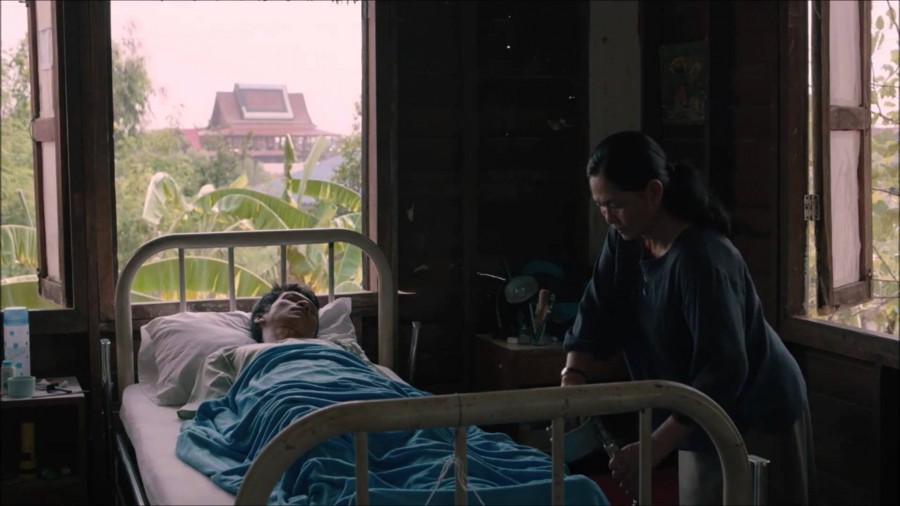
Cemetery of Splendour from Thai filmmaker Apichatpong Weerasethakul won the 2015 Asia Pacific Screen Award (APSA) for Best Feature Film, considered the region’s highest accolade in film. Cemetery of Splendour is set in and around a hospital ward full of comatose soldiers. Attached to glowing dream machines, and tended to by a kindly volunteer (Jenjira Pongpas Widner) and a young clairvoyant (Jarinpattra Rueangram), the men are said to be waging war in their sleep on behalf of long-dead feuding kings, and their mysterious slumber provides the rich central metaphor: sleep as safe haven, as escape mechanism, as ignorance, as bliss.
-
2015 Chicago International Film Festival Unveils Spotlight: Architecture+Space+Design Program
 The 2015 Chicago International Film Festival (Oct 15-29, 2015), in conjunction with the Chicago Architecture Biennial, revealed the Festival’s Spotlight: Architecture+Space+Design program.
The international selection showcases 11 new feature films, including notable portraits of architects, designers and buildings (Concrete Love – The Bohm Family, Why A Film About Michele De Lucchi?, The Infinite Happiness) and beautifully photographed depictions of contemporary and futuristic cities (Obra, Invention, Under Electric Clouds).
In addition to the program of shorts, Chicago Film Archives program and feature-length films (all listed below), the Spotlight features a discussion with architect Helmut Jahn on Sat, Oct 17 at 6:00pm at the AMC River East 21.
Rounding out the Spotlight: Architecture+Space+Design program, on Wednesdays throughout the Chicago Architecture Biennial (Oct-Dec 2015), local and visiting architects and designers will present Architects on Film.
2015 Chicago International Film Festival SPOTLIGHT: ARCHITECTURE+SPACE+DESIGN
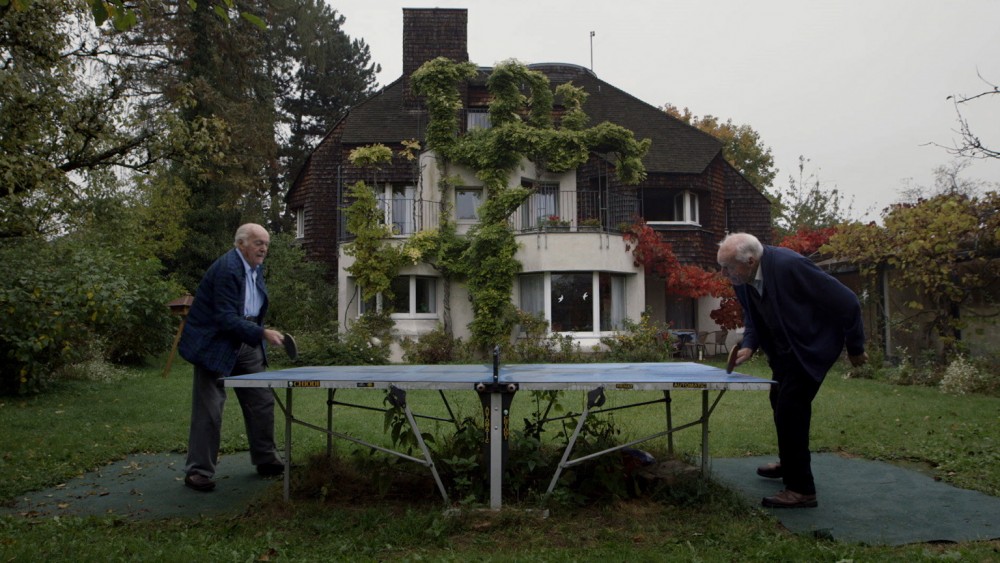
Concrete Love – The Bohm Family (pictured above)
CHICAGO PREMIERE
Country: Germany, Switzerland
Director: Maurizius Staerkle Drux
Synopsis: Prominent German architect Gottfried Böhm is celebrated for his buildings of concrete, steel, and glass. His three sons are also highly acclaimed. When the family matriarch, an architect herself and source of inspiration for all Böhm men, dies, their emotional foundation is shattered. Sensitive to form and emotion, Concrete Love lays bare the blueprint of a family.
Double Happiness
CHICAGO PREMIERE
Country: Austria, China
Director: Ella Raidel
Synopsis: This surreal, exquisitely framed documentary looks at the construction of a near-exact replica of a scenic Austrian town-cobblestone by cobblestone-in an undeveloped Chinese tract of land. In a style both entrancing and playful, the film questions the difference between real and imagined, model and reality, raising thought-provoking questions about the nature of authenticity and happiness. Features insightful interviews with urban planners, designers, and trailblazing Beijing architect Ma Yansong.
Greater Things
USA PREMIERE
Country: UK, Japan
Director: Vahid Hakimzadeh
Synopsis: In this stunningly composed meditation on space and human relationships, an adrift Iranian architect, a disengaged Japanese couple, and a Lithuanian mixed martial arts fighter search for connection in modern Japan. From the stylishly designed shops of Tokyo to a minimalist glass suburban home to a mysterious tree house in the woods, Greater Things reveals the strange places we inhabit, and how they can both unite and divide us.
Helmut Jahn: An Architect’s Life
Country: N/A
Director: N/A
Synopsis: World-renowned for his progressive architecture and constant innovation, Helmut Jahn has designed 16 buildings in Illinois, including Chicago’s own United Airlines Terminal. He has also designed skyscrapers in major cities around the world, from Brussels and Rotterdam to Bangkok, Shanghai, and Berlin, which boasts his celebrated Sony Center. Jahn will discuss his remarkable 49-year career in architecture and his unique vision, using clips from modern and classic films that showcase his designs and reflect his philosophy.
Illegal Portraits (Ritratti Abusivi)
NORTH AMERICAN PREMIERE
Country: Italy
Director: Romano Montesarchio
Synopsis: Welcome to Parco Saraceno, a derelict neighborhood in southeast Italy. Built in the 1960s, its run-down houses once held the promise of suburban coastal bliss. Now home to a community of squatters, the development is a portrait of both poverty and resilience. Without power or resources, the residents persevere, finding new ways to live among the ruins and maintain their way of life-and their dignity.
The Infinite Happiness
CHICAGO PREMIERE
Country: France, Denmark
Director: Ila Beka, Louise Lemoine
Synopsis: Copenhagen’s “8 House,” an ultramodern loop of apartments created by architect Bjarke Ingels, reinvents the concept of “home.” Its 500 residents can traverse all nine floors by bike while their kids attend kindergarten on the ground floor. This exuberant documentary profiles the (mostly) happy residents, including a group of children who experience the best scavenger hunt ever, offering a hopeful, inspired picture of communal living by design.
Invention
USA PREMIERE
Country: Canada, France
Director: Mark Lewis
Synopsis: A meditative sensory experience from Canadian avant-garde artist Mark Lewis, Invention intimately explores our relationship to the physical space around us. Long, luxurious tracking shots take the viewer through museum works and modern cityscapes in Toronto, São Paolo, and Paris, panning and tilting at improbable angles to give a fresh perspective on the everyday. Echoes of Koyaanisqatsi and Man With a Movie Camera infuse this poem of modern life.
Milano 2015
NORTH AMERICAN PREMIERE
Country: Italy
Director: various
Synopsis: From subways to skyscrapers, from antique monasteries to ornate mansions, from shuttered old theaters to the inimitable La Scala, this stunning omnibus feature captures the soul and majesty of the northern Italian city. Six Italian directors explore different facets of contemporary Milan. The result is a rich and eclectic portrait of urban life and spaces-both rooted in history and bursting with a diversity of architecture and humanity.
Modern Metropolis: Mid-Century Chicago On Film
Note: This is a FREE event at the Chicago Cultural Center
Country: N/A
Director: various directors
Synopsis: Chicago’s rich architectural tradition has long been a hallmark of the Windy City. In this evocative collection of shorts culled from the Chicago Film Archives dating from 1962 to 1976, go back in time to witness its urban glories. The films include dynamic “city-symphonies,” an ode to stainless steel, and an admiring portrait of Louis Sullivan’s Stock Exchange building and its woeful demolition.
Obra
CHICAGO PREMIERE
Country: Brazil
Director: Gregorio Graziosi
Synopsis: When a complacent young architect in São Paulo discovers a burial ground at the site of his first construction project, he must reckon with hidden secrets that make him question the very foundation of his heritage. An entrancing meditation on urban alienation and repressed national memory filmed in stark, exquisitely composed black-and-white, Obra is a haunting portrait of contemporary Brazil in flux.
Shorts 8: The Tower Above The Earth – Architecture
Countries: France, Iran, Israel, Poland, Switzerland, US
Directors: Teresa Czepiec, Sandy Pitetti, Miki Polonski, Chuck Przybyl, Matthieu Landour, Arash Nassiri
Description: The shorts takes a bright new view of space and design in cinema from claustrophobic urban spaces to hypnotic skylines and historic architecture coalesce, courtesy of Program Partner Jeanne Randall Malkin Family Foundation.
Under Electric Clouds (Pod elektricheskimi oblakami)
USA PREMIERE
Country: Russia, Ukraine
Director: Aleksey German Jr.
Synopsis: In 2017 Russia, exactly 100 years after the Bolshevik Revolution, the world is on the verge of a new great war. An unfinished skyscraper looms on the horizon, casting an emblematic shadow over a society about to collapse. With breathtaking sci-fi imagery, this wildly strange magical realistic film interweaves the stories of seven individuals, from an architect to a Kyrgyz laborer, as it explores a dystopian dreamscape.
Underground Fragrance (Di Xia Xiang)
USA PREMIERE
Country: China, France
Director: Di Xia Xiang
Synopsis: On the rapidly urbanizing outskirts of Beijing, Yong Le spends his days scouring homes scheduled for demolition for furniture to pawn and his nights in the sub-basement of a high-rise apartment building. After an accident blinds him, a nightclub dancer, hoping to secure a day job with a real estate developer, nurses him back to health. Produced by Tsai Ming-Liang, the film adapts his signature meditative social realism, revealing a world in which everyone, literally and figuratively, is looking to move up.
Why a Film About Michele De Lucchi? (Perché un film su Michele De Lucchi)
CHICAGO PREMIERE
Country: Italy
Director: Alessio Bozzer
Synopsis: A portrait of the famous radical Italian designer and progenitor of the Maker Movement, this informative, playful documentary traces Michele De Lucchi’s personal experiments and provocations. With De Lucchi serving as his own narrator, the film examines his pioneering achievements with the design movement Memphis, including the stripped-down “First Chair,” the Oceanic Lamp, and a spectacular LED-lit bridge in Tbilisi, Georgia.
ARCHITECTS ON FILM
The Hawks and the Sparrows
Country: Italy (1966)
Director: Pier Paolo Pasolini
Featured Architect: Xavier Wrona, founder of the architecture office Est-ce ainsi, a structure working to refocus the architectural practice on its political consequences and its possible participation in the reform of “vivre ensemble.”
Synopsis: In this whimsical fable from the legendary Italian director, an old man (played by the famous Keaton-esque clown Toto) walks along the dusty road of life with his empty-headed son. Joined by a philosophical crow, who asks probing questions about existence, father and son witness the complex contradictions of Italian life, from Christianity vs. Marxism, Church vs. State.
Hearts of Darkness: A Filmmaker’s Apocalypse
Country: USA (1991)
Directors: Fax Bahr, George Hickenlooper
Featured Architect: Eric Ellingsen is currently teaching at the School of the Art Institute (SAIC) and has a practice called species of space.
Synopsis: This eye-opening documentary examines the outrageous behind-the-scenes making of Francis Ford Coppola’s 1979 classic Apocalypse Now. With rarely seen archival footage shot by Coppola’s wife, the film recounts how events on the Philippines-set production soon resembled the madness recounted in the story. Over-budget, with cast and crew bordering on the edge of insanity, the film is a revealing look at the extraordinary lengths that some will go to make their art.
Waste Land
Country: USA (2010)
Director: Lucy Walker
Featured Architect: Emmanuel Pratt, Co-Founder and Executive Director of the Sweet Water Foundation and founding member of axilL3C. He is also Director of Aquaponics for Chicago State University and teaches courses within the College of Arts and Sciences.
Synopsis: This Oscar-nominated documentary follows renowned artist Vik Muniz as he journeys from his home base in Brooklyn to the world’s largest garbage dump in his native Brazil. There, he photographs an eclectic band of “catadores”-people who scrounge for recyclable materials. As he collaborates with these inspiring characters to recreate photographs of themselves, Waste Land offers stirring evidence of the transformative power of art and the alchemy of the human spirit.
Screening 1: Wed, Nov 18; 6:00pm
Note: This is a FREE event held at the Chicago Cultural Center
My Winnipeg
Country: USA (2007)
Director: Guy Madden
Featured Architect: Design With Company’s co-founders Stewart Hicks and Allison Newmeyer, who are also assistant professors at the University of Illinois at Chicago
Synopsis: A self-described “docu-fantasia,” this rollicking cinematic poem charts the not-exactly-true goings-on in the birthplace of Canadian filmmaker Guy Maddin (The Saddest Music in the World). Brazenly blurring the borders of nonfiction and dream, Maddin recounts his return to his childhood home, revisiting key moments from his adolescence and his city’s history (from a semi-nude civic pride event to a jazz-age séance ballet!) My Winnipeg is a wild ride of remembrance, place, and imagination.
Screening 1: Wed, Nov 4; 6:00pm
Note: This is a FREE event held at the Chicago Cultural Center
The Wiz
Country: USA (1978)
Director: Sidney Lumet
Featured Architect: Amanda Williams whose work centers on color, race, and space. She uses vivid, culturally derived colors to paint abandoned houses on Chicago’s South Side, marking the pervasiveness of undervalued Black space. Accolades include a 3Arts Award, a Joyce Foundation scholarship, and a Robert James Eidlitz Fellowship in Ethiopia.
Synopsis: The film version of the popular Broadway musical retells the events of “The Wonderful Wizard of Oz” through the eyes of Dorothy, a young African-American kindergarten teacher (Diana Ross) who’s “never been below 125th Street.” On her journey down the yellow brick road of ’70s Manhattan, she encounters a garbage-stuffed scarecrow (Michael Jackson), a broken-down tin man (Nipsey Russell), and a cowardly lion (Ted Ross) posing as a stone statue outside a museum. Together, they seek out the Wiz (Richard Pryor), a powerful wizard living in Emerald City who may be able to help Dorothy get home.
Screening 1: Wed, Dec 9; 6:00pm
Note: This is a FREE event held at the Chicago Cultural Center; featuring a conversation with Jacqueline Stewart, Professor in the University of Chicago’s Department of Cinema and Media Studies. Stewart’s research and teaching explore African American film cultures from the origins of the medium to the present, as well as the archiving and preservation of moving images, and “orphan” media histories, including nontheatrical, amateur, and activist film and video. She directs the South Side Home Movie Project and is co-curator of the L.A. Rebellion Preservation Project at the UCLA Film and Television Archive. She also serves as an appointee to the National Film Preservation Board. She is currently researching the racial politics of moving image preservation and is also completing a study of the life and work of African American actor/writer/director Spencer Williams.
Voices of Cabrini
Country: USA (1999)
Director: Ronit Bezalel
Featured Architect: Andres Hernandez, an artist-designer-educator who works with youth and adults to interpret, critique, and re-imagine the physical, social and cultural environments we inhabit.
Synopsis: Shot over a four-year period, this gripping documentary chronicles the demolition of Cabrini Green, Chicago’s most infamous housing development. Told sympathetically from the perspectives of the people being uprooted, the film shows the startling evictions of longtime residents from the city’s mid-city ghetto. A sobering look at “city planning” at work, Voices of Cabrini is a valuable historical look at a city in transition-and those left behind.
The 2015 Chicago International Film Festival (Oct 15-29, 2015), in conjunction with the Chicago Architecture Biennial, revealed the Festival’s Spotlight: Architecture+Space+Design program.
The international selection showcases 11 new feature films, including notable portraits of architects, designers and buildings (Concrete Love – The Bohm Family, Why A Film About Michele De Lucchi?, The Infinite Happiness) and beautifully photographed depictions of contemporary and futuristic cities (Obra, Invention, Under Electric Clouds).
In addition to the program of shorts, Chicago Film Archives program and feature-length films (all listed below), the Spotlight features a discussion with architect Helmut Jahn on Sat, Oct 17 at 6:00pm at the AMC River East 21.
Rounding out the Spotlight: Architecture+Space+Design program, on Wednesdays throughout the Chicago Architecture Biennial (Oct-Dec 2015), local and visiting architects and designers will present Architects on Film.
2015 Chicago International Film Festival SPOTLIGHT: ARCHITECTURE+SPACE+DESIGN
Concrete Love – The Bohm Family (pictured above)
CHICAGO PREMIERE
Country: Germany, Switzerland
Director: Maurizius Staerkle Drux
Synopsis: Prominent German architect Gottfried Böhm is celebrated for his buildings of concrete, steel, and glass. His three sons are also highly acclaimed. When the family matriarch, an architect herself and source of inspiration for all Böhm men, dies, their emotional foundation is shattered. Sensitive to form and emotion, Concrete Love lays bare the blueprint of a family.
Double Happiness
CHICAGO PREMIERE
Country: Austria, China
Director: Ella Raidel
Synopsis: This surreal, exquisitely framed documentary looks at the construction of a near-exact replica of a scenic Austrian town-cobblestone by cobblestone-in an undeveloped Chinese tract of land. In a style both entrancing and playful, the film questions the difference between real and imagined, model and reality, raising thought-provoking questions about the nature of authenticity and happiness. Features insightful interviews with urban planners, designers, and trailblazing Beijing architect Ma Yansong.
Greater Things
USA PREMIERE
Country: UK, Japan
Director: Vahid Hakimzadeh
Synopsis: In this stunningly composed meditation on space and human relationships, an adrift Iranian architect, a disengaged Japanese couple, and a Lithuanian mixed martial arts fighter search for connection in modern Japan. From the stylishly designed shops of Tokyo to a minimalist glass suburban home to a mysterious tree house in the woods, Greater Things reveals the strange places we inhabit, and how they can both unite and divide us.
Helmut Jahn: An Architect’s Life
Country: N/A
Director: N/A
Synopsis: World-renowned for his progressive architecture and constant innovation, Helmut Jahn has designed 16 buildings in Illinois, including Chicago’s own United Airlines Terminal. He has also designed skyscrapers in major cities around the world, from Brussels and Rotterdam to Bangkok, Shanghai, and Berlin, which boasts his celebrated Sony Center. Jahn will discuss his remarkable 49-year career in architecture and his unique vision, using clips from modern and classic films that showcase his designs and reflect his philosophy.
Illegal Portraits (Ritratti Abusivi)
NORTH AMERICAN PREMIERE
Country: Italy
Director: Romano Montesarchio
Synopsis: Welcome to Parco Saraceno, a derelict neighborhood in southeast Italy. Built in the 1960s, its run-down houses once held the promise of suburban coastal bliss. Now home to a community of squatters, the development is a portrait of both poverty and resilience. Without power or resources, the residents persevere, finding new ways to live among the ruins and maintain their way of life-and their dignity.
The Infinite Happiness
CHICAGO PREMIERE
Country: France, Denmark
Director: Ila Beka, Louise Lemoine
Synopsis: Copenhagen’s “8 House,” an ultramodern loop of apartments created by architect Bjarke Ingels, reinvents the concept of “home.” Its 500 residents can traverse all nine floors by bike while their kids attend kindergarten on the ground floor. This exuberant documentary profiles the (mostly) happy residents, including a group of children who experience the best scavenger hunt ever, offering a hopeful, inspired picture of communal living by design.
Invention
USA PREMIERE
Country: Canada, France
Director: Mark Lewis
Synopsis: A meditative sensory experience from Canadian avant-garde artist Mark Lewis, Invention intimately explores our relationship to the physical space around us. Long, luxurious tracking shots take the viewer through museum works and modern cityscapes in Toronto, São Paolo, and Paris, panning and tilting at improbable angles to give a fresh perspective on the everyday. Echoes of Koyaanisqatsi and Man With a Movie Camera infuse this poem of modern life.
Milano 2015
NORTH AMERICAN PREMIERE
Country: Italy
Director: various
Synopsis: From subways to skyscrapers, from antique monasteries to ornate mansions, from shuttered old theaters to the inimitable La Scala, this stunning omnibus feature captures the soul and majesty of the northern Italian city. Six Italian directors explore different facets of contemporary Milan. The result is a rich and eclectic portrait of urban life and spaces-both rooted in history and bursting with a diversity of architecture and humanity.
Modern Metropolis: Mid-Century Chicago On Film
Note: This is a FREE event at the Chicago Cultural Center
Country: N/A
Director: various directors
Synopsis: Chicago’s rich architectural tradition has long been a hallmark of the Windy City. In this evocative collection of shorts culled from the Chicago Film Archives dating from 1962 to 1976, go back in time to witness its urban glories. The films include dynamic “city-symphonies,” an ode to stainless steel, and an admiring portrait of Louis Sullivan’s Stock Exchange building and its woeful demolition.
Obra
CHICAGO PREMIERE
Country: Brazil
Director: Gregorio Graziosi
Synopsis: When a complacent young architect in São Paulo discovers a burial ground at the site of his first construction project, he must reckon with hidden secrets that make him question the very foundation of his heritage. An entrancing meditation on urban alienation and repressed national memory filmed in stark, exquisitely composed black-and-white, Obra is a haunting portrait of contemporary Brazil in flux.
Shorts 8: The Tower Above The Earth – Architecture
Countries: France, Iran, Israel, Poland, Switzerland, US
Directors: Teresa Czepiec, Sandy Pitetti, Miki Polonski, Chuck Przybyl, Matthieu Landour, Arash Nassiri
Description: The shorts takes a bright new view of space and design in cinema from claustrophobic urban spaces to hypnotic skylines and historic architecture coalesce, courtesy of Program Partner Jeanne Randall Malkin Family Foundation.
Under Electric Clouds (Pod elektricheskimi oblakami)
USA PREMIERE
Country: Russia, Ukraine
Director: Aleksey German Jr.
Synopsis: In 2017 Russia, exactly 100 years after the Bolshevik Revolution, the world is on the verge of a new great war. An unfinished skyscraper looms on the horizon, casting an emblematic shadow over a society about to collapse. With breathtaking sci-fi imagery, this wildly strange magical realistic film interweaves the stories of seven individuals, from an architect to a Kyrgyz laborer, as it explores a dystopian dreamscape.
Underground Fragrance (Di Xia Xiang)
USA PREMIERE
Country: China, France
Director: Di Xia Xiang
Synopsis: On the rapidly urbanizing outskirts of Beijing, Yong Le spends his days scouring homes scheduled for demolition for furniture to pawn and his nights in the sub-basement of a high-rise apartment building. After an accident blinds him, a nightclub dancer, hoping to secure a day job with a real estate developer, nurses him back to health. Produced by Tsai Ming-Liang, the film adapts his signature meditative social realism, revealing a world in which everyone, literally and figuratively, is looking to move up.
Why a Film About Michele De Lucchi? (Perché un film su Michele De Lucchi)
CHICAGO PREMIERE
Country: Italy
Director: Alessio Bozzer
Synopsis: A portrait of the famous radical Italian designer and progenitor of the Maker Movement, this informative, playful documentary traces Michele De Lucchi’s personal experiments and provocations. With De Lucchi serving as his own narrator, the film examines his pioneering achievements with the design movement Memphis, including the stripped-down “First Chair,” the Oceanic Lamp, and a spectacular LED-lit bridge in Tbilisi, Georgia.
ARCHITECTS ON FILM
The Hawks and the Sparrows
Country: Italy (1966)
Director: Pier Paolo Pasolini
Featured Architect: Xavier Wrona, founder of the architecture office Est-ce ainsi, a structure working to refocus the architectural practice on its political consequences and its possible participation in the reform of “vivre ensemble.”
Synopsis: In this whimsical fable from the legendary Italian director, an old man (played by the famous Keaton-esque clown Toto) walks along the dusty road of life with his empty-headed son. Joined by a philosophical crow, who asks probing questions about existence, father and son witness the complex contradictions of Italian life, from Christianity vs. Marxism, Church vs. State.
Hearts of Darkness: A Filmmaker’s Apocalypse
Country: USA (1991)
Directors: Fax Bahr, George Hickenlooper
Featured Architect: Eric Ellingsen is currently teaching at the School of the Art Institute (SAIC) and has a practice called species of space.
Synopsis: This eye-opening documentary examines the outrageous behind-the-scenes making of Francis Ford Coppola’s 1979 classic Apocalypse Now. With rarely seen archival footage shot by Coppola’s wife, the film recounts how events on the Philippines-set production soon resembled the madness recounted in the story. Over-budget, with cast and crew bordering on the edge of insanity, the film is a revealing look at the extraordinary lengths that some will go to make their art.
Waste Land
Country: USA (2010)
Director: Lucy Walker
Featured Architect: Emmanuel Pratt, Co-Founder and Executive Director of the Sweet Water Foundation and founding member of axilL3C. He is also Director of Aquaponics for Chicago State University and teaches courses within the College of Arts and Sciences.
Synopsis: This Oscar-nominated documentary follows renowned artist Vik Muniz as he journeys from his home base in Brooklyn to the world’s largest garbage dump in his native Brazil. There, he photographs an eclectic band of “catadores”-people who scrounge for recyclable materials. As he collaborates with these inspiring characters to recreate photographs of themselves, Waste Land offers stirring evidence of the transformative power of art and the alchemy of the human spirit.
Screening 1: Wed, Nov 18; 6:00pm
Note: This is a FREE event held at the Chicago Cultural Center
My Winnipeg
Country: USA (2007)
Director: Guy Madden
Featured Architect: Design With Company’s co-founders Stewart Hicks and Allison Newmeyer, who are also assistant professors at the University of Illinois at Chicago
Synopsis: A self-described “docu-fantasia,” this rollicking cinematic poem charts the not-exactly-true goings-on in the birthplace of Canadian filmmaker Guy Maddin (The Saddest Music in the World). Brazenly blurring the borders of nonfiction and dream, Maddin recounts his return to his childhood home, revisiting key moments from his adolescence and his city’s history (from a semi-nude civic pride event to a jazz-age séance ballet!) My Winnipeg is a wild ride of remembrance, place, and imagination.
Screening 1: Wed, Nov 4; 6:00pm
Note: This is a FREE event held at the Chicago Cultural Center
The Wiz
Country: USA (1978)
Director: Sidney Lumet
Featured Architect: Amanda Williams whose work centers on color, race, and space. She uses vivid, culturally derived colors to paint abandoned houses on Chicago’s South Side, marking the pervasiveness of undervalued Black space. Accolades include a 3Arts Award, a Joyce Foundation scholarship, and a Robert James Eidlitz Fellowship in Ethiopia.
Synopsis: The film version of the popular Broadway musical retells the events of “The Wonderful Wizard of Oz” through the eyes of Dorothy, a young African-American kindergarten teacher (Diana Ross) who’s “never been below 125th Street.” On her journey down the yellow brick road of ’70s Manhattan, she encounters a garbage-stuffed scarecrow (Michael Jackson), a broken-down tin man (Nipsey Russell), and a cowardly lion (Ted Ross) posing as a stone statue outside a museum. Together, they seek out the Wiz (Richard Pryor), a powerful wizard living in Emerald City who may be able to help Dorothy get home.
Screening 1: Wed, Dec 9; 6:00pm
Note: This is a FREE event held at the Chicago Cultural Center; featuring a conversation with Jacqueline Stewart, Professor in the University of Chicago’s Department of Cinema and Media Studies. Stewart’s research and teaching explore African American film cultures from the origins of the medium to the present, as well as the archiving and preservation of moving images, and “orphan” media histories, including nontheatrical, amateur, and activist film and video. She directs the South Side Home Movie Project and is co-curator of the L.A. Rebellion Preservation Project at the UCLA Film and Television Archive. She also serves as an appointee to the National Film Preservation Board. She is currently researching the racial politics of moving image preservation and is also completing a study of the life and work of African American actor/writer/director Spencer Williams.
Voices of Cabrini
Country: USA (1999)
Director: Ronit Bezalel
Featured Architect: Andres Hernandez, an artist-designer-educator who works with youth and adults to interpret, critique, and re-imagine the physical, social and cultural environments we inhabit.
Synopsis: Shot over a four-year period, this gripping documentary chronicles the demolition of Cabrini Green, Chicago’s most infamous housing development. Told sympathetically from the perspectives of the people being uprooted, the film shows the startling evictions of longtime residents from the city’s mid-city ghetto. A sobering look at “city planning” at work, Voices of Cabrini is a valuable historical look at a city in transition-and those left behind.