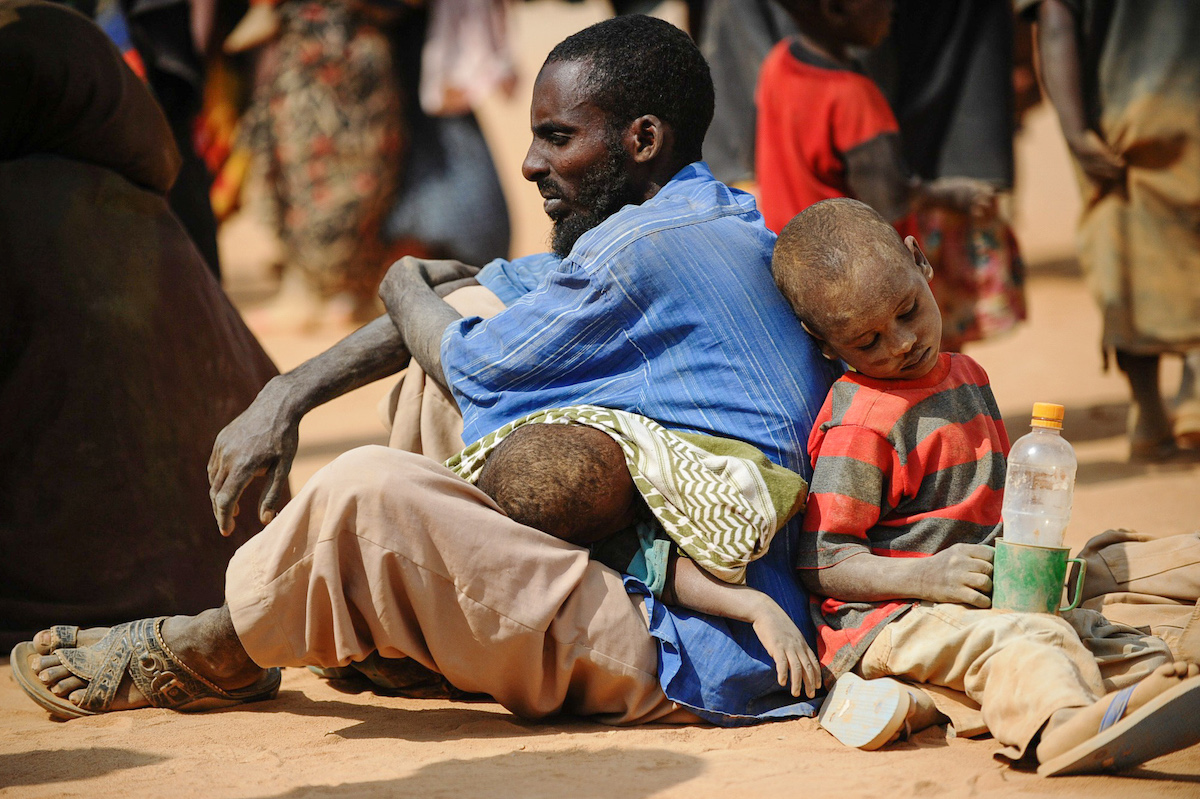
A Somali man who fled violence and drought in Somalia with his family sits on the ground outside a food distribution point in the Dadaab refugee camp in northeastern Kenya on July 5, 2011. Dadaab, a complex of three settlements, is the world’s largest refugee camp. Built to house 90,000 people and home to more than four times that number, it was already well over its maximum capacity before an influx of 30,000 refugees in June. Upon arrival, the refugees find themselves tackling a chaotic system that sees new arrivals go days, even weeks, without food aid. “It still takes too much time for refugees to get proper assistance,” Antoine Froidevaux, Medecins Sans Frontieres’s (Doctors Without Borders) field coordinator in Dadaab told AFP. “The answer in terms of humanitarian aid is not satisfactory at all at the moment.” AFP PHOTO/Roberto SCHMIDT (Photo by Roberto SCHMIDT / AFP) (Photo credit: ROBERTO SCHMIDT/AFP via Getty Images)
Today, natural disasters threaten the planet with increasing ferocity. They strike without warning, tearing apart infrastructure and destroying lives. How should the world respond, and how can vulnerable populations be better prepared in the future? When Disaster Strikes, a new three-part documentary series, explores what happens after natural disasters occur in three countries: a cyclone that brings biblical floods in Mozambique, a deadly drought that destroys lives and livelihoods in Somalia, and an historic hurricane that ravages the Bahamas. Each episode charts the on-the-ground response over months as frontline workers race to save lives, restore order from chaos and turn despair into hope. When Disaster Strikes premieres Wednesdays, January 6-20, 10:00-11:00 p.m. ET on PBS.
To provide the best experiences, we use technologies like cookies to store and/or access device information. Consenting to these technologies will allow us to process data such as browsing behavior or unique IDs on this site. Not consenting or withdrawing consent, may adversely affect certain features and functions.
Functional
Always active
The technical storage or access is strictly necessary for the legitimate purpose of enabling the use of a specific service explicitly requested by the subscriber or user, or for the sole purpose of carrying out the transmission of a communication over an electronic communications network.
Preferences
The technical storage or access is necessary for the legitimate purpose of storing preferences that are not requested by the subscriber or user.
Statistics
The technical storage or access that is used exclusively for statistical purposes.The technical storage or access that is used exclusively for anonymous statistical purposes. Without a subpoena, voluntary compliance on the part of your Internet Service Provider, or additional records from a third party, information stored or retrieved for this purpose alone cannot usually be used to identify you.
Marketing
The technical storage or access is required to create user profiles to send advertising, or to track the user on a website or across several websites for similar marketing purposes.