
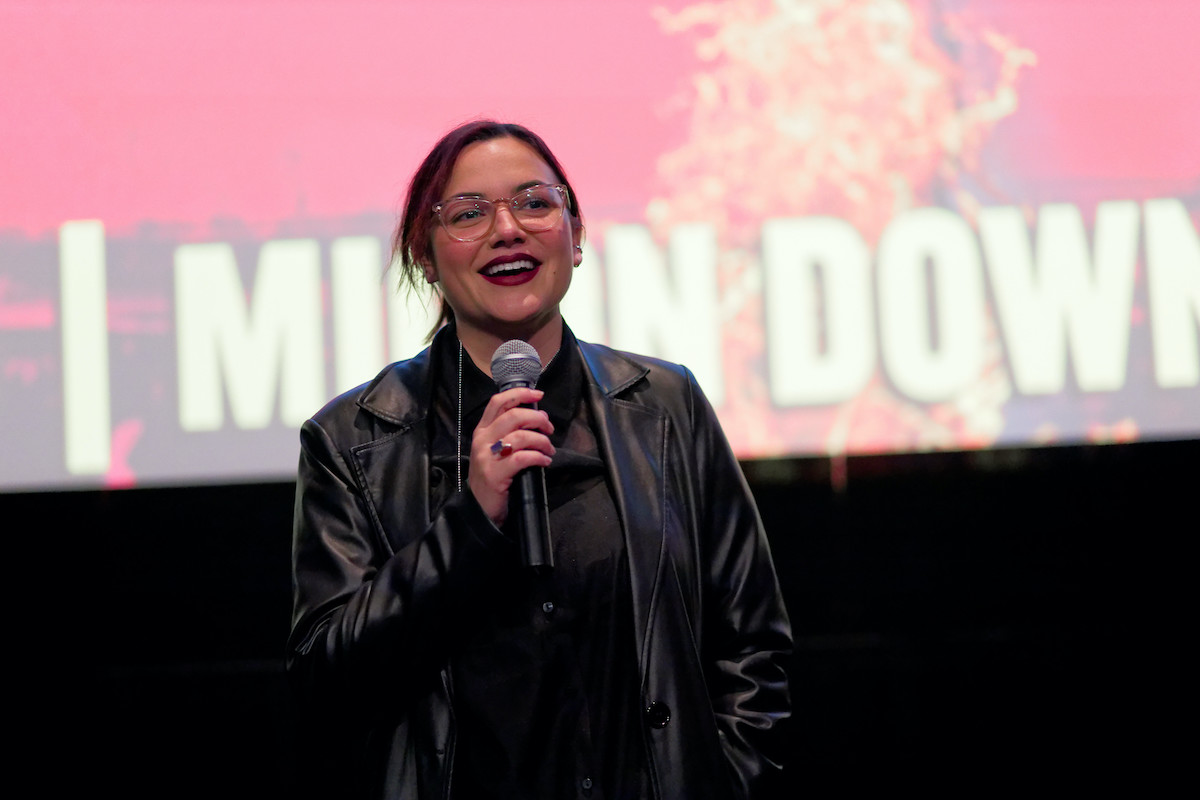
Gabriela Lopez is driven by the disturbing, the surreal, and the absurd. She uses her personal experiences and narratives to push the boundaries of psychologically driven film, asking the audience to reflect on their psyches when exposed to her art.
Lopez is an award-winning filmmaker from Dothan, Alabama, who’s been in the business of acting, writing, producing, and directing for 15 years. After appearing in shows like Teen Spirit and the Emmy Award–winning series The Crossover, she wanted to explore being behind the camera. In 2015, she wrote, produced, and starred in the award-winning short Unrelated.
Her latest surreal horror short film, Sovereign, which premiered at the Mórbido Film Fest last year, has won multiple awards, including Best International Short. Lopez is currently working on her debut feature, Sunshine, a religious horror inspired by true events.
VIMooZ writer Beni Cwiakala interviewed Lopez, focusing on her journey as a modern filmmaker and the process of directing her first feature.
Beni Cwiakala: Was there an “ah-ha” moment where you knew you wanted to make films?
Gabriela Lopez: There were really two moments. One was to create the kinds of roles I had always wanted to be cast in, rather than waiting for the industry to see me that way. I think the art I want to make and the way I’m perceived don’t always match, so filmmaking became a way to close that gap for myself. The other moment was watching a film called “Seahorses” at a film festival. The film wasn’t for me creatively; I was laughing during what I think were meant to be serious moments in the film. I tend to do this, but it made something click in me. I realized filmmaking isn’t about perfection; it’s about having the courage to make something. I went home that night and wrote my first screenplay, which became my first short, Unrelated.
BC: How did your upbringing lead you to find your preferred genre and niche?
GL: Growing up with a psychiatrist dad and counselor mom made me very interested in human behavior and raised a lot of questions about why humans in extreme or uncomfortable situations act a certain way, and my films are a way for me to explore the answers to those questions. As for genre, my mom showed me The Exorcist when I was 9, the same age she had watched it. I was talking to my therapist recently, and she said that there’s a study that watching horror at a young age will help the way you process fear. In a way, I believe my mom was preparing me for how to handle life. As for surrealism, I think it’s how my mind has always worked. I’ve always understood emotions through symbolism and metaphor more easily than literal language. Even growing up, I struggled to explain exactly how I felt, but I could describe those feelings through an image or a symbol.
BC: The Exorcist at 9, I don’t think child me could handle that. What has been your favorite film to create/film so far?
GL: Sovereign has been my favorite so far. It was the first film where I feel I was able to really capture my voice and tone as a filmmaker.
BC: There’s a quote, “art is supposed to disturb the comforted and comfort the disturbed…” Do you hope your films disturb more or comfort more, and what do you hope viewers take from them?
GL: Definitely disturb. For me, I want the audience in my films to confront themselves. Maybe they feel shame or fear around what they’re witnessing, but I hope to create a space for that to be allowed, even welcomed.
BC: Sovereign was your directorial debut; how did it feel to direct for the first time on this scale?
GL: It was for a 48-hour film fest, so it was high stakes, but I had a lot of support. Josh Pafchek, who I made the film with, really encouraged me and guided me throughout the process while we were working on Weather Girl together. He told me, ‘You should direct this one, ’ because he knew I wanted to. And he supported how I wanted to curate the shots. And he would help me when I’d be like, I don’t know what I’m supposed to do here. I’m a perfectionist, so it’s hard for me to just do things sometimes.
BC: In your experience, and I know this probably differs every single time, but when you have a concept for a film, what is the process like in those beginning steps? Before the shooting, how do you fully flesh out the idea for the film?
GL: I’m actually working on a new film right now that has been coming to me for a few months now. I work with my intuition; I’m very spiritual and connected to myself. So if something is repeating to me over and over again in my head, this is how I start developing a concept. I think about a certain human behavior or this psychological thing in myself or in other people, and I see a pattern. If I see these patterns happen over and over again, I start to jot them down; maybe I don’t understand. And if I don’t understand something, I want to make a film about it. I see writing and filmmaking as magic. It’s like sorcery. It’s like what you write, you write it into existence almost, which is a little scary. It’s very powerful. I think filmmaking and writing can be really dangerous if it’s not handled with care. So for me, I love Pinterest boards so much because I’m a visual person. I’ll start creating the visual, and then so many more things on a practical level will start coming to me after I have a concept. Then I’ll just start playing with what other films inspire me, which films I can watch that I want to pull from, and go from there.
BC: Your first short film, Sovereign, was all you: you wrote, directed, acted, and produced. How is it being in your own world that you create? How was it acting in this universe you created?
GL: Oof. It’s a heavy one, and it’s autobiographical for me; that’s what has made it harder. Because, with Weather Girl, it was more detached and it’s more whimsical, so it’s not really based on anything personal, whereas Sovereign was based on so many very, very personal things and I was playing it. So to me, acting in that world I created was like reliving the darkest, scariest moments of my life with my surreal mind surrounding me, which was really cathartic, really scary for my psyche to be like, I’m back. I’m in it. Like in these dark, scary places. But then I’m seeing like a fairy in the window because that’s how I used to cope with it at that moment in my life. But also this time I actually experienced it. It was almost therapeutic. It’s like, all right, exposure therapy. Go back into the experience and rewrite it for yourself.
BC: I’m sure you’ve had a long journey processing your childhood. Did this help you fully be content with it?
GL: Yeah. I’ve worked on myself. You know, whatever. We’re all human. We all go through things. But I have done a lot of healing, I guess I’ll say, on myself so that I’m more comfortable talking and being like, ‘yeah, this is who I am.’ And I think that’s what has permitted me to create the art that I do, because I’m not burdened by these things. It’s freeing, it’s liberating for me. I’ve held these as secrets, or not a lot of people know this happened to me. And then you show it to people, and there’s something really powerful about it because it is, to me, taking your power back, and I have felt so much more powerful since then.
BC: Was it hard for you to get to that level of vulnerability?
GL: A hundred percent. I just showed it to someone a couple of days ago, and then I felt like this person saw me. It’s very exposing and vulnerable to that sense of being like, ‘Are they going to understand that all of this is the real me? It’s kind of weird because once someone’s seen that film, you know me. It’s something I’m still not quite used to. And I feel like this is probably how a lot of musicians feel with their songs, writing something so personal and then people hearing it and singing it and they’re like, ‘Now you see me, you know me.’
BC: For sure. It is interesting because people forget that it’s real. They’re like, this is this show, this is a movie, but this is what someone went through.
GL: Yeah, exactly. I know. But I was gonna say, especially as a journalist, you know, or someone interviewing people, with art in general, we are really all caught pulling from really, really personal stuff that can be really heavy. And I just love people taking these really heavy things and making them beautiful.
BC: Speaking of personal projects, Sunshine is in the works. This is your first feature film, and the backstory is fascinating. What are some things that you’re most excited about? Is this project a little different from the past ones?
GL: This one is inspired by true events. It’s different because it’s my first feature. And I think I’ve refined myself as an artist. I’ve been really hunkering down, working on this feature instead of a bunch of shorts to see what my visual language will be in long form. But honestly, one of the things I’m really excited about is the stop-motion animation. I’m doing a stop-motion animation to show flashbacks in the film. And I am so excited. I have always been a big stop- motion fan.
BC: What kind of stop motion is it? Is it clay? Is it fabric?
GL: I want to do marionette puppets.
BC: Are you finding someone to help you make them, or do you have any experience with puppeteering?
GL: I don’t; I just love puppets, and I always have. And I just went to Paris for the first time recently, and I went to a puppet show; I just think it’s so cool. I know right now the plan is to film in Brazil, and there’s a stop-motion team down there that would be creating the puppets and creating this world.
BC: Hah, with you pulling the strings, right?
GL: Yeah, I have such a huge respect for stop motion artists. A couple of people, some of the designers I know, production designers, have said they have really great teams. I’m excited to get to know them and talk to them and see if it’s the right fit. I’m just really open to where this film is gonna land at this point. But I wish I could do it myself. That’d be cool.
BC: I really am looking forward to this film. The release plan is 2028, right?
GL: Thank you. Yeah, 2028 is the hope. I’m really hoping that we start filming by the end of the year or early next year, and then can just go through post pretty quickly so that way it’ll be ready, at the earliest, by the end of 2027, but 2028, like the beginning, would be great.
BC: Well, I’m hoping for that too. Please let me know when I can watch it. I want to ask: how would you describe the genre you’re in?
GL: To me, it’s more like black comedy, surreal, absurd, absurdist. It’s kind of those things mixed together, which are really crazy genres to be in. There are some other filmmakers that do it well that I admire.
BC: Fantastic, you led into my next question. Who inspires you stylistically?
GL: Jodorowsky, Alejandro Jodorowsky is my god, I tell people. He had a documentary called Jodorowsky’s Dune. The documentary is incredible because you see he’s worked with some of the most interesting artists, and I just really admire his detail with the art and the surrealism and the black comedy and the horror. There’s a film called Santa Sangre that really encapsulates all of those elements for me so well. And it was the first time I ever watched a film where I was like, I feel seen. And I didn’t realize how deeply, when you’re that inspired by an artist, how much it just infuses your work. He was inspired by Dali and other surrealists. I don’t know if you’ve ever seen Holy Mountain, but it is a masterpiece; it’s very strange and weird. It has comedic elements, and it’s surreal. It has those things that I really admire and look up to and aspire to be as a filmmaker. And the style of these sets and the production and the artistry that goes into it is just mind-blowing.
BC: That’s so cool, I’ll have to check him out. And with that, I’m so excited for your upcoming film! You’re incredible; thank you so much for meeting with me today.
GL: You’ll be in the loop, and thank you!
This interview has been edited for length, clarity, and formatting. Some responses may have been condensed or lightly modified to improve readability while maintaining the original intent.
Leave a Reply
You must be logged in to post a comment.