
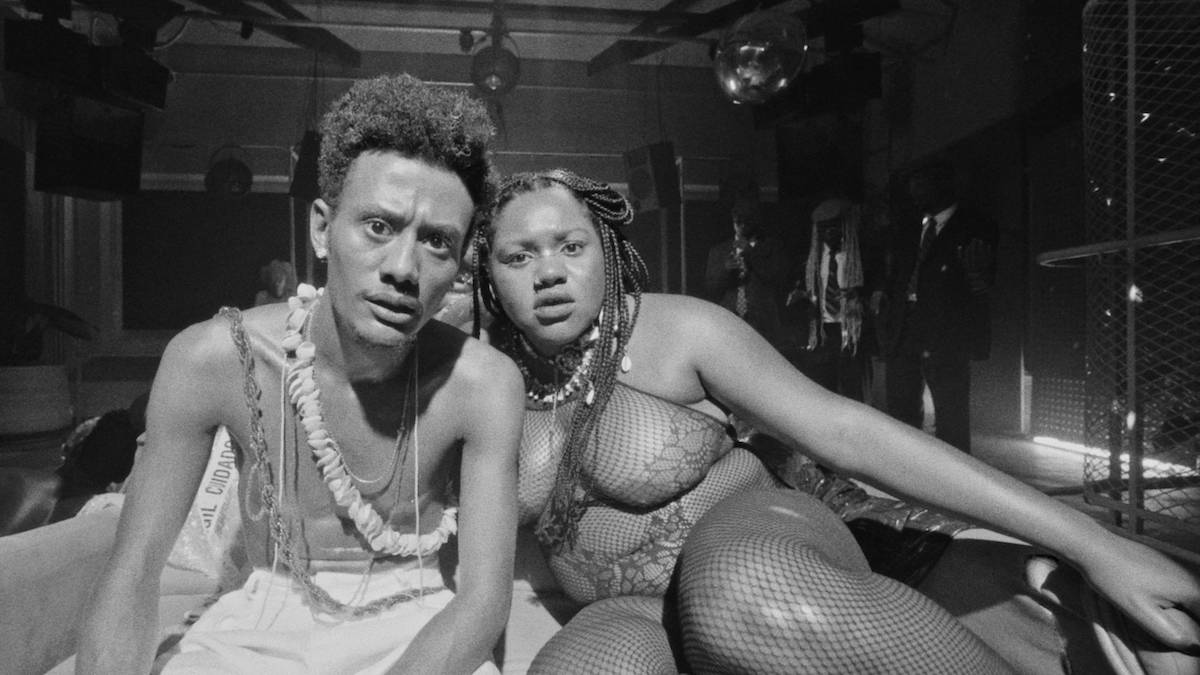
Set in the heart of the Brazilian metropolis, São Paulo, Tony Odyssey, directed by Thales Banzai, follows best friends Tony and Ivy on a hallucinogenic journey through spirituality and crime in a search for a divine power.
The stars of this experimental film include Kelson Succi and Iraci Estrela, who play Tony and Ivy, respectively. Succi, a Black, favela-born artist, co-created the film with Banzai and aimed to counter centralized narratives of violence in São Paulo.
Tony and Ivy’s story centers around possibility. Ivy, who is the catalyst for change in Tony’s life, cracks open his shell, persuading him to commit the heist for the drug. Together, they search for a way to live that is not only based on raw survival but that also confronts internal conflict to find a true personal meaning.
Tony Odyssey is a testament to questioning standards and remaining curious not only about reality but also beyond it.
VIMooZ met with director Thales Banzai to discuss how this film came to life and where the inspiration for topics such as philosophy and spirituality came from.
BENI CWIAKALA: To start, congrats on your film being selected to screen! What does it mean to you to premiere at the Brooklyn Film Festival?
THALES BANZAI: I’m excited to premiere the film at BFF for many reasons. One of them is that the film takes place in a huge metropolis – São Paulo – which almost becomes a character of its own. I think anyone living in New York can easily connect to the energy, chaos, and occasional loneliness that come with being in a city of that scale. And I think Brooklyn is the right place for this film. It has a more underground spirit, which feels very aligned with what we’ve made. This isn’t a cute Manhattan film. It’s rougher around the edges, stranger, louder, and hopefully a little more unpredictable.
BC: What type of journey has it been making this film from conception to completion?
TB: Honestly, it still doesn’t feel completed. I think it will only be truly finished once it’s distributed in theaters and on streaming platforms for the general public to discover. The journey itself has been intense. This is a self-funded film with a large cast, multiple locations, and an original soundtrack. Every step demanded an enormous amount of work, persistence, and faith. But that also makes it incredibly rewarding. Every time we screen it for a new audience and get to experience their reactions, it reminds me why we made it in the first place.
BC: Was there a defining moment that made you want to become a filmmaker?
TB: I’ve been making films since I was nine years old, shooting little movies on VHS cameras back in 1999. From there, I moved into MiniDV skate videos, documentaries, stop-motion animation, commercials, fashion films, and music videos. The truth is, I don’t really know how to do anything else. Filmmaking has never felt like a career choice; it has simply been the way I’ve spent my life. Looking back, there wasn’t a single defining moment. It was more like a continuous path that started in childhood and never stopped.
BC: Who inspires you in filmmaking, and who’s your favorite director?
TB: The filmmakers who have touched my soul the most – and whose films I keep returning to – are Krzysztof Kieślowski, Stanley Kubrick, David Lynch, and Ingmar Bergman. Among contemporary filmmakers, I’m especially inspired by Alice Rohrwacher. I love her films, and she’s one of the few directors whose next project I’m always genuinely curious and excited to see.
BC: What made you want to create a story centered around relationships to religion as well as substances?
TB: Brazil is a deeply syncretic country, and São Paulo is perhaps the ultimate expression of that. I was never baptized, but I grew up surrounded by Catholic saints, figures of Preto Velho from Umbanda, friends and family practicing Buddhism, and later witnessed the rapid growth of neo-Pentecostal churches across Brazil. Even though Brazil is officially a predominantly Catholic country, I feel that African-rooted religions form part of its cultural foundation. Their influence is everywhere—in our music, our language, our rituals, and the way we relate to one another. So while I’m not particularly religious myself—except perhaps in the Church of Cinema—Brazil certainly is. That tension became a very fertile place from which to tell this story.
And the connection between religion and substances in the film is something I prefer to leave open for each viewer to interpret in their own way.
BC: For our aesthetic-focused people, how would you describe the visual style or tone of the movie?
TB: I’ve actually been learning how to describe the film by reading the reviews that have come out so far. Some of my favorite descriptions have been “Surrealist Pop,” “Psychedelic Acid Trip,” and “Future-Shock Fellini.”
To me, the film feels like a collision between a crime story, a spiritual quest, and a fever dream.
BC: What scene or moment in the film means the most to you personally and why?
One of my favorite moments is the sequence where Tony and Ivy wander through São Paulo alone at night. The city feels huge, indifferent, and oppressive. What makes the scene special to me is the original soundtrack. The music adds a sense of longing and melancholy that completely transforms the experience and elevates the emotion of the sequence.
BC: What do you hope viewers take away after watching Tony Odyssey?
TB Questions. In an era where answers are everywhere, I think it’s healthy to leave a film with more questions than certainties. I hope viewers walk away questioning their reality a little bit: why we’re here, what we’re searching for, and what roles religion, drugs, technology, and belief systems play in our lives. Not necessarily to find answers, but to remain curious.
BC: Were there any memorable behind-the-scenes moments you can share?
TB: One of my favorite behind-the-scenes stories involves the owner of the quarry where we shot the opening scene. Fátima, a woman in her 60s, runs this massive quarry business by herself. While scouting the location, we discovered that when she was young, she studied cinema and almost became a grip. But after her father passed away, she had to take over the family business instead. Because of that, she loves helping artists get their projects made.
She let us film there for free, and while we were shooting, she spent her time writing poetry. She felt like a character who could have stepped right into the film herself.
BC: Now that you’ve reached the festival circuit, what’s the next step for the film?
TB: We’re currently negotiating what we hope will be a strong U.S. distribution deal, with plans for a theatrical release across the country in 2027, followed by a physical media release as well.
We’re still figuring out the international distribution strategy, but one thing is certain: we really want Brazilians to be able to see the film. After all, it’s a very Brazilian story, and it’s important to us that it eventually finds its audience back home.
This interview has been edited for length, clarity, and formatting. Some responses may have been condensed or lightly modified to improve readability while maintaining the original intent.
Leave a Reply
You must be logged in to post a comment.