
Film at Lincoln Center announced the lineup of 17 features and four shorts for the ninth edition of Art of the Real, the showcase for the world’s most vital and innovative voices in nonfiction and hybrid filmmaking, taking place March 31–April 7.

Art of the Real is a platform for filmmakers and artists who have given us a wider view of nonfiction cinema and at the same time brought the form full circle, pointing to its early, boundary-pushing days.
Art of the Real started in 2014 and takes place in New York City, NY, USA
Film at Lincoln Center announced the lineup of 17 features and four shorts for the ninth edition of Art of the Real, the showcase for the world’s most vital and innovative voices in nonfiction and hybrid filmmaking, taking place March 31–April 7.

Film at Lincoln Center announced the eighth edition of Art of the Real, the essential showcase for vital and innovative voices in nonfiction and hybrid filmmaking, from November 19-21, 2021. Aptly subtitled “Counter Encounters,” this year’s Art of the Real presents one feature and 41 shorts, and encompasses works by historical and contemporary filmmakers, artists, collectives, and communities. Their practices not only disturb classical ethnographic paradigms, but also reinvent an art of the real in itself.

Film at Lincoln Center announced the lineup of 16 features and 11 shorts for the seventh edition of Art of the Real, an essential showcase for the most vital and innovative voices in nonfiction and hybrid filmmaking. Original set to take place in April, Art of the Real will now take place over the course of two weeks from November 13-26, exclusively in the FLC Virtual Cinema.

The Film Society of Lincoln Center announced the lineup for the sixth edition of Art of the Real featuring a vibrant slate of nonfiction and hybrid films by internationally acclaimed filmmakers and impressive, award-winning debuts from around the world, April 18-28.

The Film Society of Lincoln Center today announced the fifth edition of Art of the Real, an essential showcase for the most vital and innovative voices in nonfiction and hybrid filmmaking, taking place April 26 to May 6. The 2018 lineup features a host of brilliant new works and exciting artist spotlights, including one world premiere, eight North American premieres, and seven U.S. premieres, with many of the filmmakers in person.
 Risk, Laura Poitras[/caption]
Laura Poitras’s Risk will have its North American premiere as the Closing Night selection of Art of the Real, Film Society of Lincoln Center’s essential showcase for boundary-pushing nonfiction film, on May 2. The festival opens this Thursday, April 20, with Theo Anthony’s Rat Film.
After laying bare Edward Snowden the man and the myth in her Oscar-winning Citizenfour, Laura Poitras returns to the knotty territory of political truth-telling and international espionage with this years-in-the-making portrait of controversial WikiLeaks founder Julian Assange. A hero to some, a pariah to others, Assange comes across in this compelling documentary as guarded and inscrutable despite his crusade for complete transparency. Not interested in painting a simple portrait of one man fighting the system, Poitras traces his journey from 2011 all the way through this year’s election, finally admitting in voiceover: “This is not the film I thought I was making.” Significantly updated since its Cannes premiere last May, Risk is a film about principles, power, and human contradiction, and is not to be missed. Poitras will also appear in person for a post-screening discussion.
NEON will release the film theatrically nationwide on May 5th.
https://www.youtube.com/watch?v=Zx6l4gPVeNE
Risk, Laura Poitras[/caption]
Laura Poitras’s Risk will have its North American premiere as the Closing Night selection of Art of the Real, Film Society of Lincoln Center’s essential showcase for boundary-pushing nonfiction film, on May 2. The festival opens this Thursday, April 20, with Theo Anthony’s Rat Film.
After laying bare Edward Snowden the man and the myth in her Oscar-winning Citizenfour, Laura Poitras returns to the knotty territory of political truth-telling and international espionage with this years-in-the-making portrait of controversial WikiLeaks founder Julian Assange. A hero to some, a pariah to others, Assange comes across in this compelling documentary as guarded and inscrutable despite his crusade for complete transparency. Not interested in painting a simple portrait of one man fighting the system, Poitras traces his journey from 2011 all the way through this year’s election, finally admitting in voiceover: “This is not the film I thought I was making.” Significantly updated since its Cannes premiere last May, Risk is a film about principles, power, and human contradiction, and is not to be missed. Poitras will also appear in person for a post-screening discussion.
NEON will release the film theatrically nationwide on May 5th.
https://www.youtube.com/watch?v=Zx6l4gPVeNE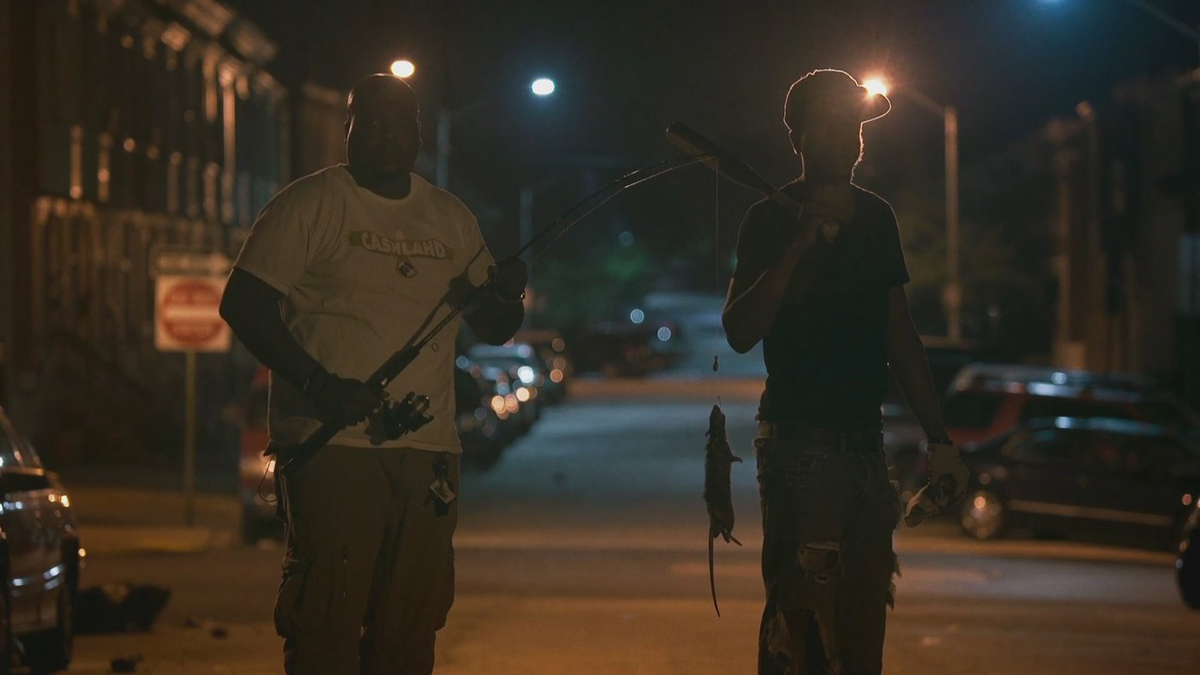 Rat Film[/caption]
Art of the Real, a showcase for boundary-pushing nonfiction film presented each year by the Film Society of Lincoln Center will open with the New York premiere of Theo Anthony’s eye-opening Rat Film, a buzzed-about film that creates a damning account of segregation and injustice in Baltimore via the cultural history of rats in the city.
New works by familiar names at the festival include World Without End (No Reported Incidents) from director Jem Cohen (Museum Hours, Benjamin Smoke), a sweet, structuralist look at three small English towns along the Thames Estuary; Pow Wow, a series of visually striking vignettes by Robinson Devor (Zoo); and Untitled, a moving elegy to the late Michael Glawogger composed of remarkable footage from the filmmaker’s unfinished final project, lovingly assembled by his longtime editor Monika Willi. Complementing the roster of esteemed filmmakers are works by innovative and exciting new artists, including Salomé Jashi, whose acerbic The Dazzling Light of Sunset follows a local news team in rural Georgia, and Shengze Zhu, whose compassionate Another Year follows a series of meals shared by a family of Chinese migrant workers, revealing both intimate household dynamics and the broader socioeconomic realities of the country.
Highlights also include the North American premiere of two works from Heinz Emigholz’s ambitious “Streetscapes” series—his magnum opus Streetscapes [Dialogue], and 2+2=22 [The Alphabet], a response to Godard’s One Plus One— and special events with artists Basma Alsharif, whose cine-performance Doppelgänger has been performed around the world, and Moyra Davey, who will participate in a career-spanning discussion after the U.S. premiere of her two new works, essayistic tributes to Chantal Akerman, Karl Ove Knausgård, and Virginia Woolf.
In addition, there will be a spotlight on Ignacio Agüero and José Luis Torres Leiva, two prominent Chilean documentarians whose works act in conversation. They will be represented here by one new premiere and one older film each, including Agüero’s This Is the Way I Like It II, in its U.S. premiere, which moves between past and present and follows the director as he interviews fellow filmmakers, and his personal The Other Day (2013), beautifully shot in his own home; and José Luis Torres Leiva’s The Sky, the Earth, and the Rain (2008), about four rural Chileans struggling to find meaningful connection, alongside the U.S. premiere of his The Wind Knows That I’m Coming Back Home, a hybrid work that features Agüero, following the elder filmmaker as he prepares to shoot his first fiction film.
This year’s Art of the Real also features a tribute to the late Brazilian filmmaker Andrea Tonacci, a key figure in Brazil’s udigrudi(“underground”) or marginal cinema movement, who passed away last December. Three rarely screened key films will be presented on 35mm, including Blah Blah Blah and Bang Bang, two short classics of the marginal cinema movement that opposed both Cinema Novo and Brazil’s military government, and Hills of Disorder, which tells the story of an indigenous man who survived the massacre of his tribe through a blend of re-enactments and archival news reports.
The fourth edition of Art of the Real will take place April 20 to May 2, 2017 at the Elinor Bunin Munroe Film Center (144 West 65th St.).
FILMS & DESCRIPTIONS
OPENING NIGHT
Rat Film
Theo Anthony, USA, 2016, 84m
Balancing a cultural history of rats in Baltimore with portraits of the city’s present-day rat catchers, Theo Anthony presents a damning account of entrenched racism and (sometimes questionable) scientific research ordered by governments and financial institutions. With a hypnotic voiceover by Maureen Jones and music by Baltimore native Dan Deacon, the film connects these multitudinous injustices with footage of Google Maps navigation, archival materials, interviews, poetry, and a tour of Frances Glessner Lee’s “Nutshell Studies of Unexplained Death” forensic dioramas. Dense but accessible, Rat Film is a vital document that refuses easy answers or classifications. A Cinema Guild release. New York Premiere
2+2=22 [The Alphabet]
Heinz Emigholz, Germany, 2017, 88m
German with English subtitles
Celebrated for his rigorous films about the experience of architecture (Schindler’s Houses, Loos Ornamental), Heinz Emigholz launches a new chapter of his “Photography and Beyond” project with an ambitious four-film cycle titled “Streetscapes” (which premiered to great acclaim at the recent Berlinale). The first installment is an open-ended response to Godard’s One Plus One, which chronicled the Rolling Stones in the studio at the height of the 1960s counterculture. This 21st-century update documents the German post-rock band Kreidler at work on their album ABC in a wood-paneled hall in Tbilisi, Georgia. Throughout Emigholz cuts to shots of the city streets outside and to the briskly leafed pages of his densely illustrated notebooks, while a voiceover ruminates on the nature of art and desire. North American Premiere
Ama-San
Cláudia Varejão, Portugal/Switzerland, 2016, 113m
Japanese with English subtitles
Cláudia Varejão’s intimate documentary focuses on women living in a small town off of Japan’s Shima Peninsula who have carried on the 2,000-year-old tradition of diving for pearls, sea urchins, and abalone. Challenging notions of how Japanese females are supposed to behave, the Ama (“sea women”) dive without scuba gear or oxygen tanks, wearing minimal protection. Like the Ama probing the ocean’s depths, Varejão’s camera examines the minutiae of the women’s day-to-day existence: their hair curlers, the sea salt clinging to their skin, and assorted daily feminine tasks that are all too often taken for granted. Winner of best Portuguese documentary at DocLisboa. U.S. Premiere
Another Year
Shengze Zhu, China, 2016, 181m
Chinese (Hubei dialect) with English subtitles
Thirteen meals shared by a family of migrant workers over 14 months. Through this simple premise, Shengze Zhu’s film speaks volumes about life in contemporary China. Shot in leisurely long takes with a static camera amid cramped living quarters, Another Yearconstantly finds something new and unexpected to focus on, magnifying small physical and psychological details and capturing subtly shifting family dynamics. Zhu uses her subjects as a microcosm for China’s broader socioeconomic realities, but her compassionate commitment to patient observation does justice to their specificity and dignity. U.S. Premiere
Brothers of the Night / Brüder der Nacht
Patric Chiha, Austria, 2016, 88m
Romani, Bulgarian, and German with English subtitles
In a Viennese underworld that’s somewhere between the theatrical glam of Fassbinder’s Querelle and the cinéma du look of 1980s France, Patric Chiha (Domain) follows a group of Bulgarian Roma who support their families back home by taking on gay sex work. Through stylized interviews and staged situations, these (mostly straight) men frankly discuss their rates, customers’ requests, and the financial hardships they face. Nevertheless, the film never shies away from the inherent humor and playfulness of human sexuality: every aspect of desire gets burlesqued, be it cash or water sports. U.S. Premiere
Casa Roshell
Camila José Donoso, Chile, 2016, 71m
Spanish with English subtitles
Roshell Terranova, 51, is the co-owner of Club Roshell, a transgender club on an unassuming street in Mexico City that holds “personality workshops” for its clientele, offering tutorials on makeup, costumes, heels, and other accessories. A “safe space” in the sincerest sense, the club allows men to eschew the limits of macho culture, push the boundaries of their own gender, and, as Roshell emphasizes in an address to the club’s patrons, to own their identities and desires, to feel pretty and less alone. As with her previous feature, Naomi Campbel (an Art of the Real 2015 selection), Camila José Donoso’s richly detailed film immerses itself in its world, mixing digital, 16mm film, and even closed-circuit TV footage to locate a glamorous utopia within the confines of the club. New York Premiere
The Dazzling Light of Sunset / Daisis miziduloba
Salomé Jashi, Georgia/Germany, 2016, 74m
Georgian with English subtitles
Beautifully shot and strangely comic, Salomé Jashi’s documentary follows Dariko and Khaka, an ultra-low-budget local news team in rural Georgia. Whether it’s elections, death announcements, a rare owl, or an oddly stressful fashion show for prepubescent and teenage girls, the pair approach each story without ego and with absolute professionalism, managing every aspect of reporting and production themselves. Through subtle editing choices, Jashi suggests that nothing truly changes in this former Soviet satellite—but allows her subjects to have one last acerbic word on the matter of representation. New York Premiere
Dark Skull / Viejo Calavera
Kiro Russo, Bolivia/Qatar, 2016, 80m
Spanish with English subtitles
A hybrid work set in the uniquely rough world of the Bolivian mines, Dark Skull is a character drama and an idiosyncratic portrait of workers’ daily lives. The narrative unfolds around the troubled and troublesome Elder, sent to live with his grandmother in Huanuni, a small country town in Bolivia. Once there, Elder proves a constant embarrassment to his godfather, Francisco, frequently skipping work to get drunk or high. But his off-the-clock activities eventually lead him to a dark secret about Francisco’s involvement in his father’s death. Shot largely inside the mines, and made in collaboration with the miners’ union, Kiro Russo’s elegant and formally daring film employs an ambitious structure and gorgeous cinematography to express the nuances and codes of the workers. New York Premiere
LIVE EVENT
Doppelgänger: a cine-performance by Basma Alsharif
2014, 45m
In Doppelgänger, which premiered at the Berlin Documentary Forum, and has since been performed at the Sharjah Biennial and in Gwangju, South Korea, artist and filmmaker Basma Alsharif examines her own family history and the concept of the double in a performance that reflexively weaves together the Occupation of Palestine, narrative cinema, and the possibility for Utopia. In reference to her own practice, Alsharif proposes how bilocation and doubling might enable the moving image to embody the Palestinian perspective, and invites the audience to engage in a new kind of voluntary collective memory. U.S. Premiere
Empathy
Jeffrey Dunn Rovinelli, USA, 2016, 83m
This rigorous yet sensitive debut from Jeffrey Dunn Rovinelli follows Em, a queer sex worker, as she moves between New York City and her native Pittsburgh, struggling to kick her heroin addiction and get on with her life. With intimate access to seemingly all aspects of her life—her friends, lovers, clients, and Em alone—we witness firsthand the difficulties of getting clean and are given a stark but touching image of what it means to be young and at odds with oneself today. Elegantly shot on a mixture of digital and Super 16mm film and suffused with an intricate and atmospheric score, Empathy deftly chronicles its subject’s attempts to regain (or preserve) a shred of autonomy and evokes both the tragedy and the comedy of dire personal struggles. North American Premiere
From a Year of Non-Events
Ann Carolin Renninger & René Frölke, Germany, 2017, 83m
German with English subtitles
The latest by Renninger and Frölke (Le Beau danger) tenderly traces the daily rhythms and rituals of 90-year-old Willi Detert on his rural northern German farm by way of an elegantly interwoven tapestry of 16mm and Super 8mm images. With Willi no longer able to work the land, the farm’s grounds are overrun and his house is littered with physical remnants of days gone by (and cats). In his presence, time itself passes in an altogether distinctive way, and the filmmakers meticulously capture this present speckled with the past. From a Year of Non-Events leaves us with a rich sense of both a man and a place as conduits for history. North American Premiere
Gray House
Austin Lynch & Matthew Booth, USA, 2017, 76m
Deftly blending vérité footage, interviews, landscapes, and fictional elements (some of which involve actors Denis Lavant and Aurore Clément), Gray House candidly explores blue-collar lives across five different settings. By way of stunning nocturnal imagery and a commandingly atmospheric sound design, the film presents glimpses of corners of the country seldom portrayed in cinema—trailer parks, industrial hallways, cluttered desks in small business offices—and methodically unearths their obscure beauty. Perhaps more urgently, Lynch and Booth provide ample screen time to American working-class people who are seen in films even less often, carving out a space for them to express their fears, desires, politics, and musings about their everyday realities. North American Premiere
In Time to Come
Tan Pin Pin, Singapore, 2017, 62m
Returning to themes of redevelopment and excavation of the past, Tan Pin Pin carefully probes the topography of Singapore with long, slow-burning shots of schoolchildren, shopping malls, and workers, digging up a time capsule buried by the state. Less overtly political than her film To Singapore, with Love (Art of the Real 2014), In Time to Come questions Singaporeans’ relationship to time and each other. In every quotidian interaction we witness, an underlying question burns: how can true connection take place when so much has been preshaped and destroyed by a government that’s only looking out for its own interests? U.S. Premiere
The Modern Jungle / La Selva Negra
Charles Fairbanks & Saul Kak, Mexico/USA, 2016, 72m
Zoque and Spanish with English subtitles
Centered on the relationship between indigenous and Western culture, The Modern Jungle documents the tensions that emerge when an elderly Zoque couple come into contact with global capitalism and the filmmaking process. Carmen and Juan are fighting to keep the small plot of land they’ve worked on their whole lives in southern Mexico. Juan, who is also a shaman, struggles with a hernia that traditional methods can’t treat, and soon gets sucked into a nutritional supplement pyramid scheme. Fairbanks and Kak (himself an advocate for indigenous rights) disclose upfront that Juan and Maria are being paid, dismissing long-held myths about “pure” relationships between ethnographer and subject. New York Premiere
MOYRA DAVEY: TWO PREMIERES
Hemlock Forest (2016, 42m) + Wedding Loop (2017, 23m)
Moyra Davey, USA
Steeped in personal and literary history, Moyra Davey’s videos explore compulsion, creativity, and the feminine. Hemlock Forest, a sequel to her 2011 work Les Goddesses, and Wedding Loop, employ the same rigorous formal strategy: Davey paces in front of the camera inside her apartment, reciting her narration from an iPhone, then incorporates old photographs or home movies to form a visual essay around the monologue. In the former, Davey traces the worlds of Karl Ove Knausgård and Chantal Akerman as she considers the implications of her son leaving home and Akerman’s suicide; the latter recounts a wedding party and the women involved, reflected through Virginia Woolf’s family history. An in-depth discussion, tracing many different facets of Davey’s decades-long career as an artist, will follow the screening. U.S. Premiere
The Other Day / El otro díaIgnacio
Agüero, Chile, 2013, 122m
Spanish with English subtitles
Ignacio Agüero fashions a documentary that manages to encompass his family and national history, Chile’s economic problems, identity, and nature via the most low-key of approaches: the film is shot primarily inside his home and through a door that leads to the street, establishing a clear line between the self and the world. Beautifully photographed, this impressive work locates the profound through family heirlooms and encounters with strangers who come knocking.
Pow Wow
Robinson Devor, USA, 2016, 72m
Robinson Devor (Police Beat, Zoo) returns to documentary after a 10-year hiatus with Pow Wow, a visually striking series of vignettes. Showcasing the many environmental contrasts of the Coachella Valley in Palm Springs, CA, the film has an equally diverse array of subjects, including legendary Las Vegas comedian Shecky Greene, an elderly Austrian heiress, trust-funders, Native Americans, and white golfers who participate in their club’s annual “pow wow” party by wearing feather headdresses. These slices of life gradually come to illustrate the story of Willie Boy, a Paiute youth who escaped a mounted posse on foot across 500 miles of desert in 1908. New York Premiere
The Sky, the Earth, and the Rain / El Cielo la tierra y la lluvia
José Luis Torres Leiva, Chile/France/Germany, 2008, 35mm, 112m
Spanish with English subtitles
In a remote, rural harbor town in southern Chile, Ana carries out her daily routines in silence, even when she’s with others. After she is fired, her gregarious best friend Veronica secures her a job as a housekeeper for Toro, a solitary man who lives outside the city. As the characters struggle to connect and discover themselves, Torres Leiva’s camera finds the beauty in their sepia-toned surroundings: the inside of Veronica’s home, a lonely forest path, the muddy bayous that encircle their town. As these moments accumulate, the film achieves a state of contemplative grace.
Streetscapes [Dialogue]
Heinz Emigholz, Germany, 2017, 132m
A director speaks at length to a psychoanalyst, confiding his obsessions, fears, ideas about cinema, and psychological blocks, and eventually comes to realize that this all-encompassing exchange could be the basis of a film . . . Streetscapes [Dialogue] is based on a six-day psychoanalytic marathon that Emigholz undertook with trauma specialist Zohar Rubinstein—their roles are played in the film by American actor John Erdman and Argentinian filmmaker Jonathan Perel, who are photographed in and around buildings in Uruguay by Julio Vilamajó, Eladio Dieste, and Arno Brandlhuber. The result is Emigholz’s magnum opus, a demonstration of his singular working methods, and a playful, moving treatise on trauma and architecture in which foreground and background carry equal weight. North American Premiere
This Is the Way I Like It II / Como me da la gana II
Ignacio Agüero, Chile, 2016, 86m
Spanish with English subtitles
In 1985, Ignacio Agüero spontaneously visited other Chilean directors on set to ask them about making films under Pinochet’s dictatorship. (The resulting 30-minute short, Como me da la gana, was, unsurprisingly, censored.) Thirty years later, Agüero revisits the concept, but he dramatically complicates it, by both rephrasing his line of questioning and repeatedly interrupting these recorded scenes with clips from his family’s home movies and his own films, interviews with random people, and landscape shots. This complex and entertaining film, which won the International Competition Grand Prix at FIDMarseille, dramatizes an ongoing negotiation between past and present. U.S. Premiere
THREE BY TONACCI
Blah Blah Blah / Blablablá (1968, 35mm, 26m) + Bang Bang / Bangue Bangue (1971, 35mm, 80m)
Andrea Tonacci, Brazil
Portuguese with English subtitles
A key figure in Brazil’s udigrudi (“underground”) or marginal cinema movement, Andrea Tonacci passed away last December at the age of 72. Blah Blah Blah, his seminal short, is a middle finger to both Cinema Novo and Brazil’s military government at the time: in the face of national crisis, a dictator makes a long speech on television, seeking to justify his government in order to achieve an illusory peace. Bang Bang, his structurally radical first feature, is a “Maoist detective comedy”: a monkey man is chased by a gang of bizarre criminals, each encounter growing increasingly absurd.
and
Hills of Disorder / Serras da Desordem
Andrea Tonacci, Brazil, 2006, 35mm, 135m
Portuguese with English subtitles
Remaining true to his radical roots, Andrea Tonacci retells the true story of Carapiru, an indigenous man who survived the massacre of his tribe in 1978, roaming over 350 miles through the mountains of Central Brazil and toward Western civilization. Years later, a government agency attempts to resettle him to his native village—yet another uprooting. Commenting on Brazil’s alternately fetishistic and ugly treatment of native peoples as well as the director’s own gaze, Tonacci’s penultimate film constantly asks difficult questions, and employs a challenging aesthetic approach that blends re-enactments and archival news reports.
Untitled
Michael Glawogger & Monika Willi, Austria, 2017, 107m
In English and German with English subtitles
A traveling filmmaker who found beauty in some of the harshest living conditions on the planet, Michael Glawogger (Whores’ Glory, Workingman’s Death) contracted malaria and died in 2014 while filming in Liberia, a little over four months into what was meant to be a year-long journey around the world. (“The most beautiful film I could imagine is one which would never come to rest,” he said of the project.) His longtime editor, Monika Willi, has assembled the extraordinary footage—shot by Attila Boa—into Untitled, based on Glawogger’s notes for its completion and incorporating excerpts from his witty and meditative journal entries. The result is a revelatory glimpse into Glawogger’s ideas and process as well as a moving elegy to the man. North American Premiere
Voyage to Terengganu / Kisah Pelayaran Ke Terengganu
Amir Muhammad & Badrul Hisham Ismail, Malaysia, 2016, 62m
Malay with English subtitles
Retracing the early 19th-century travels of the great Malaysian writer Munshi Abdullah, Amir Muhammad (The Big Durian) and Badrul Hisham Ismail journey across the state of Terengganu and interview its inhabitants, including a dirt bike enthusiast/mechanic, the owner of a camera repair shop, and various wheeler-dealers at the marketplace. Interspersing these present-day observations with excerpts of Abdullah’s text—by turns critical and ironic, some outdated and some still relevant—the directors fashion a warm, sly, humanistic travelogue that explores their countrymen’s beliefs about money, religion, and nationhood. North American Premiere
The Wind Knows That I’m Coming Back Home / El viento sabe que vuelvo a casa
José Luis Torres Leiva, Chile, 2016, 103m
Spanish with English subtitles
In the early 1980s, a couple vanished without a trace in the woods of Meulín Island. Director Ignacio Agüero (This Is the Way I Like It II) had intended to shoot a documentary about this strange occurrence, but eventually abandoned the project. Now, he journeys to the area to shoot his first fiction film based on the events, and José Luis Torre Leiva follows Agüero as he speaks with locals about the legends that have arisen surrounding this mysterious occurrence in between scouting for locations and auditioning nonprofessionals, who often provide a source of tender comic relief. The film is also a meditation on the isolation of those living on Chile’s Chiloé Archipelago, capturing its unique and solitary landscapes. U.S. Premiere
World Without End (No Reported Incidents)
Jem Cohen, USA/UK, 2016, 56m
Perfectly encapsulating the sweet-hearted chatter unique to small-town England, Jem Cohen offers views of three different (yet almost identical) cities along the Thames Estuary: Southend-on-Sea, Leigh-on-Sea, and Canvey Island. With a structuralist approach, Cohen (Museum Hours) shows the high street, black sand dunes, and shops with great care; meanwhile, the cities’ inhabitants offer insights into the class codes of hats, Indian curry, the imaginary beaches of London, and punk rock (courtesy of members of Dr. Feelgood). A Grasshopper Film release. New York Premiere
Rat Film[/caption]
Art of the Real, a showcase for boundary-pushing nonfiction film presented each year by the Film Society of Lincoln Center will open with the New York premiere of Theo Anthony’s eye-opening Rat Film, a buzzed-about film that creates a damning account of segregation and injustice in Baltimore via the cultural history of rats in the city.
New works by familiar names at the festival include World Without End (No Reported Incidents) from director Jem Cohen (Museum Hours, Benjamin Smoke), a sweet, structuralist look at three small English towns along the Thames Estuary; Pow Wow, a series of visually striking vignettes by Robinson Devor (Zoo); and Untitled, a moving elegy to the late Michael Glawogger composed of remarkable footage from the filmmaker’s unfinished final project, lovingly assembled by his longtime editor Monika Willi. Complementing the roster of esteemed filmmakers are works by innovative and exciting new artists, including Salomé Jashi, whose acerbic The Dazzling Light of Sunset follows a local news team in rural Georgia, and Shengze Zhu, whose compassionate Another Year follows a series of meals shared by a family of Chinese migrant workers, revealing both intimate household dynamics and the broader socioeconomic realities of the country.
Highlights also include the North American premiere of two works from Heinz Emigholz’s ambitious “Streetscapes” series—his magnum opus Streetscapes [Dialogue], and 2+2=22 [The Alphabet], a response to Godard’s One Plus One— and special events with artists Basma Alsharif, whose cine-performance Doppelgänger has been performed around the world, and Moyra Davey, who will participate in a career-spanning discussion after the U.S. premiere of her two new works, essayistic tributes to Chantal Akerman, Karl Ove Knausgård, and Virginia Woolf.
In addition, there will be a spotlight on Ignacio Agüero and José Luis Torres Leiva, two prominent Chilean documentarians whose works act in conversation. They will be represented here by one new premiere and one older film each, including Agüero’s This Is the Way I Like It II, in its U.S. premiere, which moves between past and present and follows the director as he interviews fellow filmmakers, and his personal The Other Day (2013), beautifully shot in his own home; and José Luis Torres Leiva’s The Sky, the Earth, and the Rain (2008), about four rural Chileans struggling to find meaningful connection, alongside the U.S. premiere of his The Wind Knows That I’m Coming Back Home, a hybrid work that features Agüero, following the elder filmmaker as he prepares to shoot his first fiction film.
This year’s Art of the Real also features a tribute to the late Brazilian filmmaker Andrea Tonacci, a key figure in Brazil’s udigrudi(“underground”) or marginal cinema movement, who passed away last December. Three rarely screened key films will be presented on 35mm, including Blah Blah Blah and Bang Bang, two short classics of the marginal cinema movement that opposed both Cinema Novo and Brazil’s military government, and Hills of Disorder, which tells the story of an indigenous man who survived the massacre of his tribe through a blend of re-enactments and archival news reports.
The fourth edition of Art of the Real will take place April 20 to May 2, 2017 at the Elinor Bunin Munroe Film Center (144 West 65th St.).
FILMS & DESCRIPTIONS
OPENING NIGHT
Rat Film
Theo Anthony, USA, 2016, 84m
Balancing a cultural history of rats in Baltimore with portraits of the city’s present-day rat catchers, Theo Anthony presents a damning account of entrenched racism and (sometimes questionable) scientific research ordered by governments and financial institutions. With a hypnotic voiceover by Maureen Jones and music by Baltimore native Dan Deacon, the film connects these multitudinous injustices with footage of Google Maps navigation, archival materials, interviews, poetry, and a tour of Frances Glessner Lee’s “Nutshell Studies of Unexplained Death” forensic dioramas. Dense but accessible, Rat Film is a vital document that refuses easy answers or classifications. A Cinema Guild release. New York Premiere
2+2=22 [The Alphabet]
Heinz Emigholz, Germany, 2017, 88m
German with English subtitles
Celebrated for his rigorous films about the experience of architecture (Schindler’s Houses, Loos Ornamental), Heinz Emigholz launches a new chapter of his “Photography and Beyond” project with an ambitious four-film cycle titled “Streetscapes” (which premiered to great acclaim at the recent Berlinale). The first installment is an open-ended response to Godard’s One Plus One, which chronicled the Rolling Stones in the studio at the height of the 1960s counterculture. This 21st-century update documents the German post-rock band Kreidler at work on their album ABC in a wood-paneled hall in Tbilisi, Georgia. Throughout Emigholz cuts to shots of the city streets outside and to the briskly leafed pages of his densely illustrated notebooks, while a voiceover ruminates on the nature of art and desire. North American Premiere
Ama-San
Cláudia Varejão, Portugal/Switzerland, 2016, 113m
Japanese with English subtitles
Cláudia Varejão’s intimate documentary focuses on women living in a small town off of Japan’s Shima Peninsula who have carried on the 2,000-year-old tradition of diving for pearls, sea urchins, and abalone. Challenging notions of how Japanese females are supposed to behave, the Ama (“sea women”) dive without scuba gear or oxygen tanks, wearing minimal protection. Like the Ama probing the ocean’s depths, Varejão’s camera examines the minutiae of the women’s day-to-day existence: their hair curlers, the sea salt clinging to their skin, and assorted daily feminine tasks that are all too often taken for granted. Winner of best Portuguese documentary at DocLisboa. U.S. Premiere
Another Year
Shengze Zhu, China, 2016, 181m
Chinese (Hubei dialect) with English subtitles
Thirteen meals shared by a family of migrant workers over 14 months. Through this simple premise, Shengze Zhu’s film speaks volumes about life in contemporary China. Shot in leisurely long takes with a static camera amid cramped living quarters, Another Yearconstantly finds something new and unexpected to focus on, magnifying small physical and psychological details and capturing subtly shifting family dynamics. Zhu uses her subjects as a microcosm for China’s broader socioeconomic realities, but her compassionate commitment to patient observation does justice to their specificity and dignity. U.S. Premiere
Brothers of the Night / Brüder der Nacht
Patric Chiha, Austria, 2016, 88m
Romani, Bulgarian, and German with English subtitles
In a Viennese underworld that’s somewhere between the theatrical glam of Fassbinder’s Querelle and the cinéma du look of 1980s France, Patric Chiha (Domain) follows a group of Bulgarian Roma who support their families back home by taking on gay sex work. Through stylized interviews and staged situations, these (mostly straight) men frankly discuss their rates, customers’ requests, and the financial hardships they face. Nevertheless, the film never shies away from the inherent humor and playfulness of human sexuality: every aspect of desire gets burlesqued, be it cash or water sports. U.S. Premiere
Casa Roshell
Camila José Donoso, Chile, 2016, 71m
Spanish with English subtitles
Roshell Terranova, 51, is the co-owner of Club Roshell, a transgender club on an unassuming street in Mexico City that holds “personality workshops” for its clientele, offering tutorials on makeup, costumes, heels, and other accessories. A “safe space” in the sincerest sense, the club allows men to eschew the limits of macho culture, push the boundaries of their own gender, and, as Roshell emphasizes in an address to the club’s patrons, to own their identities and desires, to feel pretty and less alone. As with her previous feature, Naomi Campbel (an Art of the Real 2015 selection), Camila José Donoso’s richly detailed film immerses itself in its world, mixing digital, 16mm film, and even closed-circuit TV footage to locate a glamorous utopia within the confines of the club. New York Premiere
The Dazzling Light of Sunset / Daisis miziduloba
Salomé Jashi, Georgia/Germany, 2016, 74m
Georgian with English subtitles
Beautifully shot and strangely comic, Salomé Jashi’s documentary follows Dariko and Khaka, an ultra-low-budget local news team in rural Georgia. Whether it’s elections, death announcements, a rare owl, or an oddly stressful fashion show for prepubescent and teenage girls, the pair approach each story without ego and with absolute professionalism, managing every aspect of reporting and production themselves. Through subtle editing choices, Jashi suggests that nothing truly changes in this former Soviet satellite—but allows her subjects to have one last acerbic word on the matter of representation. New York Premiere
Dark Skull / Viejo Calavera
Kiro Russo, Bolivia/Qatar, 2016, 80m
Spanish with English subtitles
A hybrid work set in the uniquely rough world of the Bolivian mines, Dark Skull is a character drama and an idiosyncratic portrait of workers’ daily lives. The narrative unfolds around the troubled and troublesome Elder, sent to live with his grandmother in Huanuni, a small country town in Bolivia. Once there, Elder proves a constant embarrassment to his godfather, Francisco, frequently skipping work to get drunk or high. But his off-the-clock activities eventually lead him to a dark secret about Francisco’s involvement in his father’s death. Shot largely inside the mines, and made in collaboration with the miners’ union, Kiro Russo’s elegant and formally daring film employs an ambitious structure and gorgeous cinematography to express the nuances and codes of the workers. New York Premiere
LIVE EVENT
Doppelgänger: a cine-performance by Basma Alsharif
2014, 45m
In Doppelgänger, which premiered at the Berlin Documentary Forum, and has since been performed at the Sharjah Biennial and in Gwangju, South Korea, artist and filmmaker Basma Alsharif examines her own family history and the concept of the double in a performance that reflexively weaves together the Occupation of Palestine, narrative cinema, and the possibility for Utopia. In reference to her own practice, Alsharif proposes how bilocation and doubling might enable the moving image to embody the Palestinian perspective, and invites the audience to engage in a new kind of voluntary collective memory. U.S. Premiere
Empathy
Jeffrey Dunn Rovinelli, USA, 2016, 83m
This rigorous yet sensitive debut from Jeffrey Dunn Rovinelli follows Em, a queer sex worker, as she moves between New York City and her native Pittsburgh, struggling to kick her heroin addiction and get on with her life. With intimate access to seemingly all aspects of her life—her friends, lovers, clients, and Em alone—we witness firsthand the difficulties of getting clean and are given a stark but touching image of what it means to be young and at odds with oneself today. Elegantly shot on a mixture of digital and Super 16mm film and suffused with an intricate and atmospheric score, Empathy deftly chronicles its subject’s attempts to regain (or preserve) a shred of autonomy and evokes both the tragedy and the comedy of dire personal struggles. North American Premiere
From a Year of Non-Events
Ann Carolin Renninger & René Frölke, Germany, 2017, 83m
German with English subtitles
The latest by Renninger and Frölke (Le Beau danger) tenderly traces the daily rhythms and rituals of 90-year-old Willi Detert on his rural northern German farm by way of an elegantly interwoven tapestry of 16mm and Super 8mm images. With Willi no longer able to work the land, the farm’s grounds are overrun and his house is littered with physical remnants of days gone by (and cats). In his presence, time itself passes in an altogether distinctive way, and the filmmakers meticulously capture this present speckled with the past. From a Year of Non-Events leaves us with a rich sense of both a man and a place as conduits for history. North American Premiere
Gray House
Austin Lynch & Matthew Booth, USA, 2017, 76m
Deftly blending vérité footage, interviews, landscapes, and fictional elements (some of which involve actors Denis Lavant and Aurore Clément), Gray House candidly explores blue-collar lives across five different settings. By way of stunning nocturnal imagery and a commandingly atmospheric sound design, the film presents glimpses of corners of the country seldom portrayed in cinema—trailer parks, industrial hallways, cluttered desks in small business offices—and methodically unearths their obscure beauty. Perhaps more urgently, Lynch and Booth provide ample screen time to American working-class people who are seen in films even less often, carving out a space for them to express their fears, desires, politics, and musings about their everyday realities. North American Premiere
In Time to Come
Tan Pin Pin, Singapore, 2017, 62m
Returning to themes of redevelopment and excavation of the past, Tan Pin Pin carefully probes the topography of Singapore with long, slow-burning shots of schoolchildren, shopping malls, and workers, digging up a time capsule buried by the state. Less overtly political than her film To Singapore, with Love (Art of the Real 2014), In Time to Come questions Singaporeans’ relationship to time and each other. In every quotidian interaction we witness, an underlying question burns: how can true connection take place when so much has been preshaped and destroyed by a government that’s only looking out for its own interests? U.S. Premiere
The Modern Jungle / La Selva Negra
Charles Fairbanks & Saul Kak, Mexico/USA, 2016, 72m
Zoque and Spanish with English subtitles
Centered on the relationship between indigenous and Western culture, The Modern Jungle documents the tensions that emerge when an elderly Zoque couple come into contact with global capitalism and the filmmaking process. Carmen and Juan are fighting to keep the small plot of land they’ve worked on their whole lives in southern Mexico. Juan, who is also a shaman, struggles with a hernia that traditional methods can’t treat, and soon gets sucked into a nutritional supplement pyramid scheme. Fairbanks and Kak (himself an advocate for indigenous rights) disclose upfront that Juan and Maria are being paid, dismissing long-held myths about “pure” relationships between ethnographer and subject. New York Premiere
MOYRA DAVEY: TWO PREMIERES
Hemlock Forest (2016, 42m) + Wedding Loop (2017, 23m)
Moyra Davey, USA
Steeped in personal and literary history, Moyra Davey’s videos explore compulsion, creativity, and the feminine. Hemlock Forest, a sequel to her 2011 work Les Goddesses, and Wedding Loop, employ the same rigorous formal strategy: Davey paces in front of the camera inside her apartment, reciting her narration from an iPhone, then incorporates old photographs or home movies to form a visual essay around the monologue. In the former, Davey traces the worlds of Karl Ove Knausgård and Chantal Akerman as she considers the implications of her son leaving home and Akerman’s suicide; the latter recounts a wedding party and the women involved, reflected through Virginia Woolf’s family history. An in-depth discussion, tracing many different facets of Davey’s decades-long career as an artist, will follow the screening. U.S. Premiere
The Other Day / El otro díaIgnacio
Agüero, Chile, 2013, 122m
Spanish with English subtitles
Ignacio Agüero fashions a documentary that manages to encompass his family and national history, Chile’s economic problems, identity, and nature via the most low-key of approaches: the film is shot primarily inside his home and through a door that leads to the street, establishing a clear line between the self and the world. Beautifully photographed, this impressive work locates the profound through family heirlooms and encounters with strangers who come knocking.
Pow Wow
Robinson Devor, USA, 2016, 72m
Robinson Devor (Police Beat, Zoo) returns to documentary after a 10-year hiatus with Pow Wow, a visually striking series of vignettes. Showcasing the many environmental contrasts of the Coachella Valley in Palm Springs, CA, the film has an equally diverse array of subjects, including legendary Las Vegas comedian Shecky Greene, an elderly Austrian heiress, trust-funders, Native Americans, and white golfers who participate in their club’s annual “pow wow” party by wearing feather headdresses. These slices of life gradually come to illustrate the story of Willie Boy, a Paiute youth who escaped a mounted posse on foot across 500 miles of desert in 1908. New York Premiere
The Sky, the Earth, and the Rain / El Cielo la tierra y la lluvia
José Luis Torres Leiva, Chile/France/Germany, 2008, 35mm, 112m
Spanish with English subtitles
In a remote, rural harbor town in southern Chile, Ana carries out her daily routines in silence, even when she’s with others. After she is fired, her gregarious best friend Veronica secures her a job as a housekeeper for Toro, a solitary man who lives outside the city. As the characters struggle to connect and discover themselves, Torres Leiva’s camera finds the beauty in their sepia-toned surroundings: the inside of Veronica’s home, a lonely forest path, the muddy bayous that encircle their town. As these moments accumulate, the film achieves a state of contemplative grace.
Streetscapes [Dialogue]
Heinz Emigholz, Germany, 2017, 132m
A director speaks at length to a psychoanalyst, confiding his obsessions, fears, ideas about cinema, and psychological blocks, and eventually comes to realize that this all-encompassing exchange could be the basis of a film . . . Streetscapes [Dialogue] is based on a six-day psychoanalytic marathon that Emigholz undertook with trauma specialist Zohar Rubinstein—their roles are played in the film by American actor John Erdman and Argentinian filmmaker Jonathan Perel, who are photographed in and around buildings in Uruguay by Julio Vilamajó, Eladio Dieste, and Arno Brandlhuber. The result is Emigholz’s magnum opus, a demonstration of his singular working methods, and a playful, moving treatise on trauma and architecture in which foreground and background carry equal weight. North American Premiere
This Is the Way I Like It II / Como me da la gana II
Ignacio Agüero, Chile, 2016, 86m
Spanish with English subtitles
In 1985, Ignacio Agüero spontaneously visited other Chilean directors on set to ask them about making films under Pinochet’s dictatorship. (The resulting 30-minute short, Como me da la gana, was, unsurprisingly, censored.) Thirty years later, Agüero revisits the concept, but he dramatically complicates it, by both rephrasing his line of questioning and repeatedly interrupting these recorded scenes with clips from his family’s home movies and his own films, interviews with random people, and landscape shots. This complex and entertaining film, which won the International Competition Grand Prix at FIDMarseille, dramatizes an ongoing negotiation between past and present. U.S. Premiere
THREE BY TONACCI
Blah Blah Blah / Blablablá (1968, 35mm, 26m) + Bang Bang / Bangue Bangue (1971, 35mm, 80m)
Andrea Tonacci, Brazil
Portuguese with English subtitles
A key figure in Brazil’s udigrudi (“underground”) or marginal cinema movement, Andrea Tonacci passed away last December at the age of 72. Blah Blah Blah, his seminal short, is a middle finger to both Cinema Novo and Brazil’s military government at the time: in the face of national crisis, a dictator makes a long speech on television, seeking to justify his government in order to achieve an illusory peace. Bang Bang, his structurally radical first feature, is a “Maoist detective comedy”: a monkey man is chased by a gang of bizarre criminals, each encounter growing increasingly absurd.
and
Hills of Disorder / Serras da Desordem
Andrea Tonacci, Brazil, 2006, 35mm, 135m
Portuguese with English subtitles
Remaining true to his radical roots, Andrea Tonacci retells the true story of Carapiru, an indigenous man who survived the massacre of his tribe in 1978, roaming over 350 miles through the mountains of Central Brazil and toward Western civilization. Years later, a government agency attempts to resettle him to his native village—yet another uprooting. Commenting on Brazil’s alternately fetishistic and ugly treatment of native peoples as well as the director’s own gaze, Tonacci’s penultimate film constantly asks difficult questions, and employs a challenging aesthetic approach that blends re-enactments and archival news reports.
Untitled
Michael Glawogger & Monika Willi, Austria, 2017, 107m
In English and German with English subtitles
A traveling filmmaker who found beauty in some of the harshest living conditions on the planet, Michael Glawogger (Whores’ Glory, Workingman’s Death) contracted malaria and died in 2014 while filming in Liberia, a little over four months into what was meant to be a year-long journey around the world. (“The most beautiful film I could imagine is one which would never come to rest,” he said of the project.) His longtime editor, Monika Willi, has assembled the extraordinary footage—shot by Attila Boa—into Untitled, based on Glawogger’s notes for its completion and incorporating excerpts from his witty and meditative journal entries. The result is a revelatory glimpse into Glawogger’s ideas and process as well as a moving elegy to the man. North American Premiere
Voyage to Terengganu / Kisah Pelayaran Ke Terengganu
Amir Muhammad & Badrul Hisham Ismail, Malaysia, 2016, 62m
Malay with English subtitles
Retracing the early 19th-century travels of the great Malaysian writer Munshi Abdullah, Amir Muhammad (The Big Durian) and Badrul Hisham Ismail journey across the state of Terengganu and interview its inhabitants, including a dirt bike enthusiast/mechanic, the owner of a camera repair shop, and various wheeler-dealers at the marketplace. Interspersing these present-day observations with excerpts of Abdullah’s text—by turns critical and ironic, some outdated and some still relevant—the directors fashion a warm, sly, humanistic travelogue that explores their countrymen’s beliefs about money, religion, and nationhood. North American Premiere
The Wind Knows That I’m Coming Back Home / El viento sabe que vuelvo a casa
José Luis Torres Leiva, Chile, 2016, 103m
Spanish with English subtitles
In the early 1980s, a couple vanished without a trace in the woods of Meulín Island. Director Ignacio Agüero (This Is the Way I Like It II) had intended to shoot a documentary about this strange occurrence, but eventually abandoned the project. Now, he journeys to the area to shoot his first fiction film based on the events, and José Luis Torre Leiva follows Agüero as he speaks with locals about the legends that have arisen surrounding this mysterious occurrence in between scouting for locations and auditioning nonprofessionals, who often provide a source of tender comic relief. The film is also a meditation on the isolation of those living on Chile’s Chiloé Archipelago, capturing its unique and solitary landscapes. U.S. Premiere
World Without End (No Reported Incidents)
Jem Cohen, USA/UK, 2016, 56m
Perfectly encapsulating the sweet-hearted chatter unique to small-town England, Jem Cohen offers views of three different (yet almost identical) cities along the Thames Estuary: Southend-on-Sea, Leigh-on-Sea, and Canvey Island. With a structuralist approach, Cohen (Museum Hours) shows the high street, black sand dunes, and shops with great care; meanwhile, the cities’ inhabitants offer insights into the class codes of hats, Indian curry, the imaginary beaches of London, and punk rock (courtesy of members of Dr. Feelgood). A Grasshopper Film release. New York Premiere
 The Other Side, Roberto Minervini[/caption]
The 2016 Art of the Real, an essential showcase for boundary-pushing nonfiction film, will run April 8 to 21, 2016, in New York City, presented by the Film Society of Lincoln Center.
Founded on the most expansive possible view of documentary film, the series features an eclectic, globe-spanning host of discoveries by artists who are reenvisioning the relationship between cinema and reality, with one World Premiere, eight North American Premieres, and seven U.S. premieres, and many of the filmmakers in person.
“This is perhaps our strongest and most diverse edition yet, and one that truly affirms the impulse behind Art of the Real: the most exciting and essential films being made today are precisely those that defy genres and confound expectations, and that find bold new ways of reimagining cinema’s relationship with the real,” said Director of Programming Dennis Lim, who organized the festival with Programmer at Large Rachael Rakes.
The two Opening Night selections are the World Premiere of Ben Rivers’s What Means Something, an intimate portrait of painter Rose Wylie at work, and ND/NF alum Roberto Minervini’s The Other Side, an indelible, surprising, and often unnerving portrait of Louisianan junkies that was a highlight of Cannes’ Un Certain Regard section.
[caption id="attachment_11805" align="aligncenter" width="1200"]
The Other Side, Roberto Minervini[/caption]
The 2016 Art of the Real, an essential showcase for boundary-pushing nonfiction film, will run April 8 to 21, 2016, in New York City, presented by the Film Society of Lincoln Center.
Founded on the most expansive possible view of documentary film, the series features an eclectic, globe-spanning host of discoveries by artists who are reenvisioning the relationship between cinema and reality, with one World Premiere, eight North American Premieres, and seven U.S. premieres, and many of the filmmakers in person.
“This is perhaps our strongest and most diverse edition yet, and one that truly affirms the impulse behind Art of the Real: the most exciting and essential films being made today are precisely those that defy genres and confound expectations, and that find bold new ways of reimagining cinema’s relationship with the real,” said Director of Programming Dennis Lim, who organized the festival with Programmer at Large Rachael Rakes.
The two Opening Night selections are the World Premiere of Ben Rivers’s What Means Something, an intimate portrait of painter Rose Wylie at work, and ND/NF alum Roberto Minervini’s The Other Side, an indelible, surprising, and often unnerving portrait of Louisianan junkies that was a highlight of Cannes’ Un Certain Regard section.
[caption id="attachment_11805" align="aligncenter" width="1200"] A Magical Substance Flows Into Me, Jumana Manna[/caption]
Closing the festival is the North American premiere of Jumana Manna’s A Magical Substance Flows Into Me, in which the Palestinian artist brings German-Jewish ethnomusicologist Robert Lachmann’s recordings from 1930s Palestine to modern-day Israeli and Palestinian territories, re-creating the songs across communities and cultures.
In addition to Rivers and Manna’s films, a number of selections in this year’s lineup marry nonfiction cinema and the arts: José Luis Guerín’s The Academy of the Muses is a meditation on film, art, and gender via a simulated college seminar about the role of woman-as-muse in art, attended entirely by actresses; Ruth Beckermann’s minimalist The Dreamed Ones, in which a pair of actors bring to life the tragic love story of two mid-century poets by reading their letters aloud before the camera; and Thom Andersen’s The Thoughts That Once We Had, a film inspired by French philosopher Gilles Deleuze’s writings on cinema.
New works by familiar names include Jean-Gabriel Periot’s A German Youth, which charts the evolution of the Red Army Faction using only archival footage; Andrea Bussmann and Nicolás Pereda’s Tales of Two Who Dreamt, a black-and-white look at a Roma family seeking asylum in Toronto; and Kazuhiro Soda’s latest verité opus Oyster Factory, a fly-on-the-wall chronicle of a struggling Japanese fishery.
Many films in the 2016 edition have garnered acclaim at festivals and exhibitions around the globe, including three highlights from the Venice Biennale: Im Heung-soon’s Silver Lion–winner Factory Complex, and the shorts One.Two.Three by Vincent Meessen and Sea State Six by Charles Lim, where the two artists represented the Belgian and Singapore Pavilions, respectively; Andrés Duque’s Oleg and the Rare Arts, a freeform portrait of Russian pianist Oleg Nikolaevitch Karavaychuk that won the top prize at Punto de Vista’s documentary festival; Ju Anqi’s bawdy, absurdist Poet on a Business Trip, which won the Grand Prize of the 2015 Jeonju International Film Festival; Alessio Rigo de Righi and Matteo Zoppis’s Il Solengo, winner of DocLisboa’s 2015 Best International Film Award; and Mauro Herce’s exquisitely shot Dead Slow Ahead, winner of the Special Jury prize at Locarno 2015, a surreal look at the journey of a freighter from Ukraine to New Orleans.
This year’s festival also features a retrospective of the legendary Bruce Baillie, whose lyrical films defy traditional form and genre. From autobiographical documentary to cosmic mythology, the retrospective pays homage to Baillie’s work as an artist, and also recognizes his legacy as a distributor and promoter of avant-garde filmmakers. Consisting of five programs of short films, including his social documentaries, his collaborations with the Canyon Cinema Community, which he founded, and an exploration of the connection his films have to those of his longtime friend Stan Brakhage, All My Life: The Films of Bruce Baillie examines his far-reaching influence on experimental and nonfiction cinema. After Art of the Real, the retrospective, organized by curator Garbiñe Ortega, will travel around the country and internationally; more details will be announced later.
In addition to the repertory offerings in the retrospective, a revival of Philip Trevelyan’s 1971 The Moon and the Sledgehammer, a portrait of an eccentric family living off the grid outside of London, will screen in a new print. Following the film, Trevelyan will appear in person for a conversation moderated by our Opening Night filmmaker Ben Rivers.
FILMS & DESCRIPTIONS
Opening Night
The Other Side
Roberto Minervini, France/Italy, 2015, 92m
Roberto Minervini’s follow-up to his acclaimed “Texas Trilogy” (including Stop the Pounding Heart, New Directors/New Films 2014) is an indelible, surprising, and often unnerving portrait of bayou nihilism. Focusing primarily on Louisianian junkies Mark Kelley and Lisa Allen, Minervini immerses us in their daily routines—shooting up, shooting their mouths off, and just plain shooting—with an eye and ear for unexpected poetry and comedy, as well as for the political ramifications of their downtrodden, hedonistic libertarianism. Minervini tactfully presents his subjects in all their contradictions, permitting them a freedom that contrasts with the liberties they paranoiacally intend to protect from the federal government. In light of the Ammon Bundy militia, and in an election year of inflammatory rhetoric, it’s hard to imagine a more topical or more essential film. A Film Movement release.
Opening Night
What Means Something
Ben Rivers, UK, 2015, 67m
In the spirit of his previous explorations of solitude (including Two Years at Sea and A Spell to Ward Off the Darkness), Ben Rivers shows painter Rose Wylie at work—in real time—inside her home. Neither passive nor overly styled, this intimate portrait of an artist truly illuminates her singular creative process. In lone sections of the film that acknowledge the camera’s presence, Wylie speaks about her past work while thumbing through a sketchbook and reads an extensive passage from an essay titled “What Are Masterpieces?” A treat for both fans of the artist and the director. World Premiere
Closing Night
A Magical Substance Flows Into Me
Jumana Manna, Palestine/Germany/UK, 2015, 68m
English, Arabic, and Hebrew with English subtitles
Artist Jumana Manna picks up the torch of musicologist Robert Lachmann, a Palestinian analogue to Alan Lomax. Lachmann moved from Berlin to Jerusalem in 1935 to found a department of “Oriental” music at Hebrew University, and hosted a radio program on Palestine Broadcasting Service that featured pieces from the country’s ethnic and religious groups. Manna includes snippets of the broadcasts, and returns to record captivating performances from contemporary musicians in these communities. Unpretentious in its approach and beautifully photographed, this infectious film proves Manna a master of conveying both the quotidian and the staged. North American Premiere
The Academy of the Muses / La academia de las musas
José Luis Guerín, Spain, 2015, 92m
Italian and Spanish with English subtitles
The director of In the City of Sylvia returns with a thought-provoking meditation on film form, art, love, and gender. University of Barcelona philology professor Raffaele Pinto leads a simulated college seminar on women’s roles in inspiring art and historical literary muses, attended entirely by actresses. Their objections to his arguments are sharp and profound—as are the professor’s post-class discussions with his wise wife. The film also incorporates moments of the women in and around Barcelona, relating both mythological parables and deeply personal stories about their relationships. A favorite at the Locarno Film Festival and Film Comment’s fourth best undistributed film of 2015. U.S. Premiere
Dead Slow Ahead
Mauro Herce, Spain, 2014, 74m
English, Spanish, French, and Tagalog with English subtitles
Winner of the Special Jury prize at Locarno 2015, Mauro Herce’s slow epic transforms a commercial freighter and the landscapes it traverses into a truly surreal experience. Tracing the ship’s journey from Ukraine and New Orleans, time eventually decelerates to the point of abstraction, the sound of its machinery creating an otherworldly atmosphere. The immaculate, solitary visuals—which have the power to distort sights as familiar as a sunrise—demand to be seen inside a theater. More incredibly still, Herce manages to deliver slices of the Filipino crew’s lives—and then effortlessly transition back to the alien.
The Dreamed Ones / Die Geträumten
Ruth Beckermann, Austria, 2016, 89m
German with English subtitles
Ruth Beckermann’s unconventional record of a tragic love story surveys its prospects and impossibilities in the wake of World War II. Ingeborg Bachmann and Paul Celan, two key German-language poets, exchanged letters from 1948 to 1967, and Beckermann presents this remarkable correspondence before the camera with two young, attractive actors (Anja Plaschg and Laurence Rupp) reading them at a studio in Vienna’s Funkhaus. Plaschg and Rupp expose the complexities and emotions beneath the lovers’ words through their speech and expressions, both in and out of character, as Beckermann captures them on cigarette breaks, commenting on the text, peering in on orchestral rehearsals, or listening to music on an iPhone. As much a retelling of a doomed romance as an exploration of the reverberating effects of a global tragedy, The Dreamed Ones is a minimalist tour de force, as emotionally wrenching as it is elegantly precise. Director’s appearance made possible with the generous support from the Austrian Cultural Forum New York. North American Premiere
Fragment 53
Federico Lodoli & Carlo Gabriele Tribbioli, Italy/Switzerland/Liberia, 2015, 71m
English, Italian, and Mande with English subtitles
Comprising interviews with seven different men of varying rank about atrocities they committed (or ordered) during the First Liberian Civil War, this frank and frequently disturbing documentary examines the nature of modern violence and an essentialist concept of warfare. Their testimony, interspersed with snapshots of Liberia’s streets and mangrove trees as they currently exist, along with some terrifying video footage from the era, illustrate the ravages—and the inevitability—of humanity’s basest desire for conflict. Without falling into the sensationalist or simplistic, Lodoli and Tribbioli’s film is crucial viewing for our current age of extremism.
Screening with:
Impression of a War / La impresion de una guerra
Camilo Restrepo, Colombia, 2015, 26m
Spanish with English subtitles
Reminiscent of the Dziga Vertov Group’s essay films, this poetic and painful meditation on Colombia’s 70-year civil war employs a variety of techniques—found footage, stop-motion animation, commercial design, paintings, and original 16mm recordings of present-day cities—to confront the violence that has shaped the everyday lives of Colombians.
A German Youth / Une jeunesse allemande
Jean-Gabriel Périot, France/Switzerland/Germany, 2015, 93m
German and French with English subtitles
Using only archival footage, Jean-Gabriel Périot charts the evolution of the Red Army Faction members from impassioned intellectuals to urban guerrillas. The range of materials—which include student agitprop films, glib French and German news panel shows, and Fassbinder’s semi-fictional chat with his mother about democracy in Germany in Autumn—underscore the generational and ideological disconnect that (in part) led to the group’s decision to turn to violence and criminal acts. Nimbly constructed, the film’s analytical patterns are less concerned with pathologizing Baader-Meinhof than showing police coercion and how easily the word “terrorist” can be employed for political gain.
Factory Complex
Im Heung-soon, South Korea, 2014, 92m
Khmer and Korean with English subtitles
Without a trace of sentimentality typical of such exposés, Im Heung-soon’s powerful film outlines the abusive, dangerous, grueling, and humiliating conditions under which “unskilled” female laborers in South Korea have worked for years. Talking-head interviews with women from a variety of low-paying professions (many of whom have organized strikes for better treatment) are interspersed with painterly compositions of their work environments or public spaces, artfully expressing the degradation and inequality they’ve suffered. These struggles are ultimately connected with female textile workers in neighboring Cambodia, with rare footage of how violently their protests were shut down by armed forces. Winner of the Silver Lion at the 2015 Venice Biennale. U.S. Premiere
Il Solengo
Alessio Rigo de Righi & Matteo Zoppis, Italy, 2015, 66m
Italian with English subtitles
Winner of DocLisboa’s 2015 Best International Film Award, Alessio Rigo de Righi and Matteo Zoppis’s documentary explores the life of Mario de Marcella, a man who lived alone in a cave for over 60 years, nicknamed “Il Solengo” (the lone boar that’s been cut off from his pack). No one knows for certain why he decided to become a hermit. Still, hunters from his home village (who would occasionally encounter him in the wilderness) offer conflicting reasons about his solitude through elaborate stories. The negative space created by his absence is filled with gorgeous imagery of the Italian countryside. North American Premiere
The Moon and the Sledgehammer
Philip Trevelyan, UK, 1971, 35mm, 65m
Philip Trevelyan’s 1971 portrait of a family residing on the outskirts of the 20th century depicts a lifestyle rich in eccentricities, wit, and independence. The Page family lives a simple but self-sufficient existence in their ramshackle house, tucked away within a six-acre woodland property 20 miles south of London. Cut off from society and its influences, the women embroider and garden while the men (wearing suits caked with dirt and grease) tinker, hammer, and braze machines that range from steam engines to a submarine-type boat. This freedom to obsess—over such machines, the moon, or any of their philosophical musings that Trevelyan captures through magnified close-ups—suggests this is a family in control of their lives in more ways than the commuters’ just outside the backcountry.
The Monument Hunter / Rastreador de estatuas
Jerónimo Rodríguez, Chile, 2015, 71m
Spanish with English subtitles
A droll yet profound exploration of memory, history, forgetting, and, of course, Raúl Ruiz. After seeing a documentary about Portuguese neurologist Egas Moniz while low on sleep, Jorge, a Chilean filmmaker living in Greenpoint, Brooklyn, suddenly remembers visiting a statue of Moniz in a park somewhere in Santiago with his father—who also happens to be a neurosurgeon. Jorge goes on a lengthy exploration of the city of his birth and all the way to Patagonia looking for the statue, all the while pondering memories of his dad and the imaginary territories between his homeland and New York. North American Premiere
On Football / O Futebol
Sergio Oksman, Brazil/Spain, 2015, 70m
Portuguese with English subtitles
An unassuming and bitterly poignant portrayal of a father-son relationship that speaks volumes between the lines. After reconnecting in 2013 (breaking 20 years of silence), director Sergio Oksman decided to see every game of the 2014 World Cup with his father, Simão. Without falling into the realm of the therapeutic, the film shows their interactions while driving to and watching the games, bearing witness to their silences and unconscious symmetries. In addition to the odd male bonding engendered by watching sports, the film’s exquisite cinematography also offers a key to a city under soccer’s spell.
Oleg and the Rare Arts / Oleg y las raras artes
Andrés Duque, Spain, 2016, 66m
Russian with English subtitles
Defying musical classification, pianist Oleg Nikolaevitch Karavaychuk is an icon in his native Russia but relatively unknown elsewhere. Largely banned from performing in public during the Soviet era, Karavaychuk instead made a career composing music for filmmakers like Sergei Parajanov, Vasily Shukshin, and Kira Muratova, and has recently expanded into multimedia performance. A hit at the recent Rotterdam Film Festival and the top prizewinner at Punto de Vista’s documentary festival, Andrés Duque’s affectionate, free-form portrait features the androgynous virtuoso wandering through the halls of the Hermitage while speaking about how he arrived at the museum that day, the art on the walls, and eventually his own life. In the spaces between, he performs his music with electric intensity. North American Premiere
Oyster Factory / Kaki Kouba
Kazuhiro Soda, Japan/USA, 2015, 145m
Japanese with English subtitles
Documenting a struggling fishery in Ushimado, Japan, Kazuhiro Soda’s latest verité opus speaks volumes about the state of that nation with an economy of words. Shot over the course of three months, the film slowly reveals the simmering xenophobia of the company’s owners—enflamed by the influx of unskilled Chinese laborers in their employ (who are scooping up the low-wage jobs the Japanese refuse to take). This messiness is matched by the camera, which, while maintaining a cool, observational distance, often gets splashed by sand and sea muck from unloading nets and oysters being shucked.
Poet on a Business Trip
Ju Anqi, China, 2015, 103m
Mandarin and Uyghur with English subtitles
Originally shot back in September of 2002, this lo-fi, black-and-white adventure across China’s remote Xinjiang Uygur Autonomous Region is both bawdy and astute. First seen mid-coitus in Beijing, the titular scribe Shu decides to go on a “business trip”—which consists of drinking, eating, and chewing the fat with truck drivers and fellow bus passengers in seedy barbecue joints and hotels. Against inhospitable, scarcely populated plateaus and bumpy roads, his experiences yield 16 poems that sardonically capture his journey. Grand Prize winner of the 2015 Jeonju International Film Festival. U.S. Premiere
The Prison in Twelve Landscapes
Brett Story, USA/Canada, 2016, 90m
The United States has the highest incarceration rate in the world, with many prisoners living in facilities operated by private, for-profit companies. Brett Story’s deftly photographed and elegantly structured The Prison in Twelve Landscapes shows how this new reality is shaping all facets of life by filming not prisons but the areas and people all around them, connected by proximity, money, family, and work. Through interviews with prisoners performing cheap (or dangerous) labor, people paying exorbitant fines for minor offenses, loan officers, and others profiting (or hoping to profit) off the system across the country, Story weaves together a captivating essayistic depiction of our quotidian carceral nation.
A Roundabout in My Head / Dans ma tête un Rond-Point
Hassen Ferhani, Algeria/France/Qatar/Lebanon/Netherlands, 2015, 100m
Arabic with English subtitles
A quietly profound slice of workers’ lives in and around an Algiers slaughterhouse, this documentary illuminates the entire region. Through gorgeously shot verité footage and (increasingly in the second half) one-on-one interviews, Hassen Ferhani offers fascinating interactions between people and the spaces they happen to occupy. With humor and candor, his subjects address what are often generationally specific issues: the plight of the Kabyle people (an ethnic minority in Algeria), the Arab Spring, migration to Europe… or how know you’re in love with a girl. Save for one scene, the film is safe for those made squeamish by animal death.
Tales of Two Who Dreamt
Andrea Bussmann & Nicolás Pereda, Canada/Mexico, 2016, 87m
Hungarian with English subtitles
Photographed in austere black and white, Andrea Bussmann and Nicolás Pereda’s film spins mythic tales around an actual Roma family living inside a Toronto housing block for asylum seekers. As the family awaits their day in court, the kids try to stave off boredom by goofing around (often playing solo games of soccer in the halls) while the adults repeat and refine stories about their past, some real and some fictional. Observational but never cold, this hybrid work offers a look into how a marginalized people construct fiction and their own identities. U.S. Premiere
The Thoughts That Once We Had
Thom Andersen, USA, 2015, 108m
Inspired by Gilles Deleuze’s writing on cinema, and filtered through the filmmaker’s own boundless cinematic expertise, Thom Andersen’s feature traverses history through film, hopping through genres and eras. Celluloid references and allusions abound (the title is from a Christina Rossetti poem quoted in Kiss Me Deadly). The Thoughts That Once We Had poetically associates clips from one to the next—surprising, enlightening, charming, and bewildering in their juxtapositions—to reflect a vision deeply linked to the moments and visions that have sculpted a singular perspective. Griffith, von Stroheim and von Sternberg, Laurel and Hardy, Godard, and Costa—among many others—all share space in Andersen’s latest.
The Woods Dreams Are Made Of / Le bois dont les rêves sont faits
Claire Simon, France/Switzerland, 2015, 144m
French with English subtitles
Existing somewhere between ecology and ethnography, Claire Simon’s gorgeous documentary explores the many different people who pass through or take up residence in Paris’s Le Bois de Vincennes, a massive public park that puts those in most American cities to shame. We meet migrants seeking a quick respite from urban noise and bustle, hermits living off the land, artists seeking inspiration, and prostitutes doing business. This exquisitely shot study of an urban Eden manages to convey the highly specific culture(s) within Les Bois de Vincennes as well as the universal need for nature. U.S. Premiere
Shorts Program 1 (TRT: 83m)
One.Two.Three
Vincent Meessen, Belgium, 2015, 36m
French and Kikongo with English subtitles
A highlight from last year’s Venice Biennale, Vincent Meessen’s gorgeous and haunting split-screen film weaves together intersecting histories of art, music, and political activism through the eponymous protest song, written by a Congolese member of the Situationist International, Joseph M’Belolo Ya M’Piku, in May 1968. The three channels of One.Two.Three play off each other like the beautiful melody it gradually revives, culminating in a highly listenable performance inside a fiery rumba club. North American Premiere
Sea State Six
Charles Lim, Singapore, 2016, 11m
Charles Lim dives deep below sea level into a labor environment out of sight and earshot—where thunderous subterranean explosions hardly turn a stone above ground. Debuting at the Singapore Pavilion of the Venice Biennale, Lim’s work explores the physical expansion of the state, and changing state of the sea via the enormous, recently launched Jurong Rock Caverns in Singapore, a massive underground infrastructure for oil and fuel storage. U.S. Premiere
Lampedusa
Philip Cartelli & Mariangela Ciccarello, Italy/France/USA, 2015, 14m
English, Italian, and French with English subtitles
Interlacing its multilingual narrative with high-definition panoramas and black-and-white Super 8 footage, Lampedusa revisits the 1831 volcanic eruption off the coast of Sicily, which created a short-lived landmass that provoked multiple European nations to claim it as their own.
All Still Orbit
Dane Komljen & James Lattimer, Croatia/Serbia/Germany/Brazil, 2015, 22m
Portuguese with English subtitles
A philosophical-historical investigation of Brasília, the planned city capital of Brazil that was built over 41 months in the late ’50s and early ’60s, and the small, impoverished town just outside its limits that (literally) sank after its founding. Tracing its origins from Saint Don Bosco’s (possibly apocryphal) dream in 1883, the filmmakers use a lyrical voiceover and hyper-tinted digital images of the city and its environs to question the idealism of the city’s international style. North American Premiere
Shorts Program 2 (TRT: 69m)
Toré
João Vieira Torres, Brazil, 2015, 16m
Portuguese with English subtitles
An ethnographic film that doesn’t place the lives of “the other” into a vacuum. Firmly committed to capturing a sense of place, this verité film documents a Xucuru-Kariri tribe ritual that’s permitted to be witnessed by outsiders. João Vieira Torres juxtaposes the surrounding jungle and the transformative nature of the ceremony with a young native boy watching Disney’s Fantasia. U.S. Premiere
The Mesh and the Circle / A Trama e o Círculo
Mariana Caló & Francisco Queimadela, Portugal/Italy, 2014, 34m
Portuguese with English subtitles
Using a restaged version of Diary of a Country Priest’s opening shot as a recurring framing device, Mariana Caló and Francisco Queimadela depict, deconstruct, and show the movement-based connections between obscure rituals and daily domestic activities from across Portugal. These actions exist simultaneously as symbol and document of the quotidian, a fascinating, accessible experimental and anthropological study. North American Premiere
Engram of Returning
Daïchi Saïto, Canada, 2015, 35mm, 19m
Featuring a driving minimalist score by improvisational musician Jason Sharp, the latest film by Daïchi Saïto (Trees of Syntax, Leaves of Axis) literalizes the Scientology concept of an engram (a mental image that contains pain and a threat to survival) using only darkness and distorted landscapes shot on 16mm. Eerie and intense, Engram of Returning is an apt metaphor for the cinematic experience as well as a singular one of its own.
All My Life: The Films of Bruce Baillie
Bruce Baillie’s lyrical and keenly observational work evades genre and explores narratives in nontraditional forms—from short films to feature-length explorations. His film Castro Street (1966) was selected for preservation in 1992 by the United States National Film Registry. His work has been inexpressibly influential to the world of avant-garde cinema, and his role as founding member of both Canyon Cinema and the San Francisco Cinematheque speaks to his importance in creating spaces and systems of support and distribution for experimental filmmakers. But the nonfictional dimension of Baillie’s work remains underemphasized: the documentary aspects of such masterpieces as Castro Street and Quick Billy (1970) are both salient and integral to his career-spanning fusion of the mystical and the mundane, the cosmic and the personal, mythology and autobiography. The selection of Baillie’s films in this year’s Art of the Real pays homage to his body of work, and recognizes his legacy as an artist as well as his outstanding work as a distributor and promoter of avant-garde filmmakers. Organized by Garbiñe Ortega.
“There were ages of faith, when men made natural connections between themselves and the place in which they lived, the plants they cultivated, the fuel they used for warmth, their beasts, and their ancestors. My work will be discovering in American life those natural and ancient contacts through the art of cinema!” – Bruce Baillie
The following notes are a collage of Bruce Baillie’s statements about his films edited by Garbiñe Ortega. The sources are from the personal archives of the artist, “Bruce Baillie Papers l,” in the Special Collection Library, Stanford University; audio recordings from the James Stanley (“Stan”) Brakhage Collection, Special Collections and Archives, University of Colorado Boulder Library; Garbiñe Ortega’s interviews with the author; the Film-makers’ Cooperative Catalogues, the Canyon Cinema News, and MoMA film notes.
Program 1: Why Take Up the Camera (TRT: 54m)
This program compiles a number of Bruce Baillie’s poetic and social documentaries created for Canyon Cinema venues, entitled The News. These little films provided a format for creating low-budget, urgent, and politically motivated works. They also demonstrated possibilities for a more immediate transition from production to exhibition.
Mr. Hayashi
Bruce Baillie, USA, 1961, 16mm, 3m
A very brief lyrical portrait of the eponymous Japanese gardener at work.
“A living saint projected onto the silver screen. Why did I make this film? I wanted to help my friend find a job in Berkeley. It was one of my first attempts to create film as both utilitarian and Art. Cinema must be meaningful and wonderful in a single stroke of camera and mind. Mr. Hayashi was my own, simple example, derived from an experience in a Zagreb city well, where water and daily gossip flowed freely.” – B.B.
Mass for the Dakota Sioux
Bruce Baillie, USA, 1964, 16mm, 21m
“For it isn’t man but the world that has become abnormal.” – Antonin Artaud
“No chance for me to live, Mother, you might as well mourn.” – Sitting Bull, Hunkpapa Sioux Chief
“Behold, a good nation walking in a sacred manner in a good land.” – Black Elk
A film mass, for the Dakota Sioux. The Ordinary Mass is traditionally a celebration of Life; thus perhaps there is a contradiction between the form of the Mass and the theme of death in any Requiem Mass (Mozart, etc.). The dedication is to the (religious) nation destroyed by a civilization that evolved from the Mass. Created during the winter of 1963-64, between Berkeley and Mendocino, after a trip into North and South Dakota, down through the junction of New Mexico, Colorado, Utah, and Arizona, and back to the West Coast. The heroic aspect of this work is part of a personal chain of discovery for the author, including To Parsifal, Quixote, and Quick Billy.
Valentin de las Sierras
Bruce Baillie, USA, 1967, 16mm, 10m
“Filmed in Chapala, Jalisco, Mexico. Titles in Spanish. Skin, eyes, knees, horses, hair, sun, earth. Old song of a Mexican hero, Valentin, sung by the blind Jose Santollo Nacido en Santa Cruz de la Soledad… The film emerges from the always painful, continuing impossibility of recording one’s own life! I remember that the strength of my daily impressions there was so severe that I really thought I couldn’t live through it… It led me… into an essential question about recording, filming itself. Whether it’s a distinct action from those actions you make according to just being, and not being a recorder of being, or the concern with creating another being. That is, I am talking about being an artist, a vehicle through which something flows: And all the particular pain from that flow was really at a peak when I was in Mexico… So, in Mexico, I began to shoot, using an extension tube with my Bolex and the three-inch lens—skin, the vibrations in the wooden paving bricks, and the ground, the sun coming up through the road, and the blood flowing down there in the earth. And the sun was so intense I would have thought that the images would be more overexposed. They were so heavy. I deliberately purchased Kodachrome reversal stock down there—contrasty and saturated…I kind of liked Valentin. I named my horse after that film, and I’m still stuck with a kind of primitive view of terrestrial-temporal existence—like horse, home, woman, man.” – B.B.
Here I Am
Bruce Baillie, USA, 1962, 16mm, 11m
“A film for the East Bay Activity Center in Oakland, a school for mentally disturbed children.” – B.B.
Little Girl
Bruce Baillie, USA, 1966, 16mm, 9m
“Filmed with a Nikon 100mm telephoto/Bolex, while living under canvas tarp in the woods of the Morning Star Commune north of San Francisco—where this young girl so delicately waved the passing cars by her home. There were also the spring plum blossoms of Sebastopol and the beautiful water bugs in a nearby creek. For years I had tried to attach the lovely Trois Gymnopédies by Erik Satie to the footage, but was only successful recently.” – B.B.
Saturday, April 9, 2:00pm
Program 2: American Inner Landscape (TRT: 70m)
This program features three works surveying America’s (inner) landscape: Quick Billy, Baillie’s most personal piece; along with Pastorale D’Ete by Will Hindle, one of Baillie’s beloved filmmaker friends, and the astonishing Starlight by Robert Fulton.
Starlight
Robert Fulton, USA, 1970, 16mm, 5m
A Tibetan Lama. His disciple. The disciple’s wife, young boy, and terrier. An old tugboat crossing the Mississippi River. A man in his seventh month of solitude, and the hermitage built by his own hands. The man’s bloodhound; his cat. Clouds crossing the Continental Divide. A mountain stream. A girl. The sun.
Pastorale D’Ete
Will Hindle, USA, 1958, 16mm, 9m
Joining the lyrical images of a singular high summer’s day, Hindle’s debut film is also one of the nation’s first works from the Personal Film movement.
Quick Billy
Bruce Baillie, USA, 1971, 16mm, 56m
Baillie’s tour de force. “The essential experience of transformation, between Life and Death, death and birth, or rebirth, in four reels. The first three are adapted from The Tibetan Book of the Dead; the fourth reel in the form of a black-and-white one-reeler Western (conceived by Paul Tulley, Charlotte Todd, and myself, with Debby Porter, Bob Treadwell, and Jiro Tulley; music by John Adams; titles by Bob Ross), summarizing the material of the first reels, which are color and abstract… The work incorporates a large body of material: dream, the daily recording roll-by-roll of that extraordinary period of the filmmaker’s life — ‘the moment-by-moment confrontation with Reality’ (Carl Jung). Each phase of the work was given its own time to develop, stretching over a period of three-and-a-half years… All of the film was recorded next to the Pacific Ocean in Fort Bragg, California… the Sea is the main force though the film. ‘Prentice to the Sea!’ was something I wrote to myself in those days… The film was conceived for viewing with a single projector, allowing the natural pauses between reels.” – B.B.
Saturday, April 9, 4:00pm
Program 3: Searching for Heroes (TRT: 61m)
“I start out on a quest. Thus, again I am speaking of a man in the past, a hero-maker, a storyteller, an image-maker, with whom I was vitally concerned—gradually; I didn’t know any initial point I was concerned with in general, but I was concerned with heroes. Just like a warrior, this poet would start when it was time to start, not knowing really particularly where. And then where he found himself—places that began to tell him where he was bound—he then, of course, began to know about where he was after all.” – B.B.
This program presents two films—Quixote and To Parsifal—that explore the imagistic heroic with which Baillie identified during his quest period with many idols.
Quixote
Bruce Baillie, USA, 1965, 16mm, 45m
Originally intended for two simultaneous screens and encapsulating the filmmaker’s first period of work, Quixote is a kind of summary and conclusion of a number of themes, especially that of the hero… depicting Western orientation as essentially one of conquest. The film is conceived in a number of different styles and on a number of simultaneous levels. Taken during a trip across the country from September 1964 through March 1965, and edited through the subsequent summer and fall… the exposed rolls of film were mailed en route to Baillie’s parents’ home, where they remained undeveloped for some time due to lack of funds. It is the last group of films in which the filmmaker was not only learning technique, but discovering himself… often by way of these heroic forms (Mass, To Parsifal, Quixote). Quixote is founded on the original literary figure created by Cervantes… Quixote as the knight errant (self-portraiture), literally embarking on a Quixotic adventure as a 20th-century American poet.
“The Vietnam War was an essential expression of our American (Occidental, Christian) way of comprehending the world, ourselves, history; that is a reason for its thematic appearance in Quixote. The presentiment at the end of the film is of the end we have created for ourselves.” – B.B.
To Parsifal
Bruce Baillie, USA, 1963, 16mm, 16m
“Still one of my best. Tribute to the hero, Parsifal… the European legend as basic structure, as well as the hero… ‘He who becomes slowly wise.’ (Wagner, Parsifal) Promised land, I suppose… ‘Parsifal, Bleibe! (Stay!)’ (Kundry)… the last temptation… time, flesh, etc.… Off the coast, at sea, the mountains and the… slow freight trains through the passes; the Wagnerian spirit, ancient Christian legend. Compassion for nature, pursuit (of Eternal Life) through the heroic form.” – B.B.
Sunday, April 10, 3:00pm
Program 4: Correspondence – Bruce Baillie/Stan Brakhage (TRT: 68m)
“Mid June, 1968.
Dear Bruce,
You brought me, via your tape, enough joy and thought provocation in Kalamazoo to keep me going all-of-a-piece thru the second very terribly difficult day there. (…) As for your films—ah well… what sheer loveliness as, in the later work, extended with exactitude AND mystery into the film form it engenders for itself—exactly mysterious would be the simplest expletive I could applaud it with… and that’s just a tongue-clap in lieu of saying, more simply, ‘BRAVO!’” (Stan Brakhage to Bruce Baillie)
For more than five decades, Bruce Baillie corresponded with Stan Brakhage. They shared fascinating letters, films, and even audiotapes recorded from a van on the road. This program shows some possible connections and affinities between these two friends’ film universes.
Roslyn Romance (Is It Really True?)
Bruce Baillie, USA, 1977, 16mm, 17m
“When I was filming while living in the small Washington mountain town, Roslyn, I noticed it was to be a romance, in the sense of narrative, as well as a question: ‘Is it really true?’ (i.e., what my neighbors held to be reality?) I began my inquiry in this locus, this film with a ‘postcard form’—I would share, mail, exhibit the reels of film during and after as if they were ‘correspondence with a dear friend’… The work seems to be a sort of manual, concerning all the stuff of the cycle of life, from the most detailed mundanery to … God knows”. – B.B.
The Machine of Eden
Stan Brakhage, USA, 1970, 16mm, 14m
Brakhage’s dreamy vision of pastoral America uses the mechanics and artifacts of a 16mm film camera to reimagine landscapes.
Castro Street
Bruce Baillie, USA, 1966, 16mm, 10m
“Inspired by a lesson from Erik Satie: a film in the form of a street—Castro Street—running by the Standard Oil Refinery in Richmond, California… switch engines on one side, and colorful Standard Oil refinery tanks, smoke stacks, and buildings on the other—the street and film, ending at a lumber company, colored red. All visual and sound elements are from the street, progressing from the beginning to the end of the street, black and white on one side (secondary), and the other in color (primary). Editing/composing occurred while listening to an Indian raga based on similar apparent opposition.” – B.B.
The emergence of a long-switch engineer shot (in black and white) is to the filmmaker, the essential image of consciousness. Baillie worked with outdated Anscochrome T100 and high-contrast Eastman negative copy film in March of that year, and editing the film—using two projectors—at Morning Star Ranch during April and May; the soundtrack was originally two-track stereo but, of necessity, is monaural on the film print; the sound, like the picture, is from the street itself—many sounds are altered by octave via playback speed. Technically, this kind of film begins stretching the limitations of conventional cinema (single screen; conventional recording devices, separate picture and sound; ‘given’ photographed frame; established printing methods).
The Wonder Ring
Stan Brakhage, USA, 1955, 16mm, 6m
Commissioned by Joseph Cornell, The Wonder Ring is Brakhage’s record of New York City’s now-terminated Third Avenue elevated railway.
Tung
Bruce Baillie, USA, 1966, 16mm, 5m
“Portrait of a friend named Tung, deriving directly from a momentary image on waking… ‘Seeing / her bright shadow / she was someone / I / you / we / had known.’” – B.B.
Stellar
Stan Brakhage, USA, 1993, 16mm, 3m
One of the collaborations between Brakhage and optical printer Sam Bush — a short that hurdles through its kaleidoscopic images.
Still Life
Bruce Baillie, USA, 1966, 16mm, 3m
“One continuous, intimate shot from within the commune. Morning Star, north of San Francisco, where I made Castro Street and where I lived among friends for a time while sleeping in the woods under a special tree with my dog, Mama, under an old tarp. The film manages, I think, to suggest how light itself is movement, how color is movement, and how the combined play of light and color reveal that this tableau represents not only a single reality but 24 realities per second. Being is seen as transitory; everything is in the infinite process of becoming.” – B.B.
I… Dreaming
Stan Brakhage, USA, 1988, 16mm, 7m
With music by Joel Haertling and Stephen Foster, I… Dreaming envisions melancholia and love through home video footage and words etched across the film’s frames.
All My Life
Bruce Baillie, USA, 1966, 16mm, 3m
“A modern favorite! The film is very brief: it uses the soundtrack of a scratched, old Ella Fitzgerald vinyl recording with the foregoing title, and lasts only as long as it takes to play the record. A mere written description of the work might appear banal: a picket fence paralleling an ancient wooden sewage pipe among cascading, wild red roses—and finally a few telephone wires against the sky. Yet the result is to take an aspect of reality, sift it through the creative Mind, and produce a singular, joyous event!” – B.B.
Tuesday, April 12, 8:30pm
Program 5: Let’s Not Be So Serious About Art – Canyon Cinema Community (TRT: 76m)
Bruce Baillie and Chick Strand founded Canyon Cinema in 1961. The original purpose of Canyon Cinema was to bring people together, to establish a connection “between the people and what was happening.” (Baillie) They organized screenings of experimental, documentary, and narrative films in East Bay backyards and community centers. Acting in response to a lack of public venues for independent movies, they were part of a wider explosion in American avant-garde film. The era was one of social idealism and communal energy, and the films they showcased boldly embraced purely cinematic visual expression and cultural critique. This program shows some films of the filmmakers that belong to that community and who were influenced by its spirit.
“One of our ‘devices,’ as P.T. and Chicky Strand would have it, for keeping the audience honest—that is, not too serious about ‘Art.’ Years of fun, work, and thoughtful exchange, covering perhaps everything under the sun! Our Chair in the Sun, we called it.” – B.B.
The Bed
James Broughton, USA, 1968, 16mm, 20m
A lyrical film that celebrates the vast possibilities of what can (and can’t) happen in bed.
The Off-Handed Jape… & How to Pull It Off
Robert Nelson & William Wiley, USA, 1967, 16mm, 9m
Robert Nelson and his artist friend William Wiley playfully act and pose in front of the camera, and then provide a commentary to play over their own japery.
Have You Thought of Talking to the Director?
Bruce Baillie, USA, 1962, 16mm, 15m
“Under the first impression of Mendocino, up the coast north of San Francisco, and of my friend Paul Tulley… combining spontaneity and preconception in a film that is essentially a short lesson in feature form—i.e., somewhat toward a narrative film style.” – B.B.
Angel Blue Sweet Wings
Chick Strand, USA, 1966, 16mm, 3m
Combining live action, animation, montage, and found footage, Chick Strand’s experimental film poem is a celebration of life and visions.
L.A. Carwash
Janis Crystal Lipzin, USA, 1975, 16mm, 9m
Janis Crystal Lipzin’s film experiments with the qualities of light and sound at the Village Carwash in Los Angeles.
Big Sur: The Ladies
Lawrence Jordan, USA, 1966, 16mm, 3m
Lawrence Jordan’s partly pixelated diary film moves exuberantly through its brief running time with images of the Big Sur—the water, the sun against the landscape—as well as the “ladies” who run freely.
In Marin County
Peter Hutton, USA, 1970, 16mm, 10m
In Marin County is an important document on ecology that depicts the odd joy Americans take in destroying things, filtered through Peter Hutton’s bizarre and comic vision.
Riverbody
Anne Severson, USA, 1970, 16mm, 7m
A continuous dissolve of 87 male and female nudes.
Saturday, April 16, 4:30pm
A Magical Substance Flows Into Me, Jumana Manna[/caption]
Closing the festival is the North American premiere of Jumana Manna’s A Magical Substance Flows Into Me, in which the Palestinian artist brings German-Jewish ethnomusicologist Robert Lachmann’s recordings from 1930s Palestine to modern-day Israeli and Palestinian territories, re-creating the songs across communities and cultures.
In addition to Rivers and Manna’s films, a number of selections in this year’s lineup marry nonfiction cinema and the arts: José Luis Guerín’s The Academy of the Muses is a meditation on film, art, and gender via a simulated college seminar about the role of woman-as-muse in art, attended entirely by actresses; Ruth Beckermann’s minimalist The Dreamed Ones, in which a pair of actors bring to life the tragic love story of two mid-century poets by reading their letters aloud before the camera; and Thom Andersen’s The Thoughts That Once We Had, a film inspired by French philosopher Gilles Deleuze’s writings on cinema.
New works by familiar names include Jean-Gabriel Periot’s A German Youth, which charts the evolution of the Red Army Faction using only archival footage; Andrea Bussmann and Nicolás Pereda’s Tales of Two Who Dreamt, a black-and-white look at a Roma family seeking asylum in Toronto; and Kazuhiro Soda’s latest verité opus Oyster Factory, a fly-on-the-wall chronicle of a struggling Japanese fishery.
Many films in the 2016 edition have garnered acclaim at festivals and exhibitions around the globe, including three highlights from the Venice Biennale: Im Heung-soon’s Silver Lion–winner Factory Complex, and the shorts One.Two.Three by Vincent Meessen and Sea State Six by Charles Lim, where the two artists represented the Belgian and Singapore Pavilions, respectively; Andrés Duque’s Oleg and the Rare Arts, a freeform portrait of Russian pianist Oleg Nikolaevitch Karavaychuk that won the top prize at Punto de Vista’s documentary festival; Ju Anqi’s bawdy, absurdist Poet on a Business Trip, which won the Grand Prize of the 2015 Jeonju International Film Festival; Alessio Rigo de Righi and Matteo Zoppis’s Il Solengo, winner of DocLisboa’s 2015 Best International Film Award; and Mauro Herce’s exquisitely shot Dead Slow Ahead, winner of the Special Jury prize at Locarno 2015, a surreal look at the journey of a freighter from Ukraine to New Orleans.
This year’s festival also features a retrospective of the legendary Bruce Baillie, whose lyrical films defy traditional form and genre. From autobiographical documentary to cosmic mythology, the retrospective pays homage to Baillie’s work as an artist, and also recognizes his legacy as a distributor and promoter of avant-garde filmmakers. Consisting of five programs of short films, including his social documentaries, his collaborations with the Canyon Cinema Community, which he founded, and an exploration of the connection his films have to those of his longtime friend Stan Brakhage, All My Life: The Films of Bruce Baillie examines his far-reaching influence on experimental and nonfiction cinema. After Art of the Real, the retrospective, organized by curator Garbiñe Ortega, will travel around the country and internationally; more details will be announced later.
In addition to the repertory offerings in the retrospective, a revival of Philip Trevelyan’s 1971 The Moon and the Sledgehammer, a portrait of an eccentric family living off the grid outside of London, will screen in a new print. Following the film, Trevelyan will appear in person for a conversation moderated by our Opening Night filmmaker Ben Rivers.
FILMS & DESCRIPTIONS
Opening Night
The Other Side
Roberto Minervini, France/Italy, 2015, 92m
Roberto Minervini’s follow-up to his acclaimed “Texas Trilogy” (including Stop the Pounding Heart, New Directors/New Films 2014) is an indelible, surprising, and often unnerving portrait of bayou nihilism. Focusing primarily on Louisianian junkies Mark Kelley and Lisa Allen, Minervini immerses us in their daily routines—shooting up, shooting their mouths off, and just plain shooting—with an eye and ear for unexpected poetry and comedy, as well as for the political ramifications of their downtrodden, hedonistic libertarianism. Minervini tactfully presents his subjects in all their contradictions, permitting them a freedom that contrasts with the liberties they paranoiacally intend to protect from the federal government. In light of the Ammon Bundy militia, and in an election year of inflammatory rhetoric, it’s hard to imagine a more topical or more essential film. A Film Movement release.
Opening Night
What Means Something
Ben Rivers, UK, 2015, 67m
In the spirit of his previous explorations of solitude (including Two Years at Sea and A Spell to Ward Off the Darkness), Ben Rivers shows painter Rose Wylie at work—in real time—inside her home. Neither passive nor overly styled, this intimate portrait of an artist truly illuminates her singular creative process. In lone sections of the film that acknowledge the camera’s presence, Wylie speaks about her past work while thumbing through a sketchbook and reads an extensive passage from an essay titled “What Are Masterpieces?” A treat for both fans of the artist and the director. World Premiere
Closing Night
A Magical Substance Flows Into Me
Jumana Manna, Palestine/Germany/UK, 2015, 68m
English, Arabic, and Hebrew with English subtitles
Artist Jumana Manna picks up the torch of musicologist Robert Lachmann, a Palestinian analogue to Alan Lomax. Lachmann moved from Berlin to Jerusalem in 1935 to found a department of “Oriental” music at Hebrew University, and hosted a radio program on Palestine Broadcasting Service that featured pieces from the country’s ethnic and religious groups. Manna includes snippets of the broadcasts, and returns to record captivating performances from contemporary musicians in these communities. Unpretentious in its approach and beautifully photographed, this infectious film proves Manna a master of conveying both the quotidian and the staged. North American Premiere
The Academy of the Muses / La academia de las musas
José Luis Guerín, Spain, 2015, 92m
Italian and Spanish with English subtitles
The director of In the City of Sylvia returns with a thought-provoking meditation on film form, art, love, and gender. University of Barcelona philology professor Raffaele Pinto leads a simulated college seminar on women’s roles in inspiring art and historical literary muses, attended entirely by actresses. Their objections to his arguments are sharp and profound—as are the professor’s post-class discussions with his wise wife. The film also incorporates moments of the women in and around Barcelona, relating both mythological parables and deeply personal stories about their relationships. A favorite at the Locarno Film Festival and Film Comment’s fourth best undistributed film of 2015. U.S. Premiere
Dead Slow Ahead
Mauro Herce, Spain, 2014, 74m
English, Spanish, French, and Tagalog with English subtitles
Winner of the Special Jury prize at Locarno 2015, Mauro Herce’s slow epic transforms a commercial freighter and the landscapes it traverses into a truly surreal experience. Tracing the ship’s journey from Ukraine and New Orleans, time eventually decelerates to the point of abstraction, the sound of its machinery creating an otherworldly atmosphere. The immaculate, solitary visuals—which have the power to distort sights as familiar as a sunrise—demand to be seen inside a theater. More incredibly still, Herce manages to deliver slices of the Filipino crew’s lives—and then effortlessly transition back to the alien.
The Dreamed Ones / Die Geträumten
Ruth Beckermann, Austria, 2016, 89m
German with English subtitles
Ruth Beckermann’s unconventional record of a tragic love story surveys its prospects and impossibilities in the wake of World War II. Ingeborg Bachmann and Paul Celan, two key German-language poets, exchanged letters from 1948 to 1967, and Beckermann presents this remarkable correspondence before the camera with two young, attractive actors (Anja Plaschg and Laurence Rupp) reading them at a studio in Vienna’s Funkhaus. Plaschg and Rupp expose the complexities and emotions beneath the lovers’ words through their speech and expressions, both in and out of character, as Beckermann captures them on cigarette breaks, commenting on the text, peering in on orchestral rehearsals, or listening to music on an iPhone. As much a retelling of a doomed romance as an exploration of the reverberating effects of a global tragedy, The Dreamed Ones is a minimalist tour de force, as emotionally wrenching as it is elegantly precise. Director’s appearance made possible with the generous support from the Austrian Cultural Forum New York. North American Premiere
Fragment 53
Federico Lodoli & Carlo Gabriele Tribbioli, Italy/Switzerland/Liberia, 2015, 71m
English, Italian, and Mande with English subtitles
Comprising interviews with seven different men of varying rank about atrocities they committed (or ordered) during the First Liberian Civil War, this frank and frequently disturbing documentary examines the nature of modern violence and an essentialist concept of warfare. Their testimony, interspersed with snapshots of Liberia’s streets and mangrove trees as they currently exist, along with some terrifying video footage from the era, illustrate the ravages—and the inevitability—of humanity’s basest desire for conflict. Without falling into the sensationalist or simplistic, Lodoli and Tribbioli’s film is crucial viewing for our current age of extremism.
Screening with:
Impression of a War / La impresion de una guerra
Camilo Restrepo, Colombia, 2015, 26m
Spanish with English subtitles
Reminiscent of the Dziga Vertov Group’s essay films, this poetic and painful meditation on Colombia’s 70-year civil war employs a variety of techniques—found footage, stop-motion animation, commercial design, paintings, and original 16mm recordings of present-day cities—to confront the violence that has shaped the everyday lives of Colombians.
A German Youth / Une jeunesse allemande
Jean-Gabriel Périot, France/Switzerland/Germany, 2015, 93m
German and French with English subtitles
Using only archival footage, Jean-Gabriel Périot charts the evolution of the Red Army Faction members from impassioned intellectuals to urban guerrillas. The range of materials—which include student agitprop films, glib French and German news panel shows, and Fassbinder’s semi-fictional chat with his mother about democracy in Germany in Autumn—underscore the generational and ideological disconnect that (in part) led to the group’s decision to turn to violence and criminal acts. Nimbly constructed, the film’s analytical patterns are less concerned with pathologizing Baader-Meinhof than showing police coercion and how easily the word “terrorist” can be employed for political gain.
Factory Complex
Im Heung-soon, South Korea, 2014, 92m
Khmer and Korean with English subtitles
Without a trace of sentimentality typical of such exposés, Im Heung-soon’s powerful film outlines the abusive, dangerous, grueling, and humiliating conditions under which “unskilled” female laborers in South Korea have worked for years. Talking-head interviews with women from a variety of low-paying professions (many of whom have organized strikes for better treatment) are interspersed with painterly compositions of their work environments or public spaces, artfully expressing the degradation and inequality they’ve suffered. These struggles are ultimately connected with female textile workers in neighboring Cambodia, with rare footage of how violently their protests were shut down by armed forces. Winner of the Silver Lion at the 2015 Venice Biennale. U.S. Premiere
Il Solengo
Alessio Rigo de Righi & Matteo Zoppis, Italy, 2015, 66m
Italian with English subtitles
Winner of DocLisboa’s 2015 Best International Film Award, Alessio Rigo de Righi and Matteo Zoppis’s documentary explores the life of Mario de Marcella, a man who lived alone in a cave for over 60 years, nicknamed “Il Solengo” (the lone boar that’s been cut off from his pack). No one knows for certain why he decided to become a hermit. Still, hunters from his home village (who would occasionally encounter him in the wilderness) offer conflicting reasons about his solitude through elaborate stories. The negative space created by his absence is filled with gorgeous imagery of the Italian countryside. North American Premiere
The Moon and the Sledgehammer
Philip Trevelyan, UK, 1971, 35mm, 65m
Philip Trevelyan’s 1971 portrait of a family residing on the outskirts of the 20th century depicts a lifestyle rich in eccentricities, wit, and independence. The Page family lives a simple but self-sufficient existence in their ramshackle house, tucked away within a six-acre woodland property 20 miles south of London. Cut off from society and its influences, the women embroider and garden while the men (wearing suits caked with dirt and grease) tinker, hammer, and braze machines that range from steam engines to a submarine-type boat. This freedom to obsess—over such machines, the moon, or any of their philosophical musings that Trevelyan captures through magnified close-ups—suggests this is a family in control of their lives in more ways than the commuters’ just outside the backcountry.
The Monument Hunter / Rastreador de estatuas
Jerónimo Rodríguez, Chile, 2015, 71m
Spanish with English subtitles
A droll yet profound exploration of memory, history, forgetting, and, of course, Raúl Ruiz. After seeing a documentary about Portuguese neurologist Egas Moniz while low on sleep, Jorge, a Chilean filmmaker living in Greenpoint, Brooklyn, suddenly remembers visiting a statue of Moniz in a park somewhere in Santiago with his father—who also happens to be a neurosurgeon. Jorge goes on a lengthy exploration of the city of his birth and all the way to Patagonia looking for the statue, all the while pondering memories of his dad and the imaginary territories between his homeland and New York. North American Premiere
On Football / O Futebol
Sergio Oksman, Brazil/Spain, 2015, 70m
Portuguese with English subtitles
An unassuming and bitterly poignant portrayal of a father-son relationship that speaks volumes between the lines. After reconnecting in 2013 (breaking 20 years of silence), director Sergio Oksman decided to see every game of the 2014 World Cup with his father, Simão. Without falling into the realm of the therapeutic, the film shows their interactions while driving to and watching the games, bearing witness to their silences and unconscious symmetries. In addition to the odd male bonding engendered by watching sports, the film’s exquisite cinematography also offers a key to a city under soccer’s spell.
Oleg and the Rare Arts / Oleg y las raras artes
Andrés Duque, Spain, 2016, 66m
Russian with English subtitles
Defying musical classification, pianist Oleg Nikolaevitch Karavaychuk is an icon in his native Russia but relatively unknown elsewhere. Largely banned from performing in public during the Soviet era, Karavaychuk instead made a career composing music for filmmakers like Sergei Parajanov, Vasily Shukshin, and Kira Muratova, and has recently expanded into multimedia performance. A hit at the recent Rotterdam Film Festival and the top prizewinner at Punto de Vista’s documentary festival, Andrés Duque’s affectionate, free-form portrait features the androgynous virtuoso wandering through the halls of the Hermitage while speaking about how he arrived at the museum that day, the art on the walls, and eventually his own life. In the spaces between, he performs his music with electric intensity. North American Premiere
Oyster Factory / Kaki Kouba
Kazuhiro Soda, Japan/USA, 2015, 145m
Japanese with English subtitles
Documenting a struggling fishery in Ushimado, Japan, Kazuhiro Soda’s latest verité opus speaks volumes about the state of that nation with an economy of words. Shot over the course of three months, the film slowly reveals the simmering xenophobia of the company’s owners—enflamed by the influx of unskilled Chinese laborers in their employ (who are scooping up the low-wage jobs the Japanese refuse to take). This messiness is matched by the camera, which, while maintaining a cool, observational distance, often gets splashed by sand and sea muck from unloading nets and oysters being shucked.
Poet on a Business Trip
Ju Anqi, China, 2015, 103m
Mandarin and Uyghur with English subtitles
Originally shot back in September of 2002, this lo-fi, black-and-white adventure across China’s remote Xinjiang Uygur Autonomous Region is both bawdy and astute. First seen mid-coitus in Beijing, the titular scribe Shu decides to go on a “business trip”—which consists of drinking, eating, and chewing the fat with truck drivers and fellow bus passengers in seedy barbecue joints and hotels. Against inhospitable, scarcely populated plateaus and bumpy roads, his experiences yield 16 poems that sardonically capture his journey. Grand Prize winner of the 2015 Jeonju International Film Festival. U.S. Premiere
The Prison in Twelve Landscapes
Brett Story, USA/Canada, 2016, 90m
The United States has the highest incarceration rate in the world, with many prisoners living in facilities operated by private, for-profit companies. Brett Story’s deftly photographed and elegantly structured The Prison in Twelve Landscapes shows how this new reality is shaping all facets of life by filming not prisons but the areas and people all around them, connected by proximity, money, family, and work. Through interviews with prisoners performing cheap (or dangerous) labor, people paying exorbitant fines for minor offenses, loan officers, and others profiting (or hoping to profit) off the system across the country, Story weaves together a captivating essayistic depiction of our quotidian carceral nation.
A Roundabout in My Head / Dans ma tête un Rond-Point
Hassen Ferhani, Algeria/France/Qatar/Lebanon/Netherlands, 2015, 100m
Arabic with English subtitles
A quietly profound slice of workers’ lives in and around an Algiers slaughterhouse, this documentary illuminates the entire region. Through gorgeously shot verité footage and (increasingly in the second half) one-on-one interviews, Hassen Ferhani offers fascinating interactions between people and the spaces they happen to occupy. With humor and candor, his subjects address what are often generationally specific issues: the plight of the Kabyle people (an ethnic minority in Algeria), the Arab Spring, migration to Europe… or how know you’re in love with a girl. Save for one scene, the film is safe for those made squeamish by animal death.
Tales of Two Who Dreamt
Andrea Bussmann & Nicolás Pereda, Canada/Mexico, 2016, 87m
Hungarian with English subtitles
Photographed in austere black and white, Andrea Bussmann and Nicolás Pereda’s film spins mythic tales around an actual Roma family living inside a Toronto housing block for asylum seekers. As the family awaits their day in court, the kids try to stave off boredom by goofing around (often playing solo games of soccer in the halls) while the adults repeat and refine stories about their past, some real and some fictional. Observational but never cold, this hybrid work offers a look into how a marginalized people construct fiction and their own identities. U.S. Premiere
The Thoughts That Once We Had
Thom Andersen, USA, 2015, 108m
Inspired by Gilles Deleuze’s writing on cinema, and filtered through the filmmaker’s own boundless cinematic expertise, Thom Andersen’s feature traverses history through film, hopping through genres and eras. Celluloid references and allusions abound (the title is from a Christina Rossetti poem quoted in Kiss Me Deadly). The Thoughts That Once We Had poetically associates clips from one to the next—surprising, enlightening, charming, and bewildering in their juxtapositions—to reflect a vision deeply linked to the moments and visions that have sculpted a singular perspective. Griffith, von Stroheim and von Sternberg, Laurel and Hardy, Godard, and Costa—among many others—all share space in Andersen’s latest.
The Woods Dreams Are Made Of / Le bois dont les rêves sont faits
Claire Simon, France/Switzerland, 2015, 144m
French with English subtitles
Existing somewhere between ecology and ethnography, Claire Simon’s gorgeous documentary explores the many different people who pass through or take up residence in Paris’s Le Bois de Vincennes, a massive public park that puts those in most American cities to shame. We meet migrants seeking a quick respite from urban noise and bustle, hermits living off the land, artists seeking inspiration, and prostitutes doing business. This exquisitely shot study of an urban Eden manages to convey the highly specific culture(s) within Les Bois de Vincennes as well as the universal need for nature. U.S. Premiere
Shorts Program 1 (TRT: 83m)
One.Two.Three
Vincent Meessen, Belgium, 2015, 36m
French and Kikongo with English subtitles
A highlight from last year’s Venice Biennale, Vincent Meessen’s gorgeous and haunting split-screen film weaves together intersecting histories of art, music, and political activism through the eponymous protest song, written by a Congolese member of the Situationist International, Joseph M’Belolo Ya M’Piku, in May 1968. The three channels of One.Two.Three play off each other like the beautiful melody it gradually revives, culminating in a highly listenable performance inside a fiery rumba club. North American Premiere
Sea State Six
Charles Lim, Singapore, 2016, 11m
Charles Lim dives deep below sea level into a labor environment out of sight and earshot—where thunderous subterranean explosions hardly turn a stone above ground. Debuting at the Singapore Pavilion of the Venice Biennale, Lim’s work explores the physical expansion of the state, and changing state of the sea via the enormous, recently launched Jurong Rock Caverns in Singapore, a massive underground infrastructure for oil and fuel storage. U.S. Premiere
Lampedusa
Philip Cartelli & Mariangela Ciccarello, Italy/France/USA, 2015, 14m
English, Italian, and French with English subtitles
Interlacing its multilingual narrative with high-definition panoramas and black-and-white Super 8 footage, Lampedusa revisits the 1831 volcanic eruption off the coast of Sicily, which created a short-lived landmass that provoked multiple European nations to claim it as their own.
All Still Orbit
Dane Komljen & James Lattimer, Croatia/Serbia/Germany/Brazil, 2015, 22m
Portuguese with English subtitles
A philosophical-historical investigation of Brasília, the planned city capital of Brazil that was built over 41 months in the late ’50s and early ’60s, and the small, impoverished town just outside its limits that (literally) sank after its founding. Tracing its origins from Saint Don Bosco’s (possibly apocryphal) dream in 1883, the filmmakers use a lyrical voiceover and hyper-tinted digital images of the city and its environs to question the idealism of the city’s international style. North American Premiere
Shorts Program 2 (TRT: 69m)
Toré
João Vieira Torres, Brazil, 2015, 16m
Portuguese with English subtitles
An ethnographic film that doesn’t place the lives of “the other” into a vacuum. Firmly committed to capturing a sense of place, this verité film documents a Xucuru-Kariri tribe ritual that’s permitted to be witnessed by outsiders. João Vieira Torres juxtaposes the surrounding jungle and the transformative nature of the ceremony with a young native boy watching Disney’s Fantasia. U.S. Premiere
The Mesh and the Circle / A Trama e o Círculo
Mariana Caló & Francisco Queimadela, Portugal/Italy, 2014, 34m
Portuguese with English subtitles
Using a restaged version of Diary of a Country Priest’s opening shot as a recurring framing device, Mariana Caló and Francisco Queimadela depict, deconstruct, and show the movement-based connections between obscure rituals and daily domestic activities from across Portugal. These actions exist simultaneously as symbol and document of the quotidian, a fascinating, accessible experimental and anthropological study. North American Premiere
Engram of Returning
Daïchi Saïto, Canada, 2015, 35mm, 19m
Featuring a driving minimalist score by improvisational musician Jason Sharp, the latest film by Daïchi Saïto (Trees of Syntax, Leaves of Axis) literalizes the Scientology concept of an engram (a mental image that contains pain and a threat to survival) using only darkness and distorted landscapes shot on 16mm. Eerie and intense, Engram of Returning is an apt metaphor for the cinematic experience as well as a singular one of its own.
All My Life: The Films of Bruce Baillie
Bruce Baillie’s lyrical and keenly observational work evades genre and explores narratives in nontraditional forms—from short films to feature-length explorations. His film Castro Street (1966) was selected for preservation in 1992 by the United States National Film Registry. His work has been inexpressibly influential to the world of avant-garde cinema, and his role as founding member of both Canyon Cinema and the San Francisco Cinematheque speaks to his importance in creating spaces and systems of support and distribution for experimental filmmakers. But the nonfictional dimension of Baillie’s work remains underemphasized: the documentary aspects of such masterpieces as Castro Street and Quick Billy (1970) are both salient and integral to his career-spanning fusion of the mystical and the mundane, the cosmic and the personal, mythology and autobiography. The selection of Baillie’s films in this year’s Art of the Real pays homage to his body of work, and recognizes his legacy as an artist as well as his outstanding work as a distributor and promoter of avant-garde filmmakers. Organized by Garbiñe Ortega.
“There were ages of faith, when men made natural connections between themselves and the place in which they lived, the plants they cultivated, the fuel they used for warmth, their beasts, and their ancestors. My work will be discovering in American life those natural and ancient contacts through the art of cinema!” – Bruce Baillie
The following notes are a collage of Bruce Baillie’s statements about his films edited by Garbiñe Ortega. The sources are from the personal archives of the artist, “Bruce Baillie Papers l,” in the Special Collection Library, Stanford University; audio recordings from the James Stanley (“Stan”) Brakhage Collection, Special Collections and Archives, University of Colorado Boulder Library; Garbiñe Ortega’s interviews with the author; the Film-makers’ Cooperative Catalogues, the Canyon Cinema News, and MoMA film notes.
Program 1: Why Take Up the Camera (TRT: 54m)
This program compiles a number of Bruce Baillie’s poetic and social documentaries created for Canyon Cinema venues, entitled The News. These little films provided a format for creating low-budget, urgent, and politically motivated works. They also demonstrated possibilities for a more immediate transition from production to exhibition.
Mr. Hayashi
Bruce Baillie, USA, 1961, 16mm, 3m
A very brief lyrical portrait of the eponymous Japanese gardener at work.
“A living saint projected onto the silver screen. Why did I make this film? I wanted to help my friend find a job in Berkeley. It was one of my first attempts to create film as both utilitarian and Art. Cinema must be meaningful and wonderful in a single stroke of camera and mind. Mr. Hayashi was my own, simple example, derived from an experience in a Zagreb city well, where water and daily gossip flowed freely.” – B.B.
Mass for the Dakota Sioux
Bruce Baillie, USA, 1964, 16mm, 21m
“For it isn’t man but the world that has become abnormal.” – Antonin Artaud
“No chance for me to live, Mother, you might as well mourn.” – Sitting Bull, Hunkpapa Sioux Chief
“Behold, a good nation walking in a sacred manner in a good land.” – Black Elk
A film mass, for the Dakota Sioux. The Ordinary Mass is traditionally a celebration of Life; thus perhaps there is a contradiction between the form of the Mass and the theme of death in any Requiem Mass (Mozart, etc.). The dedication is to the (religious) nation destroyed by a civilization that evolved from the Mass. Created during the winter of 1963-64, between Berkeley and Mendocino, after a trip into North and South Dakota, down through the junction of New Mexico, Colorado, Utah, and Arizona, and back to the West Coast. The heroic aspect of this work is part of a personal chain of discovery for the author, including To Parsifal, Quixote, and Quick Billy.
Valentin de las Sierras
Bruce Baillie, USA, 1967, 16mm, 10m
“Filmed in Chapala, Jalisco, Mexico. Titles in Spanish. Skin, eyes, knees, horses, hair, sun, earth. Old song of a Mexican hero, Valentin, sung by the blind Jose Santollo Nacido en Santa Cruz de la Soledad… The film emerges from the always painful, continuing impossibility of recording one’s own life! I remember that the strength of my daily impressions there was so severe that I really thought I couldn’t live through it… It led me… into an essential question about recording, filming itself. Whether it’s a distinct action from those actions you make according to just being, and not being a recorder of being, or the concern with creating another being. That is, I am talking about being an artist, a vehicle through which something flows: And all the particular pain from that flow was really at a peak when I was in Mexico… So, in Mexico, I began to shoot, using an extension tube with my Bolex and the three-inch lens—skin, the vibrations in the wooden paving bricks, and the ground, the sun coming up through the road, and the blood flowing down there in the earth. And the sun was so intense I would have thought that the images would be more overexposed. They were so heavy. I deliberately purchased Kodachrome reversal stock down there—contrasty and saturated…I kind of liked Valentin. I named my horse after that film, and I’m still stuck with a kind of primitive view of terrestrial-temporal existence—like horse, home, woman, man.” – B.B.
Here I Am
Bruce Baillie, USA, 1962, 16mm, 11m
“A film for the East Bay Activity Center in Oakland, a school for mentally disturbed children.” – B.B.
Little Girl
Bruce Baillie, USA, 1966, 16mm, 9m
“Filmed with a Nikon 100mm telephoto/Bolex, while living under canvas tarp in the woods of the Morning Star Commune north of San Francisco—where this young girl so delicately waved the passing cars by her home. There were also the spring plum blossoms of Sebastopol and the beautiful water bugs in a nearby creek. For years I had tried to attach the lovely Trois Gymnopédies by Erik Satie to the footage, but was only successful recently.” – B.B.
Saturday, April 9, 2:00pm
Program 2: American Inner Landscape (TRT: 70m)
This program features three works surveying America’s (inner) landscape: Quick Billy, Baillie’s most personal piece; along with Pastorale D’Ete by Will Hindle, one of Baillie’s beloved filmmaker friends, and the astonishing Starlight by Robert Fulton.
Starlight
Robert Fulton, USA, 1970, 16mm, 5m
A Tibetan Lama. His disciple. The disciple’s wife, young boy, and terrier. An old tugboat crossing the Mississippi River. A man in his seventh month of solitude, and the hermitage built by his own hands. The man’s bloodhound; his cat. Clouds crossing the Continental Divide. A mountain stream. A girl. The sun.
Pastorale D’Ete
Will Hindle, USA, 1958, 16mm, 9m
Joining the lyrical images of a singular high summer’s day, Hindle’s debut film is also one of the nation’s first works from the Personal Film movement.
Quick Billy
Bruce Baillie, USA, 1971, 16mm, 56m
Baillie’s tour de force. “The essential experience of transformation, between Life and Death, death and birth, or rebirth, in four reels. The first three are adapted from The Tibetan Book of the Dead; the fourth reel in the form of a black-and-white one-reeler Western (conceived by Paul Tulley, Charlotte Todd, and myself, with Debby Porter, Bob Treadwell, and Jiro Tulley; music by John Adams; titles by Bob Ross), summarizing the material of the first reels, which are color and abstract… The work incorporates a large body of material: dream, the daily recording roll-by-roll of that extraordinary period of the filmmaker’s life — ‘the moment-by-moment confrontation with Reality’ (Carl Jung). Each phase of the work was given its own time to develop, stretching over a period of three-and-a-half years… All of the film was recorded next to the Pacific Ocean in Fort Bragg, California… the Sea is the main force though the film. ‘Prentice to the Sea!’ was something I wrote to myself in those days… The film was conceived for viewing with a single projector, allowing the natural pauses between reels.” – B.B.
Saturday, April 9, 4:00pm
Program 3: Searching for Heroes (TRT: 61m)
“I start out on a quest. Thus, again I am speaking of a man in the past, a hero-maker, a storyteller, an image-maker, with whom I was vitally concerned—gradually; I didn’t know any initial point I was concerned with in general, but I was concerned with heroes. Just like a warrior, this poet would start when it was time to start, not knowing really particularly where. And then where he found himself—places that began to tell him where he was bound—he then, of course, began to know about where he was after all.” – B.B.
This program presents two films—Quixote and To Parsifal—that explore the imagistic heroic with which Baillie identified during his quest period with many idols.
Quixote
Bruce Baillie, USA, 1965, 16mm, 45m
Originally intended for two simultaneous screens and encapsulating the filmmaker’s first period of work, Quixote is a kind of summary and conclusion of a number of themes, especially that of the hero… depicting Western orientation as essentially one of conquest. The film is conceived in a number of different styles and on a number of simultaneous levels. Taken during a trip across the country from September 1964 through March 1965, and edited through the subsequent summer and fall… the exposed rolls of film were mailed en route to Baillie’s parents’ home, where they remained undeveloped for some time due to lack of funds. It is the last group of films in which the filmmaker was not only learning technique, but discovering himself… often by way of these heroic forms (Mass, To Parsifal, Quixote). Quixote is founded on the original literary figure created by Cervantes… Quixote as the knight errant (self-portraiture), literally embarking on a Quixotic adventure as a 20th-century American poet.
“The Vietnam War was an essential expression of our American (Occidental, Christian) way of comprehending the world, ourselves, history; that is a reason for its thematic appearance in Quixote. The presentiment at the end of the film is of the end we have created for ourselves.” – B.B.
To Parsifal
Bruce Baillie, USA, 1963, 16mm, 16m
“Still one of my best. Tribute to the hero, Parsifal… the European legend as basic structure, as well as the hero… ‘He who becomes slowly wise.’ (Wagner, Parsifal) Promised land, I suppose… ‘Parsifal, Bleibe! (Stay!)’ (Kundry)… the last temptation… time, flesh, etc.… Off the coast, at sea, the mountains and the… slow freight trains through the passes; the Wagnerian spirit, ancient Christian legend. Compassion for nature, pursuit (of Eternal Life) through the heroic form.” – B.B.
Sunday, April 10, 3:00pm
Program 4: Correspondence – Bruce Baillie/Stan Brakhage (TRT: 68m)
“Mid June, 1968.
Dear Bruce,
You brought me, via your tape, enough joy and thought provocation in Kalamazoo to keep me going all-of-a-piece thru the second very terribly difficult day there. (…) As for your films—ah well… what sheer loveliness as, in the later work, extended with exactitude AND mystery into the film form it engenders for itself—exactly mysterious would be the simplest expletive I could applaud it with… and that’s just a tongue-clap in lieu of saying, more simply, ‘BRAVO!’” (Stan Brakhage to Bruce Baillie)
For more than five decades, Bruce Baillie corresponded with Stan Brakhage. They shared fascinating letters, films, and even audiotapes recorded from a van on the road. This program shows some possible connections and affinities between these two friends’ film universes.
Roslyn Romance (Is It Really True?)
Bruce Baillie, USA, 1977, 16mm, 17m
“When I was filming while living in the small Washington mountain town, Roslyn, I noticed it was to be a romance, in the sense of narrative, as well as a question: ‘Is it really true?’ (i.e., what my neighbors held to be reality?) I began my inquiry in this locus, this film with a ‘postcard form’—I would share, mail, exhibit the reels of film during and after as if they were ‘correspondence with a dear friend’… The work seems to be a sort of manual, concerning all the stuff of the cycle of life, from the most detailed mundanery to … God knows”. – B.B.
The Machine of Eden
Stan Brakhage, USA, 1970, 16mm, 14m
Brakhage’s dreamy vision of pastoral America uses the mechanics and artifacts of a 16mm film camera to reimagine landscapes.
Castro Street
Bruce Baillie, USA, 1966, 16mm, 10m
“Inspired by a lesson from Erik Satie: a film in the form of a street—Castro Street—running by the Standard Oil Refinery in Richmond, California… switch engines on one side, and colorful Standard Oil refinery tanks, smoke stacks, and buildings on the other—the street and film, ending at a lumber company, colored red. All visual and sound elements are from the street, progressing from the beginning to the end of the street, black and white on one side (secondary), and the other in color (primary). Editing/composing occurred while listening to an Indian raga based on similar apparent opposition.” – B.B.
The emergence of a long-switch engineer shot (in black and white) is to the filmmaker, the essential image of consciousness. Baillie worked with outdated Anscochrome T100 and high-contrast Eastman negative copy film in March of that year, and editing the film—using two projectors—at Morning Star Ranch during April and May; the soundtrack was originally two-track stereo but, of necessity, is monaural on the film print; the sound, like the picture, is from the street itself—many sounds are altered by octave via playback speed. Technically, this kind of film begins stretching the limitations of conventional cinema (single screen; conventional recording devices, separate picture and sound; ‘given’ photographed frame; established printing methods).
The Wonder Ring
Stan Brakhage, USA, 1955, 16mm, 6m
Commissioned by Joseph Cornell, The Wonder Ring is Brakhage’s record of New York City’s now-terminated Third Avenue elevated railway.
Tung
Bruce Baillie, USA, 1966, 16mm, 5m
“Portrait of a friend named Tung, deriving directly from a momentary image on waking… ‘Seeing / her bright shadow / she was someone / I / you / we / had known.’” – B.B.
Stellar
Stan Brakhage, USA, 1993, 16mm, 3m
One of the collaborations between Brakhage and optical printer Sam Bush — a short that hurdles through its kaleidoscopic images.
Still Life
Bruce Baillie, USA, 1966, 16mm, 3m
“One continuous, intimate shot from within the commune. Morning Star, north of San Francisco, where I made Castro Street and where I lived among friends for a time while sleeping in the woods under a special tree with my dog, Mama, under an old tarp. The film manages, I think, to suggest how light itself is movement, how color is movement, and how the combined play of light and color reveal that this tableau represents not only a single reality but 24 realities per second. Being is seen as transitory; everything is in the infinite process of becoming.” – B.B.
I… Dreaming
Stan Brakhage, USA, 1988, 16mm, 7m
With music by Joel Haertling and Stephen Foster, I… Dreaming envisions melancholia and love through home video footage and words etched across the film’s frames.
All My Life
Bruce Baillie, USA, 1966, 16mm, 3m
“A modern favorite! The film is very brief: it uses the soundtrack of a scratched, old Ella Fitzgerald vinyl recording with the foregoing title, and lasts only as long as it takes to play the record. A mere written description of the work might appear banal: a picket fence paralleling an ancient wooden sewage pipe among cascading, wild red roses—and finally a few telephone wires against the sky. Yet the result is to take an aspect of reality, sift it through the creative Mind, and produce a singular, joyous event!” – B.B.
Tuesday, April 12, 8:30pm
Program 5: Let’s Not Be So Serious About Art – Canyon Cinema Community (TRT: 76m)
Bruce Baillie and Chick Strand founded Canyon Cinema in 1961. The original purpose of Canyon Cinema was to bring people together, to establish a connection “between the people and what was happening.” (Baillie) They organized screenings of experimental, documentary, and narrative films in East Bay backyards and community centers. Acting in response to a lack of public venues for independent movies, they were part of a wider explosion in American avant-garde film. The era was one of social idealism and communal energy, and the films they showcased boldly embraced purely cinematic visual expression and cultural critique. This program shows some films of the filmmakers that belong to that community and who were influenced by its spirit.
“One of our ‘devices,’ as P.T. and Chicky Strand would have it, for keeping the audience honest—that is, not too serious about ‘Art.’ Years of fun, work, and thoughtful exchange, covering perhaps everything under the sun! Our Chair in the Sun, we called it.” – B.B.
The Bed
James Broughton, USA, 1968, 16mm, 20m
A lyrical film that celebrates the vast possibilities of what can (and can’t) happen in bed.
The Off-Handed Jape… & How to Pull It Off
Robert Nelson & William Wiley, USA, 1967, 16mm, 9m
Robert Nelson and his artist friend William Wiley playfully act and pose in front of the camera, and then provide a commentary to play over their own japery.
Have You Thought of Talking to the Director?
Bruce Baillie, USA, 1962, 16mm, 15m
“Under the first impression of Mendocino, up the coast north of San Francisco, and of my friend Paul Tulley… combining spontaneity and preconception in a film that is essentially a short lesson in feature form—i.e., somewhat toward a narrative film style.” – B.B.
Angel Blue Sweet Wings
Chick Strand, USA, 1966, 16mm, 3m
Combining live action, animation, montage, and found footage, Chick Strand’s experimental film poem is a celebration of life and visions.
L.A. Carwash
Janis Crystal Lipzin, USA, 1975, 16mm, 9m
Janis Crystal Lipzin’s film experiments with the qualities of light and sound at the Village Carwash in Los Angeles.
Big Sur: The Ladies
Lawrence Jordan, USA, 1966, 16mm, 3m
Lawrence Jordan’s partly pixelated diary film moves exuberantly through its brief running time with images of the Big Sur—the water, the sun against the landscape—as well as the “ladies” who run freely.
In Marin County
Peter Hutton, USA, 1970, 16mm, 10m
In Marin County is an important document on ecology that depicts the odd joy Americans take in destroying things, filtered through Peter Hutton’s bizarre and comic vision.
Riverbody
Anne Severson, USA, 1970, 16mm, 7m
A continuous dissolve of 87 male and female nudes.
Saturday, April 16, 4:30pm Iec Long
The Film Society of Lincoln Center announced the initial selections for Art of the Real, the second annual documentary-as-art festival, taking place April 10-26.
Opening Night will premiere new works by João Pedro Rodrigues & João Rui Guerra da Mata (The Last Time I Saw Macao,Mahjong), Eduardo Williams, and Matt Porterfield (I Used to Be Darker), and all filmmakers will be in attendance. The U.S. Premiere of Rodrigues & Guerra da Mata’s Iec Long, screening this week at the Berlinale, mixes archival footage, photographs, figurine-based reconstructions, and oral testimony in an eclectic depiction of a derelict Macao fireworks factory. Argentinian director Williams’s spellbinding and enigmatic I Forgot, which will also have its U.S. Premiere, follows a group of Vietnamese teenagers as they stave off boredom by leaping from one building to the next. A North American Premiere, Porterfield’s Take What You Can Carry, in competition at the 2015 Berlinale shorts program, is a delicate portrait of a young American woman in Berlin (Hannah Gross) attempting to reconcile her need for a stable sense of identity with her itinerant lifestyle.
The lineup will also feature The Actualities of Agnès Varda, a retrospective of the filmmaker’s work in the context of her career-long focus on merging fact and fiction. Varda will be in attendance for several screenings, and the spotlight will feature many new digital restorations, including her debut feature, La Pointe Courte, the landmark Vagabond, and all of her “California Films” (Lion’s Love, Documenteur, Mur Murs, Black Panthers, Uncle Yanco). The spotlight will also feature some of Varda’s most celebrated documentaries, such as Daguerrotypes and The Gleaners and I. Varda is a longtime favorite of the New York Film Festival, and several of her works will return to the big screen at the Film Society, including Documenteur(NYFF ’81), The Gleaners and I (NYFF ’00), Lions Love (NYFF ’69), and Mur Murs (NYFF ’80).
The films in Repeat as Necessary: The Art of Reenactment trace a partial history of reenactment as its own medium, an act of repetition that often leads to revelation. Recent films like The Act of Killing and The Arbor have called attention to its uses, but reenactment has a rich history as an invaluable mode of documentary art, employed as a tool of dramatization, an investigative strategy, and a means of creating art from the archive. The spotlight will feature works by a wide range of artists and filmmakers working today and over the past several decades, from Jean Eustache, Juan Downey, and Harun Farocki to Elisabeth Subrin, Ming Wong, Simon Fujiwara, Jill Godmilow, and many more.