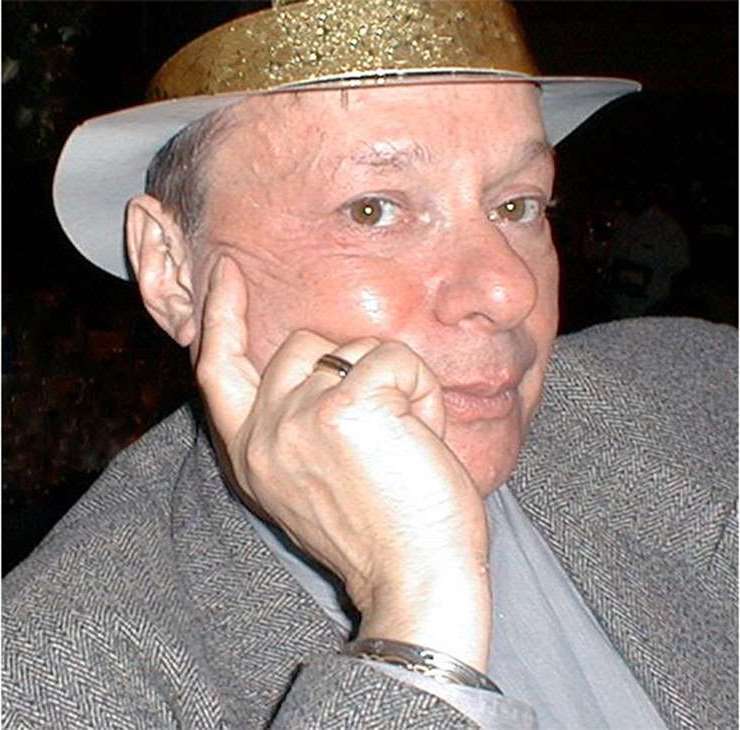
Egyptian film critic, journalist and film historian Samir Farid died on Tuesday after a long battle with lung cancer. He was 73.
In 2002, Samir Farid won the state award for excellence in the arts. He was also awarded the Cannes Film Festival Gold Medal in both 1997 and 2000. Earlier this year, he was given the honorary Berlinale Camera Award at the 2017 Berlin International Film Festival.
In 2014, he was the head of the Cairo International Film Festival.
The Berlin International Film Festival issued a statement:
The Berlin International Festival mourns the loss of renowned film critic and author Samir Farid who died after a long illness on April 4.
Samir Farid was highly esteemed as a film expert, and his opinions and advice were cherished worldwide. As a film critic he also accompanied the Berlinale over decades. In February 2017 the Festival awarded Farid a Berlinale Camera, an honour bestowed upon film personalities to whom the Berlin International Film Festival feels particularly indebted.
He first trained his sharp eye for film during his studies at the Higher Institute of Dramatic Arts at the Academy of Arts in Cairo. In 1965 he began his career as a critic at the Egyptian daily Al-Gomhoreya, where he worked for 38 years. During this period, he co-founded the National Festival of Short and Documentary Films (1970), the National Festival of Feature Films (1971), as well as the Egyptian Film Critics Association (1972). As of the 1970s, Farid was also a member of the FIPRESCI, the international federation of film critics. Over the course of his long career, he used his extensive knowledge while serving as a jury member at many world-renowned film festivals. For a few years during the 1980s, he was also a correspondent for the trade magazine Variety. In 2004 he began working for the daily Al-Masry Al-Youm. Farid was the author and translator of more than 60 books on Arab and world cinema.
“With Samir Farid we have lost an important voice from the Arab world. His commitment and passion for cinema were unrivalled. With his death I have also lost an old friend,” states Berlinale Director Dieter Kosslick.People
-
RIP: Egyptian Film Critic, Journalist and Film Historian Samir Farid Dead at 73
Egyptian film critic, journalist and film historian Samir Farid died on Tuesday after a long battle with lung cancer. He was 73.
In 2002, Samir Farid won the state award for excellence in the arts. He was also awarded the Cannes Film Festival Gold Medal in both 1997 and 2000. Earlier this year, he was given the honorary Berlinale Camera Award at the 2017 Berlin International Film Festival.
In 2014, he was the head of the Cairo International Film Festival.
The Berlin International Film Festival issued a statement:
The Berlin International Festival mourns the loss of renowned film critic and author Samir Farid who died after a long illness on April 4.
Samir Farid was highly esteemed as a film expert, and his opinions and advice were cherished worldwide. As a film critic he also accompanied the Berlinale over decades. In February 2017 the Festival awarded Farid a Berlinale Camera, an honour bestowed upon film personalities to whom the Berlin International Film Festival feels particularly indebted.
He first trained his sharp eye for film during his studies at the Higher Institute of Dramatic Arts at the Academy of Arts in Cairo. In 1965 he began his career as a critic at the Egyptian daily Al-Gomhoreya, where he worked for 38 years. During this period, he co-founded the National Festival of Short and Documentary Films (1970), the National Festival of Feature Films (1971), as well as the Egyptian Film Critics Association (1972). As of the 1970s, Farid was also a member of the FIPRESCI, the international federation of film critics. Over the course of his long career, he used his extensive knowledge while serving as a jury member at many world-renowned film festivals. For a few years during the 1980s, he was also a correspondent for the trade magazine Variety. In 2004 he began working for the daily Al-Masry Al-Youm. Farid was the author and translator of more than 60 books on Arab and world cinema.
“With Samir Farid we have lost an important voice from the Arab world. His commitment and passion for cinema were unrivalled. With his death I have also lost an old friend,” states Berlinale Director Dieter Kosslick.
-
RIP: Actor, Director Bill Paxton Dead at 61
[caption id="" align="alignnone" width="1200"]
Bill Paxton in Haywire[/caption]
TMZ is reporting that actor and director Bill Paxton died on Saturday February 25, 2017, due to complications of surgery. He was 61 years.
He appeared in a number of films, including The Terminator (1984), Weird Science (1985), Aliens (1986), Predator 2 (1990), True Lies (1994), Apollo 13 (1995), Twister (1996), and Titanic (1997).
The family released a statement “It is with heavy hearts we share the news that Bill Paxton has passed away due to complications from surgery.” The family accurately describes his “illustrious career spanning four decades as a beloved and prolific actor and filmmaker. Bill’s passion for the arts was felt by all who knew him, and his warmth and tireless energy were undeniable.”
Paxton was married to Louise Newbury, and the father of two children.
-
MOONLIGHT Partners with President Obama’s ‘My Brother’s Keeper’ Mentoring Program
In celebration of Black History Month, MOONLIGHT is partnering with My Brother’s Keeper Alliance, a mentoring program started by President Obama’s Administration for young men of color
to empower them with the resources and support to achieve their full potential regardless of circumstance.
The screenings kicked off earlier this week in Los Angeles with My Brother’s Keeper and attended by dozens of young men from several local high schools. After the film, Mike Muse of My Brother’s Keeper moderated a talk-back session with the students and MOONLIGHT’s Oscar-Nominated stars Mahershala Ali, Naomie Harris, writer/director Barry Jenkins, and writer Tarell Alvin McCraney. A screening and talk back with high schoolers in New York is also set for next week.
MOONLIGHT chronicles the life of Chiron, a boy growing up in a rough neighborhood of Miami, Florida. Lauded by critics and audiences alike, the film is nominated for eight Academy Awards®, including Best Picture, Best Director, Best Adapted Screenplay, Best Actor in a Supporting Role (Mahershala Ali), and Best Actress in a Supporting Role (Naomie Harris). To date, MOONLIGHT has won the Golden Globe® for Best Picture – Drama and was nominated for an additional five Golden Globes®, and Screen Actors Guild Award for Outstanding Male Actor in a Supporting Role (Mahershala Ali). The film is also nominated for five Independent Spirit Awards, and additionally is the this year’s recipient of the Spirits’ Robert Altman Award, which honors an outstanding ensemble cast in a motion picture. MOONLIGHT has been named the Best Picture of 2016 by the Gotham Awards, the Los Angeles Film Critics Association, The National Society of Film Critics, and The New York Times, among many others.
[gallery type="rectangular" size="medium" ids="20507,20511,20510,20509,20508"]
-
INTERVIEW: Joel Potrykus – The New King of Underground Cinema
[caption id="attachment_18175" align="aligncenter" width="1000"]
Joel Potrykus[/caption]
Whether his characters are doing stand-up comedy, eating spaghetti in fancy hotels, or devoting their lives to conjuring the Devil himself, Grand Rapids native and filmmaker Joel Potrykus has no trouble making sure it gets really, really weird. Through three features, including last year’s critically acclaimed Buzzard, Potrykus has given audiences a peek at a certain kind of American that is rarely encountered on the average day. Like one of Austin’s wanderers in Slacker who’s read one too many Bret Easton Ellis novel, Potrykus captures a certain shocking, toxic masculinity that’s as subversively hilarious as it is alarmingly relevant. I had a chance to talk to Joel about his latest film, The Alchemist Cookbook, about a forest-dweller named Sean who really wants to get possessed by Satan.
Josef: Your previous films, Buzzard and Ape, have flirted with elements of horror, but your most recent work, The Alchemist Cookbook, is the closest thing you’ve ever made to a genre film. At what point did you realize you were capable of tackling something that may have required a lot more precision in execution than some of your previous work? On the other hand, do you think your previous work has always had a pacing and tone that feels unrehearsed but is, in fact, extremely precise?
Joel: Buzzard was very precise. Every tiny exchange between characters and prop was thought over for months and months. Sometimes, the more you prep, the more it looks improvised. With Cookbook I certainly wasn’t setting out to make a horror movie. It was black magic and a demon, but I still would never call it horror. I’m just trying to make movies that I would want to see. I’d want to see Cookbook even if I hadn’t directed it.
I’m definitely not here to impose a political agenda on you or your films, but with more noticeable diversity campaigns online (#OscarsSoWhite for instance), did you make a conscious decision to cast people of color in the two lead roles, or was that something that came to you naturally during writing and pre-production?
It was a choice from the start. I didn’t want to get pegged as the guy making movies about angry white guys in the suburbs. So I intentionally brought this one out into the woods with black guys. There were so many great movies I loved growing up that focused on black characters and rarely did they get the chance to mess around with the Devil and chemistry, even. I never want to tell a story that is predictable or cliched in any way at all. Ty Hickson, who plays Sean, said he’s never been offered a role like this. He was just as excited as I was to shake things up.
Another really striking aspect of this film is its subtle comments on the nature of mental illness and how sometimes it can feel like you’re being possessed by some kind of invading force. The way it’s portrayed in the film seems like it came from a very personal place. Exploring mental illness through horror has surfaced to the mainstream in a big but ultimately disappointing way this year, with films like Lights Out seeming more exploitative than empathetic. How did you maintain that balance between entertainment, empathy, and realism in your portrayal of Sean’s mental state as it fluctuates throughout the film?
My goodness, was Lights Out a disappointment. Love the short, but it’s a simple concept stretched way too far. To be honest, the movie is about a mental illness that overcame my grandfather when I was a kid. That type of paranoia is a lot scarier to the person suffering than it is to us. Most people could never imagine the waking nightmare of schizophrenia. I’ll never make a film about just one thing, or a film that lives in one mood or tone. Our everyday lives are full of drama, humor, and even horror. This type of mental illness is a straight up horror most of the time. It was important to try to get inside Sean’s head. The camera never strays from his perspective for a reason. I want the audience to question everything.
[caption id="attachment_16518" align="aligncenter" width="1000"]
The Alchemist Cookbook[/caption]
Moving away from the thematics of the film and more into technical aspects, what was it like shooting on an Alexa? If I’m not mistaken Buzzard was shot on a Mark III so this is a huge step up in terms of the range of images you’re able to capture. I noticed a lot more night scenes in this film that were confidently lit using dim candles, campfires, and other sources of natural or visible lighting.
For the first week I hated the Alexa. It was heavy, bulky, and slowed my process down. But DP Adam J. Minnick is about the only guy I’d trust to see the scene the same as I do. So I was totally confident. The only artificial light used were blasting into the trailer in order to maintain consistent daylight effect throughout the long shooting day. Otherwise, all exteriors are natural light, which is important to Adam and me. I never want my movies to look like a movie. At night, in the woods, it’s dark. Really dark. I wanted no fake blasting full moon. I wanted the audience to strain to see things. We actually darkened night scenes to make them even blacker.
I can imagine that you and the actor who played Sean, Ty Hickman, got very close over the course of this production. Tell me a bit about the casting process, and what it was like to spend all that time focusing mostly on one actor. Specifically, did it ever cross your mind to cast someone who was right for the role as well as being someone you wouldn’t mind spending a month alone in the woods with?
Personality is important to me. Ty first got my attention after a scene in Gimme the Loot when he leaves a basement and hits a punching bag on the way out. One of the first things I asked him about is whether or not that was scripted. It wasn’t. He said, “who wouldn’t punch that?” Exactly. That’s the kind of actor I want to work with. Someone with instincts. On Cookbook I’d let the scene play out as scripted, then just let the camera linger and see what Ty would do. It threw him off for the first day or two, but once he understood that I was messing with him a little, he got into it. Those are my favorite moments – the unscripted ones, where I’m surprised. Even better if the actor can surprise himself. I hate sticking to the page and feeling like it’s a construction site. I want mistakes and surprises.
Touching again on the intimacy of it all, how big was your crew on a day-to-day basis, and what was the lodging situation like while on-set? I remember you going dark on Facebook pretty much the entire time you were shooting, and I was scared you guys had run into a Blair Witch Project scenario.
I wish we’d run into a real life witch or demon. Total bummer that those woods weren’t actually haunted. This was our biggest crew – around 20, I’d say. Not my usual style. Most of us crashed in a huge 10 room house that acted as our production headquarters, and a few stayed with friendly residents in Allegan, Michigan, where we filmed. I’m stoked to someday go back to the old set and look for the “pay up” tree and some props we hid around the woods.
What was your relationship like with horror films growing up and into your adulthood? One of my favorite things about Sean is that he so desperately wants to be possessed by the Devil, while most characters in scary movies do everything they can to avoid such a fate. Was there any part of you that wrote that character with the meta elements in mind?
Yeah, it’s rare to see a character actively pursuing evil. The original Evil Dead inspired me to make films at an early age. I’ve always been obsessed with horror and it’ll always be present in my work one way or another. An American Werewolf in London may be my favorite movie ever. Its tonal shifts are perfect. Just last night I watched Halloween III and the shitty new Ouija movie.
[caption id="attachment_18176" align="aligncenter" width="1000"]
The Alchemist Cookbook[/caption]
During our last interview I remember you talking briefly about the spaghetti scene in Buzzard, which has since become something of a legend amongst indie film buffs. But it seems like you just love to film people eating. Is there something that you feel is captured when the audience watches a character eat that can’t be conveyed any other way, or am I reading far too much into what’s ultimately just a nifty coincidence?
Eating is one of the most private things we do. It’s something we need to do and something we love to do. I’m fascinated by watching people eating when they think no one is watching. I’m a sloppy eater, with no manners. I never really consciously thought that I need an eating scene in my movies, they just appear on the page. But some of my favorite scenes are when a character eats – I want to join Zack and Jack at the table during that Italian feast in Down by Law.
I read somewhere that you’re currently not going to divulge whether or not the possum in the film is real. That’s fine! My only question is, whether or not it was real, that scene could not have been easy to shoot. Was it a scene that you had already planned out in your head or was it something you knew you’d have to figure out down the line?
Well, magic happened and we got the shot in the first take. The evil spirits of cinema were on my side that night. I watched in fascination as the camera rolled.
I’d like to know a little bit about your life as a teacher, and how your own experiences inform your lessons, or if any students have come to you as fans of your work and if that can actually help establish a connection with them without necessarily having to “prove yourself.”
I try not to talk about myself or own work much, but generally students know who I am and sometimes ask direct questions about my movies. I think it lends some credibility to watch me talk about it in class. I like to cut through the textbooks and get to the reality of the industry, especially the indie world which is in constant motion. It’s great to expose film students to work that I consider important, like Aguirre, 8 1/2, Gummo, or even Wendy and Lucy. I also think it’s just as important to learn from others’ mistakes, so occasionally we dive into Birdemic or bad commercials.
[caption id="attachment_18177" align="aligncenter" width="1000"]
The Alchemist Cookbook[/caption]
You’re obviously responsible for launching Joshua Burge’s career, and he went from Buzzard to The Revenant in just a year’s time. Have you guys stayed in regular contact since making the film? I know if there’s anyone who’s going to keep his head from getting too big it’s going to be you.
Well, I wouldn’t say I’m responsible for launching his career. And if I am, then he’s responsible for launching my career. It’s a total blast to see him get the recognition he deserves. The dude’s just got it. Hoping we work together on the next one. He still lives only a few minutes away from me, so I see him whenever he’s not in a far off land acting with the big shots. He’s still just Josh to me.
Lastly, I feel almost obligated to ask what you’re working on next since that’s the question that ends most interviews, but I’d really like to know what your day-to-day is like when you aren’t actively working on a movie. A lot of aspiring directors forget to account for the downtime in between projects, and I’m curious how you keep your mind active when you aren’t talking to producers or actors or reading over budgets and rewriting drafts.
I’m always working on at least one feature script. I’ve got three finished right now, but focusing on one to shoot next summer. Just looking for the money, as usual. Normally, I start my day looking at emails and Facebook in bed, oatmeal breakfast, then get to writing for a few hours, lunch, grade papers, read a chapter or two from whatever stuffy film theory book I’m into at the moment on my bus ride to the university, teach for a couple hours, watch some Howard Stern clips on YouTube, write for a little longer, dinner, watch an episode of Shark Tank, write, end the night with a movie in my office. I get set in my routines.
**The Alchemist Cookbook is available for purchase on any website where movies are sold, including a pay-what-you-want option on BitTorrent**
https://www.youtube.com/watch?v=2IFqOBquZjU
-
Adrienne Shelly’s Husband Speaks Out Against Trump’s Attempted Anti-Immigration Exploitation
[caption id="attachment_17761" align="aligncenter" width="1000"]
Adrienne Shelly[/caption]
Andy Ostroy, the husband of director Adrienne Shelly, whose life was tragically cut short in 2006, spoke out against the right-wing attempts to use his wife’s brutal murder to aid their anti-immigration campaign in an opinion piece for The New York Times
It was a decade ago (almost to the date), when Adrienne Shelly, an indie director and actress best known for her film Waitress was found dead in her West Village Office. Shelly was killed by an undocumented construction worker named Diego Pillco, who ended her life by staging a fake suicide after fearing she would have him deported. Though the tragedy would be a prime example to justify Trump’s anti-immigration position, Andy Ostroy artfully spurned the offer. In the article, Ostroy admits “Given the anger and grief I still feel, I could easily be seduced by Donald J. Trump’s anti-immigrant rhetoric that is the cornerstone of his presidential run.”
Yet Ostroy is committed to his pragmatic perspective, writing “Adrienne was not murdered by an illegal immigrant, per se. She fell victim to a depraved killer who simply happened to be an undocumented immigrant. It is an obvious distinction, almost too obvious, but it’s an important one to consider as the country goes further down the dangerous path of demonizing those not born here.”
In addition to being approached by Trump’s campaign, Ostroy has also been asked to speak out by Bill O’Reilly and Megyn Kelly in order to give legitimacy to their anti-immigrant argument. However, refusing to let Shelly’s murder be used as “a political prop”, Ostroy writes “It’s politically expedient for xenophobic agitators like Mr. Trump to scapegoat the millions of foreigners who have come to the United States in search of a better life. But his malevolence toward immigrants runs counter to the principles on which our great nation was founded. It’s disheartening to see so many people being swept out to sea in a riptide of ignorance and hate.”
Ostroy also mocked the Republican’s the futile attempt to have him speak out by saying “Who better than a Democrat to attack an entire segment of our population, right?”
While Ostroy agrees, “We have an immigration problem that is in desperate need of reform.”, he is against the foreseeable damage that Trump has proposed “His “solution” includes a deportation force that would separate people from their families and “send them back to wherever they came from.”
The right-wing attempt of using Shelly as a poster girl for their arguments backfired, driving Andy Ostroy to use his position to serve as a model example of how to keep a moral standing despite having been through circumstances that could easily deviate our dispositions.
-
THE ISLAND PRESIDENT’s Mohamed Nasheed, Granted Refugee Status in Britain
Mohamed Nasheed, the former president of the Maldives, and subject of the award winning documentary The Island President has reportedly been granted refugee status in Britain.
Nasheed was in Britain on medical leave from a 13-year prison sentence on terrorism charges.
The former president, Mohamed Nasheed, the country’s first democratically elected head of state, was jailed for ordering the military to arrest a sitting senior judge, which the court said was an abduction punishable under a section of an antiterrorism law. He was found guilty of terrorism and sentenced to thirteen years in prison.
Mohamed Nasheed had earlier resigned the presidency in February 2012, after weeks of demonstrations and a mutiny by some police officers.
The Island President, directed by Jon Shenk, is the story of President Mohamed Nasheed of the Maldives, a man confronting a problem greater than any other world leader has ever faced—the literal survival of his country and everyone in it. After bringing democracy to the Maldives after thirty years of despotic rule, Nasheed is now faced with an even greater challenge: as one of the most low-lying countries in the world, a rise of three feet in sea level would submerge the 1200 islands of the Maldives enough to make them uninhabitable.
The Island President captures Nasheed’s first year of office, culminating in his trip to the Copenhagen Climate Summit in 2009, where the film provides a rare glimpse of the political horse-trading that goes on at such a top-level global assembly. Nasheed is unusually candid about revealing his strategies—leveraging the Maldives’ underdog position as a tiny country, harnessing the power of media, and overcoming deadlocks through an appeal to unity with other developing nations. When hope fades for a written accord to be signed, Nasheed makes a stirring speech which salvages an agreement. Despite the modest size of his country, Mohamed Nasheed has become one of the leading international voices for urgent action on climate change.
https://www.youtube.com/watch?v=x10EbJymLz4
-
Brent Green and Thyra Heder Win SFFS / Hearst Screenwriting Grant for “Over the Eaves”
Brent Green and Thyra Heder have been selected to receive this year’s $15,000 2015 San Francisco Film Society / Hearst Screenwriting Grant for development of their script Over the Eaves.
“Man, it takes a long time to write a screenplay! Way longer than you’d think,” said Green. “Or at least longer than I’d have thought. I’m so very grateful to the San Francisco Film Society and William Hearst III for their generosity, which will allow Thyra and I to set aside the necessary time to finish up writing what we hope to be a stellar movie.”
Working in the hills of rural Pennsylvania, Brent Green is a self-taught filmmaker, storyteller and visual artist whose films have screened at the Rotterdam Film Festival, the Sundance Film Festival, the San Francisco Film Society, MoMA, the J. Paul Getty Museum, the Walker Art Center and the Hammer Museum. He serves on the board of Rooftop Films, is a 2005 Creative Capital grantee, and the recipient of 2014 MAPfund grant. Green’s work is in permanent collections including the Progressive Collection, the Hammer Museum and MoMA. Green is an alum of the January 2015 Sundance Screenwriters Lab and the 2015 Sundance Directors Lab.
Thyra Heder is an author, illustrator and artist who got her start studying film. She graduated from Brown University with a BA in Art Semiotics and put it to use storyboarding for television, feature films and advertising campaigns. Over the last decade her clients have expanded to include major restaurant groups, design companies and hotels, and her work has been regularly featured in Vogue. Her debut picture book, Fraidyzoo, garnered numerous starred reviews and was one of the ALSC Notable Children’s Books of 2014. Her second book, The Bear Report, will be released this fall. She is an alum of the June 2015 Sundance Screenwriters Lab.
In the stop-motion animated film, OVER THE EAVES, a young boy begins inventing strange, hand-made machines to ease his mother’s hard labor and bring joy to her monotonous life. When his most daring invention backfires and changes life on Earth forever, his neighbors struggle to understand whether he has done them harm or shown them what they have been missing.
-
Chris Rock is Back …. to Host 2016 Oscars
Chris Rock who hosted the 77th Oscars telecast in 2005 will return to host the Oscars® for a second time, producers David Hill and Reginald Hudlin announced today. Rock will host the 88th Academy Awards® scheduled to be broadcast live on Oscar® Sunday, February 28, 2016, on the ABC Television Network. .
“Chris Rock is truly the MVP of the entertainment industry,” said Hill and Hudlin. “Comedian, actor, writer, producer, director, documentarian – he’s done it all. He’s going to be a phenomenal Oscar host!”
“I’m so glad to be hosting the Oscars,” said Rock. “It’s great to be back.”
“We share David and Reggie’s excitement in welcoming Chris, whose comedic voice has really defined a generation,” said Academy President Cheryl Boone Isaacs. “He is certain to bring his amazing array of talents to this year’s show.”
“Chris may be best known as a stand-up comic, but we think of him as a creative innovator in many other ways. He is unafraid in his artistry,” said Academy CEO Dawn Hudson. “We couldn’t be happier to welcome him back to the Oscars.”
“Chris Rock is a comedic powerhouse who will bring tremendous energy to the event, and we’re honored to have him,” said Paul Lee, President ABC Entertainment Group.
With a career spanning more than three decades, Rock most recently directed the comedy special “Amy Schumer: Live at the Apollo,” which premiered this month on HBO. In 2014 he wrote, directed and starred in the critically acclaimed feature “Top Five,” and in 2009 ventured into the documentary world as a writer, producer and star of “Good Hair.”
Rock has enjoyed ongoing success in both film and television as a comedian, actor, writer, producer and director. His feature acting credits include “I Think I Love My Wife,” which he also wrote and directed, “Head of State” (writer, producer and director), “Death at a Funeral” (also producer), and the first three films in the blockbuster “Madagascar” series, as the voice of Marty. His other acting credits include “The Longest Yard,” “Nurse Betty,” “2 Days in New York” and “Lethal Weapon 4.” In 2011 Rock made his Broadway debut starring in “The Motherfucker with the Hat,” which was nominated for six Tony Awards®, including Best Play. In television, Rock created, executive produced and narrated the series “Everybody Hates Chris,” which ran from 2005 to 2009 and was inspired by Rock’s childhood. He was a cast member on “Saturday Night Live” from 1990 to 1993.
Known internationally for his groundbreaking stand-up comedy, Rock has won four Emmy® Awards for his comedy series and specials, including “Chris Rock – Kill the Messenger,” “The Chris Rock Show” and “Chris Rock: Bring the Pain,” and has achieved record audience numbers around the world. He also has earned three Grammy® Awards for his comedy albums Never Scared, Bigger and Blacker and Roll with the New.
The 88th Oscars will be held on Sunday, February 28, 2016, at the Dolby Theatre® at Hollywood & Highland Center® in Hollywood, and will be televised live by the ABC Television Network at 7 p.m. ET/4 p.m. PT. The Oscar presentation also will be televised live in more than 225 countries and territories worldwide.
-
Meryl Streep will be Jury President of 66th Berlin International Film Festival
Three-time Academy Award winner Meryl Streep will be the Jury President of the 66th Berlin International Film Festival taking place February 11 to 21, 2016.
”Meryl Streep is one of the most creative and multifaceted film artists. To mark our enthusiasm for her extraordinary talent we awarded her the Honorary Golden Bear in 2012 for her lifetime achievement. I am very happy that she is returning to Berlin and with her artistic experience will take on the chairmanship of the International Jury”, says Berlinale Director Dieter Kosslick.
Meryl Streep has appeared in over 40 films and is considered one of the world’s most talented and versatile actresses.
She has been a guest at the Berlin International Film Festival on a number of occasions: in 1999, she was awarded the Berlinale Camera, and in 2003, together with Julianne Moore and Nicole Kidman she shared the Silver Bear award for their performances in The Hours. In 2006, she could again be seen in the Berlinale Competition in Robert Altman’s ensemble comedy A Prairie Home Companion. In 2012, the Berlinale dedicated a homage to Meryl Streep and awarded her the Honorary Golden Bear for her lifetime achievement.
“It is a thrill to return to the festival under any circumstances, but it is with great relish and anticipation I look forward to jury duty. The responsibility is somewhat daunting, as I have never been President of anything before, and I hope I can come up to the precedent set by the distinguished juries of preceding years. Grateful for the honor”, says Meryl Streep with regard to her jury presidency.
-
Composer John Williams to Receive 44th AFI Life Achievement Award
Composer John Williams will be the recipient of the 44th AFI Life Achievement Award, America’s highest honor for a career in film. For the first time in American Film Institute (AFI) history, the award will be bestowed upon a composer. Williams will be honored at a gala Tribute on June 9, 2016 in Los Angeles, CA. The AFI Life Achievement Award Tribute special will return for its fourth year with Turner Broadcasting to air on TNT in late June 2016, followed by an encore presentation on its sister network, Turner Classic Movies (TCM).
“John Williams has written the soundtrack to our lives,” said Sir Howard Stringer, Chair, AFI Board of Trustees. “Note by note, through chord and chorus, his genius for marrying music with movies has elevated the art form to symphonic levels and inspired generations of audiences to be enriched by the magic of the movies. AFI is proud to present him with its 44th Life Achievement Award.”
John Williams’ storied career as the composer behind many of the greatest American films and television series of all time boasts over 150 credits across seven decades. Perhaps best known for his enduring collaboration with director Steven Spielberg, his scores are among the most iconic and recognizable in film history, from the edge-of-your-seat JAWS (1975) motif to the emotional swell of E.T. THE EXTRA-TERRESTRIAL (1982) and the haunting elegies of SCHINDLER’S LIST (1993). Always epic in scale, his music has helped define over half a century of the motion picture medium. Three of Williams’ scores landed on AFI’s 100 Years of Film Scores — a list of the 25 greatest American film scores of all time — including the unforgettable STAR WARS (1977) soundtrack, at number one. With five Academy Award® wins and 49 nominations in total, Williams holds the record for the most Oscar® nominations of any living person.
Other career touchstones include CLOSE ENCOUNTERS OF THE THIRD KIND (1977), RAIDERS OF THE LOST ARK (1981) and the INDIANA JONES series (1984–2008), JURASSIC PARK (1993), SAVING PRIVATE RYAN (1998), the first three films of the HARRY POTTER series (2001–2004), MEMOIRS OF A GEISHA (2005), THE ADVENTURES OF TINTIN (2011), LINCOLN (2012) and THE BOOK THIEF (2013). He will soon transport audiences back to a galaxy far, far away with STAR WARS: EPISODE VII – THE FORCE AWAKENS, opening December 2015, and he is set to reteam with Spielberg for THE BFG in 2016.
Watch Williams at the AFI Life Achievement Award Tribute to George Lucas in 2005.
https://www.youtube.com/watch?v=RBbudefAzFw
More About John Williams
Born and raised in New York, Williams moved to Los Angeles in 1948, where he studied composition with Mario Castelnuovo-Tedesco. After service in the Air Force, he returned to New York and studied piano with Madame Rosina Lhévinne at The Juilliard School, and also worked as a jazz pianist both in nightclubs and on recordings. He returned to Los Angeles and began his career in the film industry, working with many accomplished film composers including Bernard Herrmann, Alfred Newman, Henry Mancini, Elmer Bernstein and Franz Waxman. He went on to write music for more than 200 television films for the groundbreaking anthology series ALCOA THEATRE and KRAFT TELEVISION THEATRE. His more recent contributions to television music include the well-known theme for NBC NIGHTLY NEWS (“The Mission”), the theme for what has become network television’s longest-running series, NBC’s MEET THE PRESS and the theme for the prestigious PBS arts showcase GREAT PERFORMANCES.
Williams went on to compose the music and serve as music director for more than 150 films, including some of the most successful films of all time. His 40-year artistic partnership with director Steven Spielberg began in 1972 with the film THE SUGARLAND EXPRESS. The five Academy Awards® Williams has received are for: his adaptation of FIDDLER ON THE ROOF (1971), STAR WARS (1977) and hree of his scores with Spielberg: JAWS (1975), E.T. THE EXTRA-TERRESTRIAL (1982) and SCHINDLER’S LIST (1993). He is also the recipient of 22 Grammy Awards®.
Williams served as Music Director of the Boston Pops Orchestra for 14 seasons and remains their Conductor Laureate. He has composed numerous works for the concert hall, and maintains vibrant relationships with many of the world’s leading symphony orchestras. He has composed music for many important cultural and commemorative events, including the theme for the rededication of the Statue of Liberty in 1986 and themes for four Olympic Games. In 2003, he received the Olympic Order, the International Olympic Committee’s highest honor, for his contributions to the Olympic movement. He was a recipient of the Kennedy Center Honors in December of 2004 and the National Medal of Arts in 2009. Williams was inducted into the American Academy of Arts & Sciences in 2009 and in January of that same year, he composed and arranged “Air and Simple Gifts” especially for the first inaugural ceremony of President Barack Obama.
-
European Film Academy to Honor Charlotte Rampling and Christoph Waltz
The European Film Academy will present Charlotte Rampling with the honorary Lifetime Achievement Award, and the European Achievement In World Cinema will go to two-time Oscar winner Christoph Waltz. Both Charlotte Rampling and Christoph Waltz will be honorary guests at the 28th European Film Awards Ceremony on December 12th, 2015, in Berlin.
Born in England, Charlotte Rampling grew up in Gibraltar, France, Italy and Spain to become a truly European multi-language actress. Throughout her career, Charlotte Rampling has worked with great European directors from Luchino Visconti, Liliana Cavani and Patrice Chéreau to François Ozon, Laurent Cantet, Claude Lelouch, Gianni Amelio, Bille August and Lars von Trier. Charlotte Rampling is a five-time EFA Nominee and won European Actress 2003 for SWIMMING POOL. She has received an Honorary César and has been nominated four times in France, as the murder suspect Barbara in HE DIED WITH HIS EYES OPEN, the lonely wife in UNDER THE SAND, a famous mystery author in SWIMMING POOL and the deranged Alice Pollock in LEMMING. She recently received a Silver Berlin Bear for her role in 45 YEARS which is also part of this year’s EFA Selection. Among some of Charlotte Rampling’s most interesting films are THE NIGHT PORTER by Liliana Cavani, HEADING SOUTH by Laurent Cantet, STARDUST MEMORIES by Woody Allen, THE VERDICT by Sidney Lumet, UNDER THE SAND by François Ozon, MAX MY LOVE by Nagisa Oshima and MELANCHOLIA by Lars von Trier.
Born in Austria, Christoph Waltz studied acting at the Max Reinhardt Seminar in Vienna and in New York. He started out as a theatre actor and quickly became a popular TV star. In 2009 Christoph Waltz shot to international fame with Quentin Tarantino’s INGLOURIOUS BASTERDS for which he received the Best Actor Award in Cannes, a BAFTA, a Golden Globe and his first Oscar. He acted in THE GREEN HORNET by Michel Gondry, in CARNAGE by Roman Polanski and in 2012 he again collaborated with Quentin Tarantino, playing Dr. King Schultz in DJANGO UNCHAINED which won him another Golden Globe, a BAFTA, and ultimately a second Oscar. And he plays a leading part in the new James Bond film SPECTRE.
-
Civil Rights Icon Grace Lee Boggs, AMERICAN REVOLUTIONARY: THE EVOLUTION OF GRACE LEE BOGGS, Dies at 100
Grace Lee Boggs, civil rights icon, and subject of the 2013 documentary American Revolutionary: The Evolution of Grace Lee Boggs, has died at the age of 100.
According to the a statement on the Boggs Center website, Grace Lee Boggs died peacefully in her sleep at her home on Field Street in Detroit on Monday night, October 5, 2015.
Philosopher-Activist Grace Lee Boggs Dies in Detroit: A Champion for the People October 5, 2015–Grace Lee Boggs died peacefully in her sleep at her home on Field Street in Detroit this morning. She had recently celebrated her 100th birthday at the Charles H. Wright Museum of African American History. Grace was an internationally known philosopher activist for justice. She had been politically active since the 1930’s working with A. Phillip Randolph’s first march on Washington and later C.L.R. James. For more than 40 years she worked closely with her late husband James Boggs in advancing ideas of revolution and evolution for the 20th and 21st Centuries. She helped organize the 1963 March down Woodward Avenue with Dr. Martin Luther King and the Grassroots Leadership Conference with Malcolm X. Grace Lee Boggs was active in Labor, Civil Rights, Black Power, women and environmental justice movements. Later, with her husband James, she helped organize SOSAD, WePros, Detroiters Working for Environmental Justice, Gardening Angels and Detroit Summer. Grace was a founding member of the James and Grace Lee Boggs Center to Nurture Community Leadership and was a strong advocate for place based education and supported the James and Grace Lee Boggs School. “Grace died as she lived surrounded by books, politics, people and ideas,” said Alice Jennings and Shea Howell, two of her Trustees. A memorial celebrating her life will be announced later.
President Barack Obama, issued a statement, saying “Michelle and I were saddened to hear of the passing of author, philosopher, and activist Grace Lee Boggs. Grace dedicated her life to serving and advocating for the rights of others – from her community activism in Detroit, to her leadership in the civil rights movement, to her ideas that challenged us all to lead meaningful lives. As the child of Chinese immigrants and as a woman, Grace learned early on that the world needed changing, and she overcame barriers to do just that. She understood the power of community organizing at its core – the importance of bringing about change and getting people involved to shape their own destiny. Grace’s passion for helping others, and her work to rejuvenate communities that had fallen on hard times spanned her remarkable 100 years of life, and will continue to inspire generations to come. Our thoughts and prayers are with Grace’s family and friends, and all those who loved her dearly.”
The filmmakers of the documentary also issued a statement saying, “Grace Lee Boggs passed away peacefully this morning. We are so grateful for the vision of justice and human connection that she gave us and feel incredibly privileged to have been able to share her story with others.”
The documentary film, AMERICAN REVOLUTIONARY: THE EVOLUTION OF GRACE LEE BOGGS, plunges us into Boggs’s lifetime of vital thinking and action, traversing the major U.S. social movements of the last century; from labor to civil rights, to Black Power, feminism, the Asian American and environmental justice movements and beyond. Boggs’s constantly evolving strategy—her willingness to re-evaluate and change tactics in relation to the world shifting around her—drives the story forward. Angela Davis, Bill Moyers, Bill Ayers, Ruby Dee and Ossie Davis, Danny Glover, Boggs’s late husband James and a host of Detroit comrades across three generations help shape this uniquely American story. As she wrestles with a Detroit in ongoing transition, contradictions of violence and non-violence, Malcolm X and Martin Luther King, the 1967 rebellions, and non-linear notions of time and history, Boggs emerges with an approach that is radical in its simplicity and clarity: revolution is not an act of aggression or merely a protest. Revolution, Boggs says, is about something deeper within the human experience — the ability to transform oneself to transform the world.
POV is streaming the film for free until November 4.
https://www.youtube.com/watch?v=_JvyZtNA4CU