

Handmade dolls, drawings, chewing gum sculptures, plastic flowers, and much more- this was the world of Nellie Mae Rowe, a Southern folk artist from Fayette County, Georgia.
Directors Petter Ringbom and Marquise Stillwell, along with executive producer dream hampton and producer Ruchi Mital, have brought this world to the forefront in their documentary, This World Is Not My Own, showcasing the artist’s life and legacy.
The award-winning film combines traditional documentary storytelling with animation, scripted scenes, and intricately constructed sets inspired by Rowe’s famed “Playhouse,” the home where she curated her incredibly personal and spiritual worldview through her art.
The documentary premiered as the second episode of season 18 of Black Public Media‘s AfroPoP: The Ultimate Cultural Exchange. Before its theatrical release in 2023, the film won the Jury Award for Best Documentary at the Mendocino Film Festival, a Best Documentary Award Special Mention at the Palm Springs International Film Festival, and the Best Cinematography Award at the Atlanta Film Festival.
VIMooZ interviewed hampton about her work on the film, as well as her journey in discovering the rich and unlimited world of Nellie Mae Rowe. After working with Ringbom to create The Russian Winter (2012), hampton was delighted to be involved with another one of his projects, and to give long overdue recognition to Rowe.
Beni Cwiakala: To get started, can you discuss your role in making this film come to life and when you first got involved in the project?
dream hampton: I was invited onto the project by Petter. I had actually learned about Nellie Mae Rowe from this film. I grew up in Detroit, where we have a celebrated outside artist named Tyree Guyton. Even though he’s fairly celebrated, at least in the city, there was also always pushback to his work. So I always understood the tension when it came to literal outside artists, and also artists who are working outside of the usual institutions.
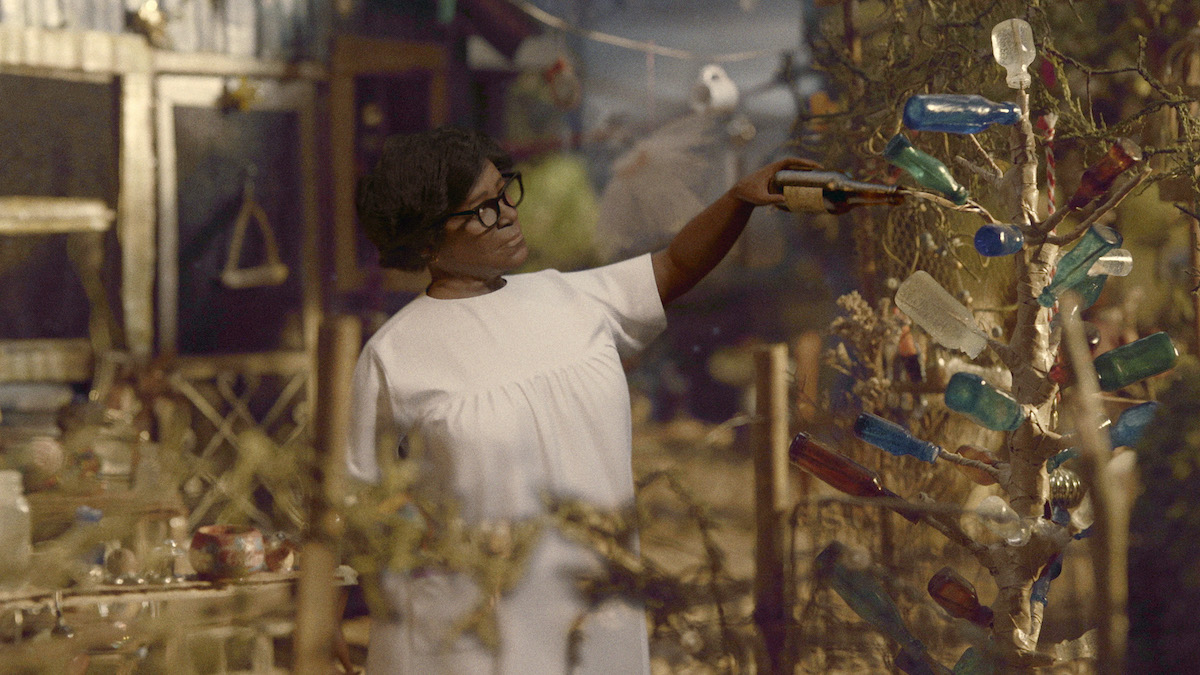
What drew me to This World Is Not My Own was that it was much more than a documentary about an artist. I think that we’re all trying to figure out how to do those in some way. It’s about someone who insisted on creating beauty and joy and imagination despite living through segregation, poverty, being a woman in the South, just enormous hardship. So, she just reminds me that creativity isn’t a luxury; it’s a form of resilience.
And that felt like a story that deserved to reach as many people as possible. So I was happy to weigh in with notes, and [Petter] already had this beautiful vision, this hybrid vision of making it more than just an artist profile, but making that profile art itself.
BC: I got the chance to watch the documentary, and I loved the animation. It caught me off guard in the best way. How have other people reacted to seeing the film about someone who hasn’t been super well known?
dh: When we talk about outsider art, we’re often talking about people who created extraordinary work without permission or formal training or without an invitation from the cultural establishment. But for a black woman in the rural South in the twentieth century, we don’t start seeing her work until the latter part of the 20th century, and there’s this gap where she, in a marriage, doesn’t produce work. Those barriers weren’t abstract; they were lived realities, and she still built an artistic universe anyway, and that’s what makes her work feel so powerful.
I was familiar with people like Thornton Dial. And I invoked Tyree Guyton earlier, having grown up in Detroit with his work. This is a Vietnam vet who came and worked out his trauma on the east side of Detroit in front of all his neighbors. But, you know, the South produced remarkable self-taught artists who transformed, and really, with Nellie Mae Rowe, everyday materials into profound works of art. And so that kind of freedom, that refusal to let circumstances define the limits of imagination – Nellie Mae Rowe belongs in that conversation. Her voice is unmistakably her own. But she wasn’t outside history. History had pushed her to the margins. You know, I love that Petter said she chose to center herself in the American story by picking this birthday, July 4th, because her art insists on moving back to the center. It asks us to expand our idea of who gets to shape American culture. And that, to me, is the standing question.

BC: I also wanted to touch on her art, and even the title of the film. And I forgot who brought this up – it might have been a historian or a relative – but the idea of Afrofuturism and this element in black culture of creating this other world, because in this world they’re met with hate and discrimination. Was that a part of picking the title for the piece?
dh: Yeah, I mean, at its core, it’s a rich connection, and as long as you frame it as a resonance rather than saying Nellie Mae Roe was an Afrofuturist, because she predates the term, right? And she’s working in a very different context. I would love to imagine her being aware of what’s happening, say in the jazz world, even before Sun Ra, of some of the experimental work that’s happening. And some of those men are Southerners too, men and women, but I’m thinking here of Cecil Taylor and Eiler. But when I look at Nellie Mayro’s work, I see something that anticipates what we now call Afrofuturism. She wasn’t making science fiction, but she was making possibility. She created a world in which a black southern woman could be the architect of her own reality. That’s one of the deepest ideas in Afrofuturism, the radical act of imagining yourself beyond the boundaries the world has placed around you. And that’s why I thought the title was so beautiful, because it’s not even about ownership.
BC: This film, of course, focuses on Nellie Mae Roe but also her friend, Judith Alexander. What was the process of capturing their stories side by side?
dh: I think we certainly knew that the key to acknowledging Judith Alexander’s importance was to do so without making her the protagonist of Nellie Mae Rowe’s story.
One of the things I appreciate about the film is that it resists the familiar narrative of the rescuer or the discoverer. Judith Alexander is a part of this story because history is complicated, but the film never loses sight of the fact that the central relationship is between Nellie Mae Rowe and her own imagination, and everything else is kind of secondary. It also reminds us of how cultural institutions have historically worked. Sometimes it takes someone with access to these institutions to open a door. And we can acknowledge that reality while also remembering that the person who walked through the door carrying a real gift was Nellie Mae Rowe. And so I really appreciated the nuanced way that Petter was already thinking about approaching that, but I certainly was like, you know, there’s just a trope.
BC: Absolutely. I’m so excited for everyone to see this. I’m going to watch it again because I thought it was fantastic.
dh: Thank you!
This interview has been edited for length, clarity, and formatting. Some responses may have been condensed or lightly modified to improve readability while maintaining the original intent.
Leave a Reply
You must be logged in to post a comment.