Film Reviews

  • REVIEW: Unfinished Song

    Unfinished Song (Song for Marion)

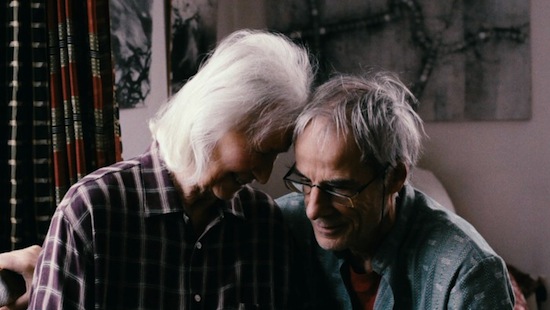
    Thank goodness UNFINISHED SONG (titled “Song for Marion” overseas) was made by an English filmmaker. I say that because Hollywood would have completely destroyed this wonderful story by overfilling it with cheesy, contrived moments. Hollywood doesn’t have the guts to make this kind of film without a “star.” Instead of the wonderful performances from Terrence Stamp and Vanessa Redgrave we’d likely get Steve Martin in one of his less-than-great performances and Cher.

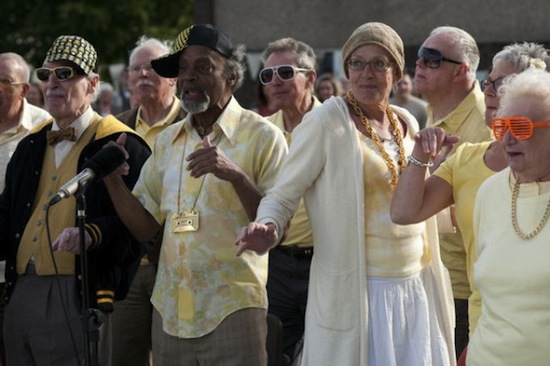
    But thankfully writer/director Paul Andrew Williams made this movie on English soil. UNFINISHED SONG stars Stamp and Redgrave as Arthur and Marion, an elderly couple who is trying to cope with Marion’s cancer. Marion spends her final months as a member of a neighborhood senior citizen choral group that performs outside the box music (like the B-52s and, to my surprise, Motörhead). Grumpy Arthur doesn’t cope quite as well, and he doesn’t get Marion’s singing though it’s not much different from his old man pub domino games. Even worse, Arthur is concerned that all the energy Marion puts into performing is taking a toll on her health, and it’s also clear that Arthur is jealous of the joy Marion gets out of singing because he doesn’t believe he is capable of making her that happy anymore. Add that to Arthur’s uncomfortable relationship with his son James (Christopher Eccleston) and his resentment of Marion’s choir teacher, Elizabeth (Gemma Arterton), and Arthur has to do a lot of emotional growth for someone his age.
    Unfinished Song (Song for Marion)

    Again, the movie is wonderfully English, and I’m not just talking about Arterton’s familiar cute cockney accent. Despite the harrowing material, it is at its heart a comedy. Stamp brings such a presence to the film, and because of his career-long stern persona the tender moments hit harder than one would expect. This is equaled by Redgrave’s powerful performance as a cancer-stricken woman who won’t give up on life. The two have wonderful chemistry. And I never expected to enjoy senior citizens singing 1990s rap songs as much as I did. Along with that, Arterton really needs to be doing more movies like Unfinished Song and not Prince of Persia or Hansel & Gretel.

    Is the material cliché? Is it overly sentimental? Sure. But most of us have hearts, don’t we? Unfinished song presents a sweet story that never seems manipulative, which is harder to find in movies like this than you think. While one might question some of the logic (I refuse to believe Arterton’s character is a woman who has trouble finding dates), you can’t deny the sincerity. Though Unfinished Song isn’t a movie for everyone – I can’t imagine many teenagers connecting with it – it is one that others will find hard not to love.

    Review Rating: 4 out of 5 : See it …… It’s Very Good

    http://youtu.be/t7sJs2sHPec


    Read more


  • REVIEW: I’M SO EXCITED! (Los Amantes Pasajeros)


    by Christopher McKittrick

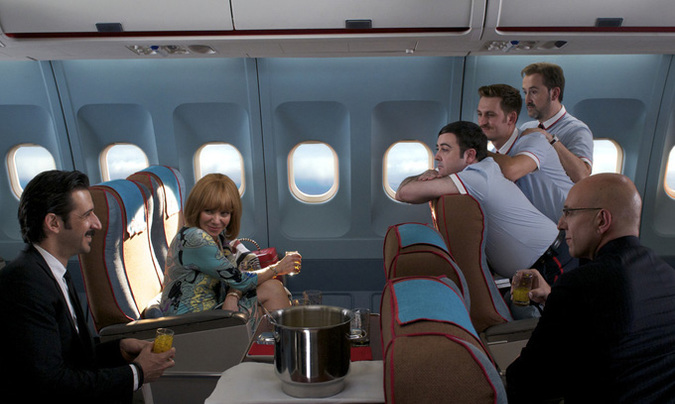
    I’M SO EXCITED! (Los amantes pasajeros) opens with a brief sequence on an airport runaway featuring Antonio Banderas and Penélope Cruz, both familiar faces in this film’s writer/director Pedro Almodóvar’s work.  However, their brief cameos only set up the main plot of the film, which is about the plane on the runaway that’s about to take off.  When the plane is in the air, it becomes clear to the pilot Alex (Antonio de la Torre), the co-pilot Benito (Hugo Silva), the head steward Joserra (Javier Cámara), and stewards Ulloa (Raúl Arévalo) and Fajas (Carlos Areces) – all of whom are either gay or bisexual and have a connecting sexual history – that there is something wrong with the landing gear.  Even if they can find a runway to attempt the landing (which proves difficult), there’s no guarantee that they will survive the impact.  When this news is revealed to the handful of passengers in first class (the passengers in coach have all been put to sleep via drugs), they began to cast away their inhibitions and reveal their deepest secrets.

    Aside from the jocular title, that plot description could easily be worked into a drama like Almodóvar’s  acclaimed The Skin I Live In (La piel que habito), which starred Banderas.  However, I’M SO EXCITED! jumps several genres, though it is mostly a black comedy.  It is also has very metaphoric, dream-like and nightmare-like elements that do not reflect reality.  In fact, the film opens with a humorous title card saying, “Everything that happens in this film is fiction and fantasy and bears no relation to reality,” demonstrating that there is little in the film that audiences are supposed to take at face value.  The fact that the film culminates at the La Mancha airport – a reference to fiction’s ultimate dreamer – highlights this.

    Since rules don’t apply on this dream-like flight, much of it feels like a throwback to the sex romp comedies of the late 1960s like What’s New Pussycat?, especially once the crew decides to comfort themselves and the passengers in first class with liquor and drugs.  Facing impending disaster (not unlike the current economic state of Europe), the crew and passengers decide to fiddle as Rome burns… and I mean “fiddle” in the most sexual way possible.

    But that raises my main question with this film: what audience is it for?  It’s simply too weird and inconsistent tonally for younger audiences and too twisted and offbeat for adult audiences.  Sure, there are some funny parts, but though I lenjoyed all of Almodóvar’s films I’ve seen before I was left scratching my head.  I also thought the characterization of the effeminate stewards was laying it on a bit thick and reached into uncomfortable stereotype territory.  It’s simply an odd attempt at a comedy/drama hybrid that really doesn’t work in the end despite its dream-like quality.  After all, “dream-like” shouldn’t be an excuse for inconsistency or an overload of camp at the expense of quality.

    http://youtu.be/DhH-A8pLCMY

    Read more


  • REVIEW: Hey Bartender

    by Chris McKittrick

    Bartending is often seen as one of those “between” jobs – you know, the type of job you have as a stopover between one job and another.  While for most bartending consists of pulling tap handles and mixing happy hour well drinks, for others it is an art.  This is the premise of HEY BARTENDER, an engrossing documentary by director Douglas Tirola featuring some of the world’s best mixologists.

    HEY BARTENDER primarily follows Steve Schneider, a former Marine who turns to mastering cocktails in the wake of a nearly life-ending injury, and Steve “Carpi” Carpentieri, a Connecticut bar owner hoping to reinvent his struggling bar as a cocktail destination.  Schneider works at the Manhattan bar Employee’s Only where earning the bartender’s jacket is a trial by fire.  He hopes to focus as much determination as he did in the Marines on his bartending.  Meanwhile, Carpi is lovable as he immerses himself in the world of the cocktail with a mixture of confusion and excitement.

    Interestingly enough, the documentary meanders from Steve and Capri’s journeys, which is a shame because both of them are really interesting people.   However, where it meanders to is equally interesting: the audience is taught the history of cocktail-making and introduces Dale “King Cocktail” DeGroff, who pioneered the current cocktail culture while bartending at New York’s Rainbow Room in the 1980s and later founded the Museum of the American Cocktail.  We are also introduced to a number of key figures in the scene, with spectacular shots of them making drinks in slow motion that shows just how much effort goes into these concoctions.  One drawback of featuring so many bartenders is that they inevitably begin to repeat each other (mostly about how seriously they take their jobs), but other than that they are fascinating.

    If you idea of a cocktail is a Jack and Coke, prepare to be surprised.  There is an entire world of advanced cocktails with prime ingredients out there, and HEY BARTENDER is spilling all the secrets.  It’s one of my favorite documentaries of the year simply because it gives the audience a key to an entire world unknown to those who frequent their corner bars for cold beers.   My only other gripe is that you really ought to watch this one with a carefully-mixed drink in each hand.  Then again, what’s wrong with that?

    Rating: 4 out of 5  : See it ……. It’s Very Good

    http://youtu.be/jgsYEMOqXO4

    Read more


  • REVIEW: The Moment

    by Morgan Davies

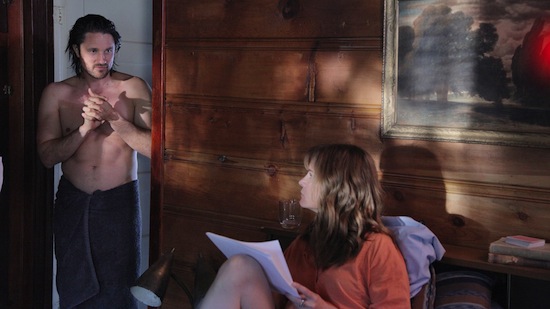
    The Moment, the sophomore feature from director Jane Weinstock, is a slippery film: we never quite know whether what we’re seeing is reality or filtered through protagonist Lee’s unstable mind. Lee, a war photographer played by Jennifer Jason Leigh, is first convinced that her ex-boyfriend John (Martin Henderson) is missing, then that she murdered him, but as her therapist reminds her, any of her particularly intense convictions could simply be fantasies. She is suffering from PTSD from her wartime experiences and injuries, and has moved from a rehab facility for the body (where she met John) to one for her mind.

    Lee can’t trust herself and we can’t trust Lee, or the film, which seems at times to be the mere product of her disordered, haunted psyche. Weinstock returns again and again to certain images and moments, changing them subtly each time, until they become almost dreamlike, a surreal, kaleidoscopic sequence of repetitions. Over and over again, Lee opens the refrigerator and sees (or doesn’t see) the leftover morphine from John’s hospital stay, takes (or doesn’t take) it out, pours (or doesn’t pour) it into his wineglass on the night when she last saw him. And though John may be gone, Lee cannot quite let go of him – she sees him in the form of one of her co-patients at the hospital, also played (for the most part) by Henderson. The purity of the frame cracks and crumbles as it attempts to follow her through the fractured narrative of her life. How can she possibly uncover the mystery of what really happened to John and what is really going on with her quasi-estranged daughter (Alia Shawkat) if she can’t trust her own memories? How can we?

    The Moment plays with these concepts in consistently interesting ways, and the actors – Leigh in particular – all give capable, persuasive performances that can seem as rewardingly ambiguous as the film itself, at least until its conclusion, which is disappointingly straightforward. Weinstock’s desire to probe the inconsistencies of memory and personality is admirable and engaging, but does not always succeed: some moments feel a little too on-the-nose, and her use of a handheld camera in the “present” portions of the film is unnecessary and alienating. There is something a little inaccessible about the movie from an aesthetic point of view that makes it difficult for the viewer to allow herself to be utterly swept away by the narrative, no matter how compelling we might find the central character.

    http://youtu.be/OY1In2lqUf4

    Read more


  • REVIEW: Greedy Lying Bastards

    by Kelsey Straight

    The conflicting ideals of science and politics have created misconceptions regarding climate change, as revealed by Craig Scott Rosebraugh’s documentary, Greedy Lying Bastards. Rosebraugh presents a fundamental struggle between scientific fact and political fabrication: where fact requires evidence, fabrication allows anything to masquerade as reality. The presentation of climate change as “the greatest hoax ever” does not come from humanitarianism, unfortunately, but from the oil industry and those politicians with direct ties to the oil industry. Rosebraugh’s documentary presents a world of individuals who need the earth for different reasons, either as a money-making resource, or as a home for our families and an environment for cultures. If we do not take care of the land that allowed our societies to grow, than the land will not take care of who we are in return.

    Using data visuals, footage of political debates, and stories from families and societies directly affected by natural disasters, such as the forest fires in Colorado and the rising sea levels on the island of Tuvalu, Rosebraugh examines all parties at play with climate change. We live in the world we make up for ourselves, but we exist on a planet that can no longer sustain the needs of our industries, never mind the needs of itself. Greedy, Lying, Bastards assertively urges viewers to see that no debate exists between hemispheres, and climate change is a reality we cannot change with lies.

    http://youtu.be/sPax5-vCvA0

    Read more


  • REVIEW: The Sightseers


    by Kelsey Straight

    The quirky English humor and quintessential characters of Ben Wheatley’s The Sightseers both disturb us and make us laugh, often without establishing which was the appropriate response. The story follows Chris and Tina on their caravan holiday to a collection of eclectic sights, including the Crich Tramway Museum, the Ribblehead Viaduct, and the Keswick Pencil Museum. Having left her mother and their small English home, a stifling setting where Tina has lived until the age of thirty-four, Tina falls in love with a red-bearded serial killer, Chris. Their odyssey through the countryside is more geared towards personal identity than touristy locations, however. Tina exchanges her baggy 1980’s blue jeans for acid-wash thrift store leggings, and her codes of morality for codes of murder. All the while, Chris gathers material for the book he never begins writing, and Tina discovers that she is less his muse than he is hers. Their story unravels in the rainy countryside instead of on Chris’s blank pages, and every scene becomes a conflict they create for themselves.


    The Sightseers presents two ordinary individuals who establish their own “raison d’etre,” and none could be more significant than the faculty to end another’s life. As Chris and Tina murder the travelers around them, they create a series of dead-ends in terms of how they relate to their world and to the people inside of it. At one point, while visiting a historical ruin, Chris rings an old bell. Although he might not ask for whom it tolls, the audience will answer for him. England might be an island, but man ever was, and the bell tolls as much for Chris and Tina’s victims as it is does for the victims they make of themselves.

    http://youtu.be/RQLE6QWleCo

    Read more


  • REVIEW: Stories We Tell

    by DeVon Hyman

    “There is something kind of deeply uncomfortable with the idea of putting your life out there”
     -Sarah Polley, AMNY, May 2013

    True to the fact. A certain level of inner peace would have to be the prerequisite to an initiative being undertaken in the manner in which acclaimed Filmmaker Sarah Polley has done with her much heralded “Stories We Tell” which hit theaters on Friday.  

    Centered on a candid look at the reality which was Polley’s birth and actual parents whom were responsible for her existence. For much of her life Polley has been under the belief that her mothers husband was indeed her biological father, only to learn recently and come to terms with that not being the truth.  Her birth in actuality was the product of an affair which her late mom partook in.

    Earth Shattering.

    For a family, for an individual; what better remedy than to come to terms fully with, and be able to share being therapy to a tremendous gray area of emotion. Including narration and on-camewra interviews with many of the parties whom some would say have been victimized by this dark secret, Polly has tinkered with a wealth of different perspectives. Questions, amassed , Polly provides credence to the families copeability and acceptance to a thity-year-old secret.

    Using a back to the future formula in a sense Polley takes what was and lets it squaredance with what is, sans the theory of what will be.  A never ending tale, at best; why is not important, how is a foregone conclusion, only what remains.

    “The idea that people are talking about it and retelling the story and hearing what people’s’responses are, and what questions come out of it for them, for me was part of the whole curiosity of seeing how different people approach the same material”

    The struggle of whether not it was the right time to share this with the world is an on-going battle whic Polly recognizes.  Its takes a strong person to be that forthcoming.  A person of self-respect and content. I have to take my hat off to the mere thought. The execution, should be of extreme interests to all.

    Review Grade: 3 – See it …..  It’s Good

    “Stories We Tell” is in theaters Friday May 10

    http://youtu.be/YJg0Qg8QRUU

    Read more


  • REVIEW: KON-TIKI

    by Joseph Williamson

    Real, old fashioned adventurers are somewhat scarce in this day and age –  there may be scientific expeditions in Antarctica, but the romance of Henry Morton Stanley stomping through the Congo isn’t quite as attainable in 2013. Safaris and treks through the Amazon are all well and good, but truly uncharted and dangerous exploration is getting harder to manage in the decade of Google Maps. 

    Not so in 1947. Enter Thor Heyerdahl, intrepid ethnographer – a man with a big idea, but no publisher willing to take him on. Desperately seeking conclusive proof of his theory – that Polynesia was first settled by ancient South Americans – he decides to take the four and a half thousand mile voyage across the Pacific Ocean himself. Furthermore, for this demonstration to have any validity at all, it must be done in the exact manner of the original settlers: a balsa wood raft, a large wooden oar as a rudder, and constructed with simple rope in lieu of stronger materials. The only concession to modernity is a two way radio. 

    This is the premise of Kon Tiki –  if it wasn’t a true story, it would sound a little too contrived. It’s being billed as a family film – a good old fashioned adventure – and on this front, it shows up well enough. The sailing of the raft is of course where the action is, and it gets going quickly enough (i.e. as quickly as the necessary preamble allows). The cinematography is confident and satisfying  – shots demonstrating the scale of the ocean and its marine life in comparison to the tiny raft are done particularly well. 

    The cast also do a thoroughly professional job. Pal Sverre Hagen gives a strong performance in the lead role, showing Heyerdahl as a driven, intense man, obsessive steel blue eyes showing just a hint of insanity. The crew of Heyerdahls eponymous raft are given less of a chance to develop their characters – it is enough to know, perhaps, that they have volunteered for a borderline suicidal enterprise. 

    Kon Tiki is an enjoyable film – certainly family oriented, with a few moments of clunking familiarity that can be easily forgiven in this context. The film falls short as both an epic and a character portrait – but it is assured and polished filmmaking. And, given this reviewers ignorance of the original events – not to mention Heyerdahls 1951 Oscar winning documentary about his voyage – it is a welcome reminder that these kind of adventures did indeed take place, and that some had a happy ending. 

    RATING: 3 / 5 : See it …..  It’s Good  There really aren’t many better ways to describe Kon Tiki – and that is both a recommendation and a slight criticism.

    http://youtu.be/i1Xf3toxvXM

    Read more


  • REVIEW: Flex is Kings

    by Morgan Davies

    Flex is Kings, a feature documentary by Deirdre Schoo and Michael Beach Nichols, is a charmer of a movie: slick, funny, compelling and awe-inspiring, it’s that rare documentary that manages to be interesting and thought-provoking without leaving its audience depressed.

    [caption id="attachment_3682" align="alignnone" width="550"]Jermaine -Flizzo- Clement[/caption]

    Flex is an urban dance movement that began in East New York, Brooklyn and has evolved into a kind of dance-off scene in the area organized by the Battlefest League. There aren’t really rules for what a dancer can and can’t do: performers rely on extreme coordination, contortions, and, often, a humorous rapport with their audience (the latter being the specialty of Flizzo, one of the film’s subjects). The scene is strongly evocative of boxing or wrestling: dancers perform in a ring, an MC riles them up before the “battle” begins, beautiful women hold up signs marking the round, and the spectators crowd around the ring, screaming bloody murder. Yet instead of beating each other up, these men are dancing. Artistic expression has trumped pointless violence (though it’s a pity that the movement couldn’t include more women – I can only remember one female dancer, onscreen for no more than a few seconds).

    [caption id="attachment_3683" align="alignnone" width="550"]Jonathan -Jay Donn- George[/caption]

    The central question of the film lies in the tension between the desire of nearly all the subjects to “make it” and their clear dedication to their neighborhood. Flex is a product of the streets, and its spontaneity is part of its charm, but in order to “make it” professionally – that is, in the dance world outside of the flex scene – dancers have to learn to rein in that spontaneity, and also adjust to a world dramatically different from the one they’re used to. Jay Dodd, the self-titled inventor of flex and another focus of the film, does manage this feat when a Cobble Hill dance company recruits him to play Pinocchio in a production. Dodd – who has gone on to have a successful dance career – adjusts quickly and successfully, but it’s quite a trip to cut between his rehearsals and his friend Flizzo practicing for Battlefest. They seem worlds apart. That’s the real melancholy of the film, which is otherwise so uplifting: in order to make it, you have to leave your home behind you.

    RATING: 4 / 5 : See it ……. It’s Very Good

    http://youtu.be/10fQVU98MwA

    Read more


  • REVIEW: Vergiss mein nicht (Forget Me Not)

    by Christopher McKittrick

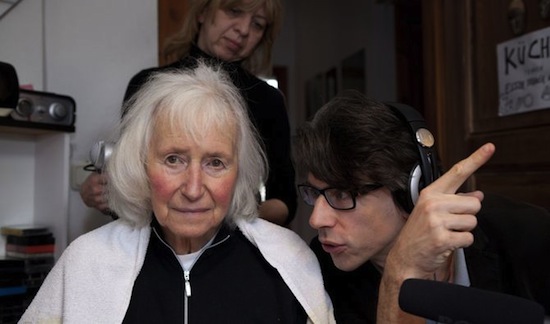
    Though there are hundreds of terrible diseases, perhaps there is none as cruel as Alzheimer’s disease, which not only slowly robs the sufferer of their mind, but tremendously impacts the sufferer’s loved ones terribly as the sufferer gradually no longer recognizes them as they slip further and further into dementia.  German documentarian David Sieveking explores the impact that Alzheimer’s disease has not only on his mother, but his entire family in Vergiss mein nicht (Forget Me Not).

    By the time David started filming this documentary his mother, Gretel, had forgotten him.  The pain David feels from this is made visually symbolic during the credits when “Mein” (Me) fades from title slower than rest of the words.  Now that he has only a frail connection with his mother, David is determined to learn as much as he can about her life before she passes away.

    David admits he knows very little about his mother’s past.  For instance, he finds out from his father, Malte, that his parents had an open marriage and Gretel was politically active in radical socialist causes in her youth.  Though their marriage was very atypical, now that Gretel is helpless they have taken on more traditional roles.  Though Malte, who was a renowned math professor, wanted to study and travel after retiring, he is now a full-time caretaker.


    Watching Gretel is heartbreaking as she alternates between childlike confusion to bewildered fear at her surroundings.  Gretel has also deteriorated physically.  Though only seventy-three, Gretel resembles a woman decades older (especially when compared to Malte’s ninety-six year old mother, who appears late in the film).  She becomes increasingly stubborn, and though David’s arrival to begin the documentary allows Malte to take a brief vacation to Switzerland it seems to do no favors for Gretel’s condition.

    There is very little that is “artistic” in this documentary – this is an honest, fly-on-the-wall, straight-forward chronicle of how Gretel’s worsening condition affects David and his family.  Toward the end of the film the family weighs the decision on whether or not to put Gretel into a home for Alzheimer’s patients, and Malte feels conflicted about his responsibility for Gretel’s condition for not being as good of a husband to her as he could have.  One of the more curious choices is the vaguely child-like musical score, which I feel somewhat belittles Gretel’s condition.


    Vergiss mein nicht is a very personal story, but also universal to the millions of people who have someone suffering from the same disease as Gretel in their own family.  Though the ending is surprisingly upbeat, being that this film is about a woman with Alzheimer’s there is naturally no happy ending.  This is not a film that anyone would consider enjoyable or entertaining, but as a chronicle of a woman’s failing dementia and the effect it has on her family; it is definitely moving.

    RATING: 3 / 5 See it … It’s Good

    Read more


  • REVIEW: KALIFORNIA

    by Kelsey Straight

    Laura Mahlberg’s illustration of an old man who starts walking towards California from his caravan entire countries away (in Russia!) is a new take on the classic road movie, except here our protagonist is fifty years past coming-of-age and still in pursuit of better prospects in the west. One could say that the film has come a few decades after its genre’s peak, and the main character coincides with that reality. Visually stunning cinematography offers an array of sensations to the film, and despite a slow-going pace and essentially meek protagonist, audiences will revel in the look and the stories in the eyes of this character, a man full from his years and still searching for more.

    The landscapes evoke in audiences the magic of the countryside when seen in widescreen formats, and the protagonist’s trek through fields of green – full of sheep and ideas for the future – offers a lot to cinema, especially coming from such a niche project. If one’s grandfather confessed that he was going to walk across the entire world in search of California, he’d probably be admitted to an old folk’s home, but Mahlberg’s film sets this man free from his age and into an old world made new again. Change clicks on and off inside of him and proves that coming-of-age is a process that occurs over and over again throughout our lives. We’re never too old to dial a friend across the world and confess to needing something new before everything feels done forever and for always.

    Rating 3 / 5 : See it …..  It’s Good

    http://youtu.be/h4s-sJBRVDA

    Read more


  • REVIEW: Silvi (Maybe Love)


    by Christopher McKittrick

    During a routine, 47 year-old Silvia (Lina Wendel) is told by her husband that he is moving out. Silvia knew their passionless marriage was essentially over anyway, but it still comes as a shock.  With little to call her own and never being with anyone besides her husband, Silvia begins her search for love, because, as she tells someone else, “Actually, everyone wants someone to hold…someone who loves and comforts you. If that’s not happening… something inside withers away. You become a lone warrior.”

    However, each one of Silvia’s subsequent relationships goes awry, even when she opens herself up to new experiences.  These relationships are bridged with scenes in which she is speaking with someone whose identity isn’t made exactly clear, but they almost seem like therapy sessions.  What she can’t find is a normal relationship.  She tries personal ads, but her date with her first caller goes downhill pretty quickly although they overcome their awkward introduction.  Each relationship she gets in seems to hold great potential, but they all fade for various reasons.  She also has to come to terms with the truth that she has been treated unfairly by her husband during their whole life together.


    Silvi explores the trouble faced by a middle-aged woman just out of a lengthy, loveless marriage trying to find true love. I suppose this is sort of a dramatic German version How Stella Got Her Groove Back, meaning I may be the wrong audience for this.  Still, Silvia’s difficulties and deep sadness is affecting, as is the fact that she never gives up.


    There were certainly some confusing moments – Silvia’s son is briefly introduced in the film, makes out with his girlfriend, and then disappears from the narrative.  I guess this was supposed to be a contrast with Silvia’s love life (or lack thereof), but her sadness is clear from Wendel’s emotive acting.  The “talking head” sequences could have probably been more effective if it was clear who she was speaking to (Silvia has a close friend in the film, so why not use her?)  Director/co-writer Nico Sommer has a great actress and a universal story – one doesn’t have to be a 47 year-old recently-separated woman to connect with Silvia’s search for love – but I can’t say I found much more to connect with beyond Wendel’s strong performance and her character’s admirable persistence.

    Rating 3 / 5 : See it …..  It’s Good

    Read more